

Lot 244
![Ornithology - [Wild Bird Protection Act] - The Farne Islands, a large archive, comprising](https://media.app.artisio.co/media/104cbde6-0d38-43cb-9e0f-bb721ef57bcf/inventory/c88ab13b-181f-4f86-b310-4b8bfad99b6e/e56dce51-11a3-4b88-9536-6a31d964d858/0001_yBghiB_original.jpg)
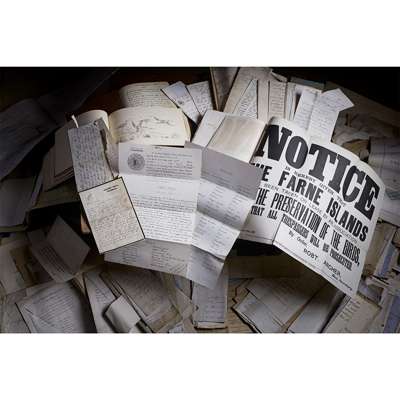
Ornithology - [Wild Bird Protection Act] - The Farne Islands, a large archive, comprising
Rare Books, Manuscripts, Maps & Photographs
Auction: 19 June 2018 at 12:00 BST
Description
Document of agreement of Dean and Chapter Office Durham to sell the Farne Islands to Ven. Archdeacon Thorp in 1853 for £404; Grant of the Reversion of Monk House & the Farne Islands from the Dean & Chapter of Durham to the Venerable Charles Thorp, 1861, with hand-drawn map; Lease of Inner Farne Islands, from J.F. Thorp to Mr John Ralph Carr-Ellison, 1881, on vellum; Indenture between Archdeacon Thorp and The Corporation of the Trinity House, of hereditaments and rights of way in the Great Farne Island, 1861, with hand-coloured plan; Lease of the Outer Farne Islands by Mrs J.F. Thorp to Mr John Ralph Carr-Ellison, on vellum, 3 Dec. 1881; Farne Island Association Notebook of Meetings of the Association to take the Farne Islands on lease for 6 years ending 1887, hand-coloured plan tipped in (torn without loss); Large quantity of Ephemeral Printed information of The Farne Islands Association, c. 1880-31; Original manuscript draft of the Rules, 1881, Notebooks, Account books, Lists of Members, Byelaws, Rules, Receipts & Expenditures, Manuscript notes & letters, Printed and typed reports, including information on the breeding season of young Arctic and Common Terns, Sandwich Terns, Eider Ducks, Puffins, Guillemots, Roeseate Terns, Razor Bills, Cormorants & Common Gulls; Architect's drawing of Prior Castell's Tower, Inner Farne Island, 1949; Northumberland Count Monument. 4pp typescript report on the Farne IslandsAdamson, Charles Murray Studies of Birds, Newcastle, 1881, oblong 8vo, inscribed "H.A. Poynter Esq, with the Donor's kind regards", lithographed plates (2 annotated in pencil), original pictorial wrappers; Quantity of correspondence from members of the Thorp family relating to the Farne Islands, including their transfer to the National Trust, c. 1925, including letters from Viscount Grey of Fallodon; Hand drawn plan relating to proposed improvements to the Inner Farne Lighthouse, a quantity of lithographed maps and plans of the Islands (many duplicates); [Wild Birds Protection Act] Motions & correspondence made to extend the period in which wild birds may not be killed as prohibited by the Wild Birds Protection Act of 1880; Correspondence, & reports of Indictments of people caught stealing eggs "Unless some steps are speedily taken to prevent it the interesting breeding station of the Eider Duck, the Sandwich Tern and of various other species of shore breeding birds at present existing on the Farne Islands is in great danger of being annihilated... I at once obtained permission to place a watcher on the Islands & I hope was instrumental in stopping the egging to a great extent as well as in bringing about the prosecution which later on followed the wholesale infringement of the provisions of the Wild Birds Protection Act" (Hugh Barclay, Colney Hall, Norwich, 1887); "The birds are taken by fishermen in thick, foggy weather, and very often at midnight..." (24/10.1887), report stating "I have often had more trouble in the day time with ornithologists and naturalists to prevent them from taking eggs than ever I had with fishermen... this last breeding season, up to 16th June, I could safely say there would not be less than 50,000 eggs taken from the Islands", extensive correspondence with members of the Farne Island Association, some relating to ornithology Morres, Rev. Arthur P. Amongst the Birds on the Farne Islands. Salisbury, [1896], 8vo, original wrappers dust-soiled; c. 200-300 items in all, some a little dusty, in a 19th century wooden chest
Footnote
Footnote: A large collection of material, manuscript and printed, relating to the Farne Islands, and the Farne Island Association, which was set up in 1880 by ornithologists and naturalists to protect the eggs and birds of the Farne Islands.
The Farne Islands are first recorded in 651, when they became home to Saint Aidan, followed by Saint Cuthbert who died there in 687. Among other acts, Saint Cuthbert introduced special laws in 676 protecting the eider duck, and other seabirds nesting on the islands; these are thought to be the earliest bird protection laws anywhere in the world. St. Cuthbert befriended the nesting birds and eider ducks which to this day are still known locally as ‘St. Cuthbert’s chicks'.
Following the dissolution of the monastic cell on the islands, the islands became the property of the Dean and Chapter of Durham Cathedral, who leased them to various tenants. In 1861 the islands were sold to Charles Thorp, who was at the time Archdeacon of Durham. In 1894 the Outer Farne Islands were bought by the industrialist William Armstrong, 1st Baron Armstrong, and in 1926 the Inner and Outer Farne Islands were purchased for The National Trust by public subscription.
A total of 290 bird species have been recorded on the Farnes including, in the 1760s, an example of the now extinct great auk. The Farnes are home to more than 20 different bird species, including Puffins, Eider Ducks, Guillemots, Razorbills, and four species of Tern. The noise is deafening with up to 150,000 birds crammed onto the Islands at the height of the breeding season. Inner Farne is the largest of the Farne Islands and during the Summer it becomes home to many thousands of nesting seabirds. Arctic terns are a familiar visitor, flitting between the North and South Poles, and stopping off in the Farne Islands during the Summer. There is also a large colony of about 3,000 grey seals, the largest meat eating mammal in the UK.
Provenance: Via the Thorp family, owners of the Farne Islands in the late 19th century.