

Lot 19
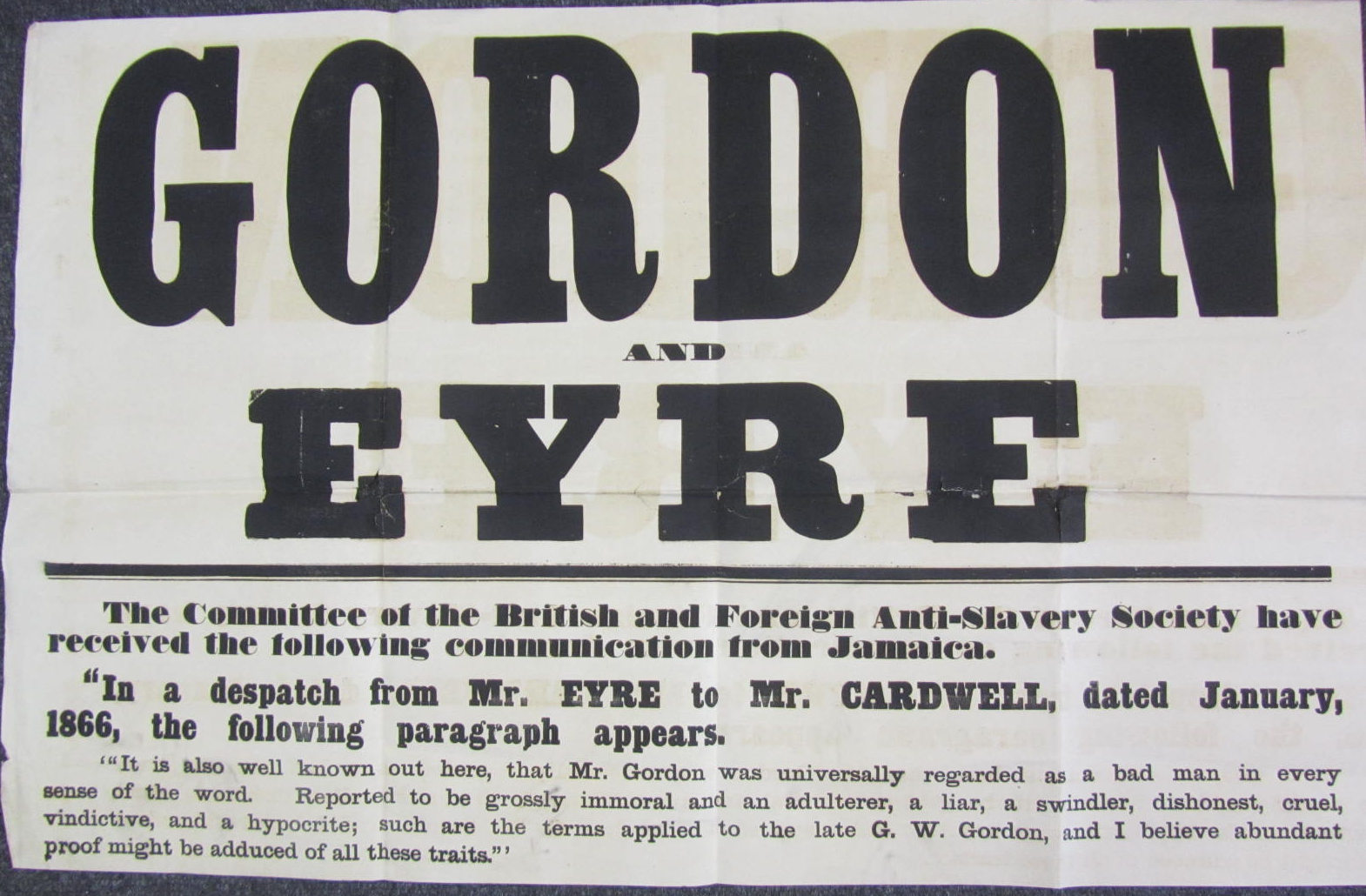
Broadside - Jamaica - Anti-Slavery Society - Gordon and Eyre
Rare Books, Manuscripts, Maps & Photographs
Auction: 28 January 2015 at 11:00 GMT
Description
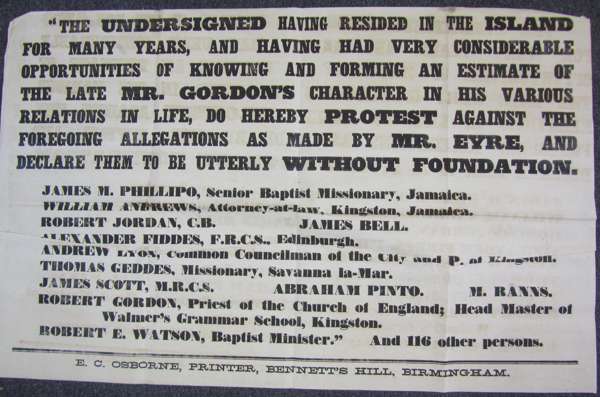
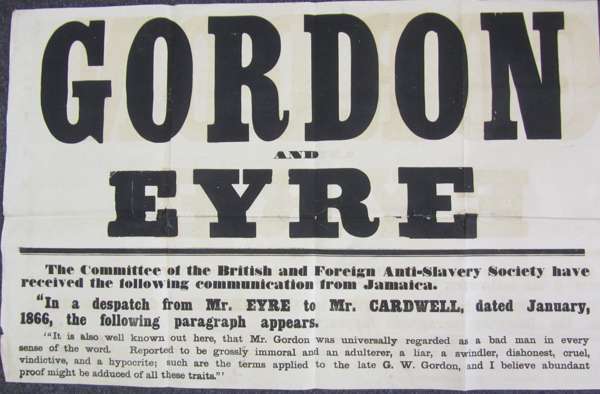
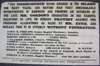
The Committee of the British and Foreign Anti-Slavery Society have received the following communication from Jamaica. "In a despatch from Mr Eyre... the following paragraph appears "It is also well known out here, that Mr Gordon was universally regarded as a bad man in every sense of the word. Reported to be grossly immoral and an adulterer, a liar, a swindler, dishonest, cruel, vindictive, and a hypocrite..." "The undersigned having resided in the Island many years, and having had very considerable opportunities of knowing and forming an estimate of Mr Gordon's character do hereby protest against the foregoing allegations as made by Mr Eyre..." Very large poster-size broadside, printed on 2 sheets, total dimensions 1380 x 1090mm. Birmingham: E.C. Osborne, Printer, Bennett's Hill, [1866], small holes at folds with minor loss
Footnote
Note: Extremely rare survival relating to the Morant Bay Rebellion, Jamaica, and the nemesis of one of Australia's great explorers.
Edward John Eyre (1815-1901), the celebrated explorer of Australia, was posted to Jamaica in 1862, and was appointed Governor in 1864.
George William Gordon (born c. 1820) was a 'man of colour', able, prosperous, and an elected member of the Assembly and magistrate. In politics he differed from his middle-class peers with his interest in the affairs of the landless , and in religion he was a Baptist.
The white plantation class, with Eyre at their head, had a loathing of the dissenters. Gordon had established his own independent Baptist chapels and pastors around the island, and was a clearly displayed target for Eyre, whose only response to the social and economic challenges that faced the island had been a brutal suppression of the lower orders. In October 1865 matters boiled over at Morant Bay where Paul Bogle, one of Gordon's deacons, led an armed group against magistrates. Eyre used the unrest as an excuse for widespread repression which cost hundreds of lives. Gordon, who was nowhere near the action, surrendered himself when he knew there was a warrant for his arrest. Eyre handed him over to the Provost Marshal, with the instruction that he be tried for treason and sedition, for which there could be only one possible outcome. Gordon was hanged.
The poster offered here is a remarkable survival of the clamour in England for a Royal Commission to investigate Eyre's administration and actions. Gordon's champion was John Stuart Mill, while Carlyle, Ruskin, Tennyson and Kingsley supported Eyre, prior to the findings of the Royal Commission which commended Eyre for containing the outbreak of violence condemned him for the excessive severity and cruelty in the aftermath of the 'rebellion'', as a result of which Eyre was dismissed from the service.
Not in BLC, NSTC, COPAC or Worldcat.