Lot 75
DAVID HOCKNEY (BRITISH 1937-2026) §
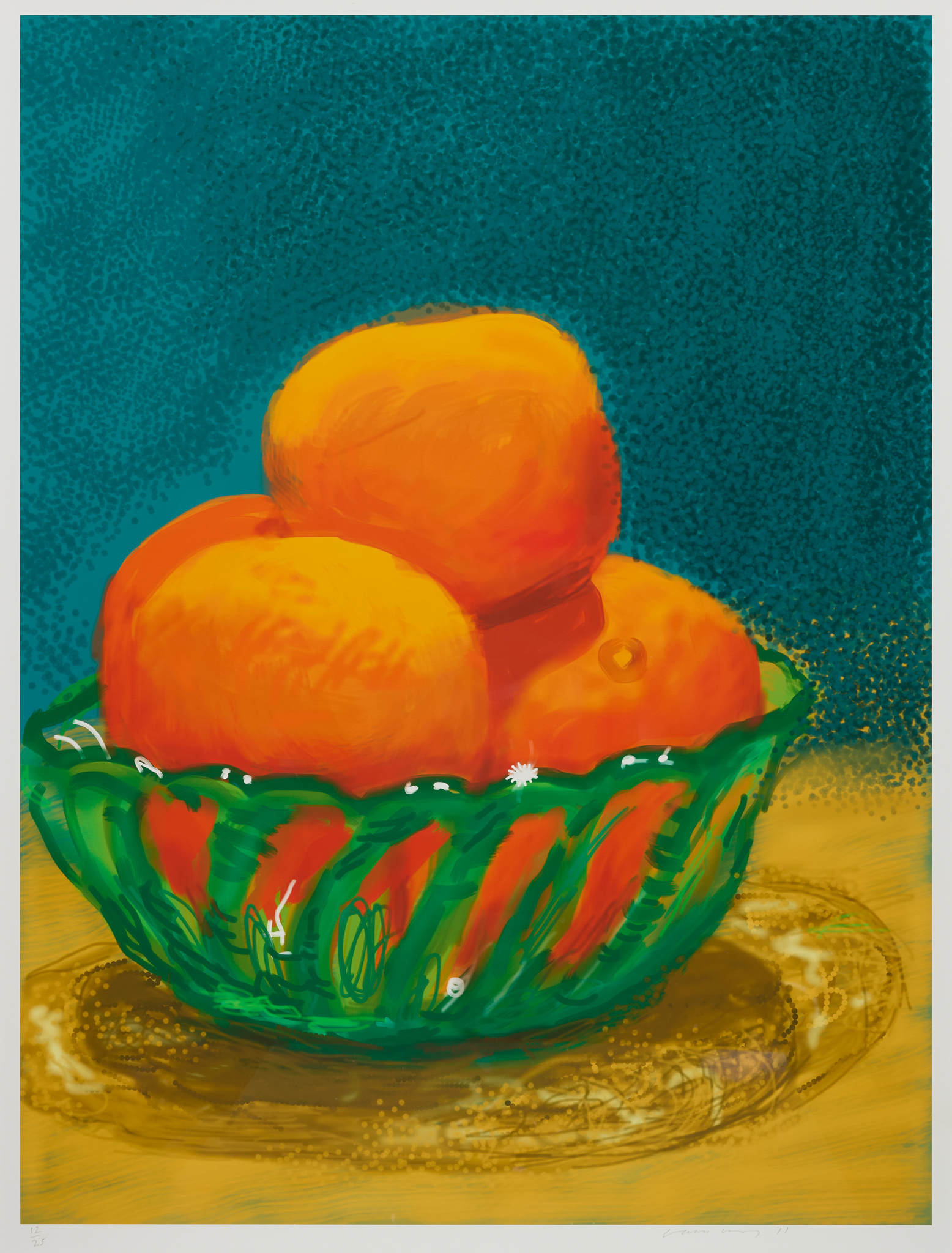
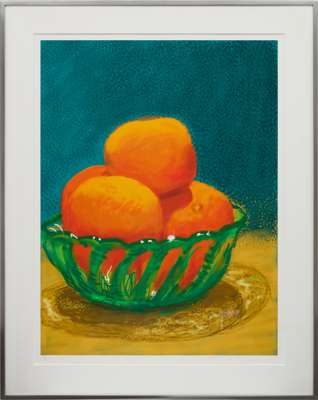
ORANGES (IPAD DRAWING NO. 643)
Auction: 13 October 2026 from 13:00 BST
Description
iPad drawing printed in colours, 2011, signed in pencil, dated, numbered 12/25, published by the artist, on wove paper, framed
Dimensions
image: 81.2cm x 60.9cm (32in x 24in)
sheet: 94cm x 71.1cm (37in x 28in)
Provenance
Pace Gallery, London, where acquired by the present owner in 2019.
Footnote
From his earliest foray into printmaking at the age of seventeen, David Hockney’s printmaking journey explored mediums, pushed boundaries and played with subject and composition.
By a fortuitous turn of fate, Hockney was driven to printmaking early in his artistic career as a result of budgetary limitations. A circumstance which led to one of the twenty-first centuries most renowned artists to begin a journey with the printed medium which would inform art history during his lifetime and beyond.
“I started etching there [the Royal College of Art] because I hadn’t any money. You know I hadn’t any paint. Someone told me that everything was free in that department so I thought I would try my hand at it”. David Hockney in a statement printed in “Ark” 41, 1967.
Hockney returned repeatedly to his favoured mediums of etching and lithography, to which he devoted long periods, yet he was also continually exploring possibilities of other media. His ‘Home Made Prints’ utilising Xerox and fax machines of the late 1980s represent a brief period of exploration into the possibilities of automatic processes – harnessing the intrinsic qualities of a machine to produce art works.
“I was very thrilled to find a totally new medium, which nobody had explored. I was interested in the Xerox as a printing machine. Most people who had played with it before had only used the reproductive aspects, and had assumed the printing wasn’t too good. But there is no such thing as a bad printing machine. If the machine works and prints, whatever qualities it has can be used. It must have some good qualities so long as it actually works.” David Hockney quoted in David Hockney, Printmaker, Richard Lloyd.
By 2009, Hockney was beginning to experiment with drawing on the computer, producing a number of works exhibited under the title Drawing in a Printing Machine. Hockney created these drawings with the printing process in mind, limiting himself to the colours available in an Inkjet printer and relishing the autonomy offered with the dispensation of technical experts. From here, Hockney discovered the convenience of the iPhone as a travelling sketchbook, and with the release of the first iPad in 2010, this formed the natural next step.
The speed with which a computer, or in this case iPad, can react to the artist’s every touch and decision cannot be matched within the world of traditional printmaking where an intermediary or craftsman is often required to translate the will of the artist into the final product. The immediacy of drawing on an iPad allows a total removal of other people from the process, a quality the artist particularly appreciated.
In Oranges, we see the true power of Hockney’s still-life iPad drawings. Hockney’s still-lifes do not describe the mundane, they are idealised. Vivid, beautiful, perfected versions of themselves. Oranges are not merely a fruit, they are radiant, juicy, shimmering orbs. A fruit bowl is heightened to the status of a revered sculpture, glints of starlight appearing to heighten the rich greens, the shadow cast, a shimmering chaos of yellow and ochre. The artist has instilled within this bowl of fruit an unavoidable force, encouraging lengthy contemplation, sinking into the Californian hues, becoming lost within this monumental representation of a simple arrangement of oranges.