

Lot 41
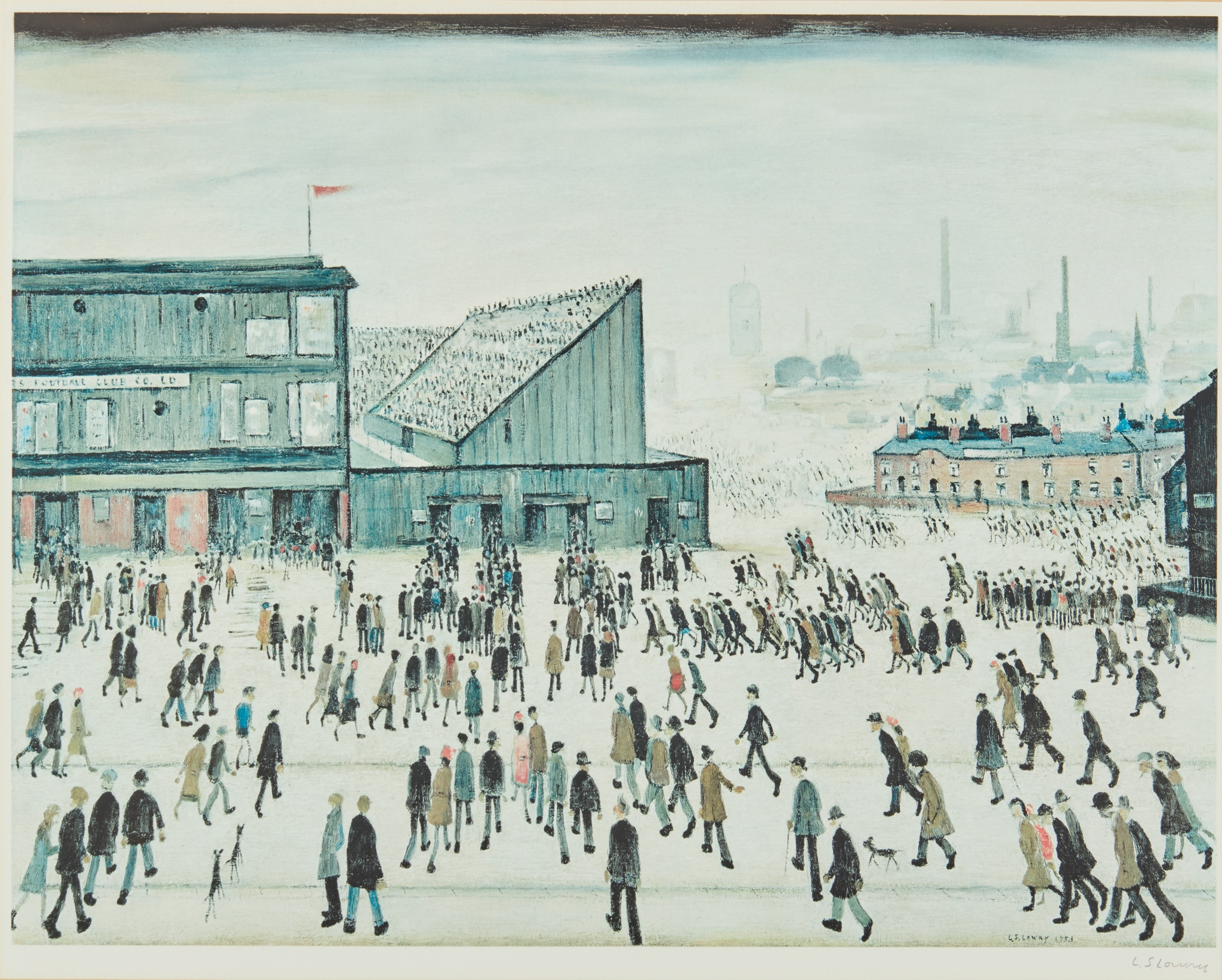
LAURENCE STEPHEN LOWRY (BRITISH 1887–1976) §
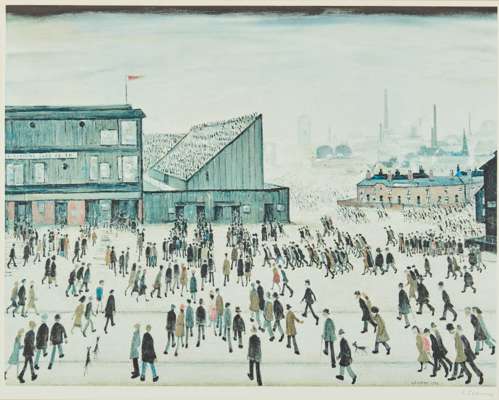
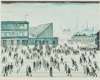
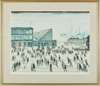
GOING TO THE MATCH
Auction: 13 October 2026 from 13:00 BST
Description
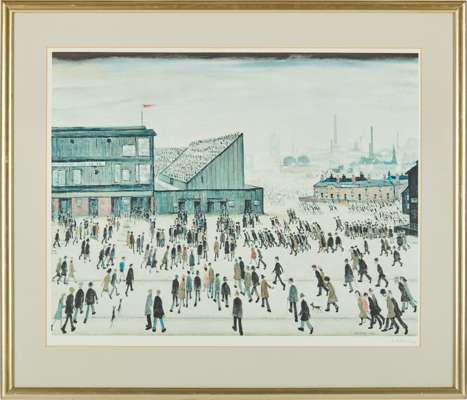
offset lithograph printed in colours, 1972, signed in pencil, from the edition of 300, published by the Medici Society, London, with the Fine Art Trade Guild blindstamp, on wove paper, framed
Dimensions
image: 53cm x 68.5cm (20 7/8in x 27in)
sheet: 64.2cm x 78.5cm (25 1/4in x 30 7/8in)
Footnote
Laurence Stephen Lowry (1887–1976) was one of the most distinctive British artists of the twentieth century. Born in Manchester and closely associated with Pendlebury and Salford, he became celebrated for his highly individual depictions of the industrial North West. Factories, mills and terraced streets populated by crowds of workers, families and children all became significant visual motifs. His elongated figures, popularly described as ‘matchstick men’, became an immediately recognisable feature of his work, although Lowry himself resisted this simplification:
“All I do, as I said before, is I paint the figures as I see them. They may be like matchsticks, they be like anyway you like, but I just do them as I like to see them”.
Lowry studied art part-time for more than twenty years while maintaining a separate professional career, eventually working as a rent collector. His training included study at the Manchester Municipal College of Art, where he was taught by the French artist Adolphe Valette. Yet Lowry developed a visual language distinctly his own, shaped less by prevailing artistic movements than by his close observation of the streets and people around him.
A formative moment came in 1916 when, while waiting for a train, Lowry watched workers leaving the Acme Spinning Company Mill. The scene transformed his perception of the industrial landscape. As he later recalled:
“My subjects were all around me, in those days there were mills and collieries all around Pendlebury. The people who work there were passing morning and night. All my material was on my doorstep.”
By the 1920s and 1930s, Lowry had established the distinctive combination of architecture, atmosphere and human activity for which he is best known. Against pale grounds, factories and smoking chimneys loom over streets animated by carefully observed figures. Although apparently simplified, these figures possess remarkable individuality: people hurrying to work, gathering outside buildings, watching football matches or simply passing one another in the street. Lowry’s paintings are therefore as much studies of human behaviour as records of a rapidly changing industrial landscape.
As the industrial North underwent significant redevelopment during the post-war decades, Lowry increasingly separated the human figure from its surroundings. Individuals and small groups appear against sparse or almost empty backgrounds, shifting the emphasis from social observation towards isolation, character and the psychology of the individual.
Printmaking played an important role in bringing Lowry’s imagery to a wider audience. Lowry authorised just fifty-four signed print editions, with individual editions ranging from 95 to 850 impressions. Once each edition had been completed, the original printing plates were destroyed, ensuring that no further impressions could be produced beyond the agreed edition. Thus, to own a signed Lowry print is to possess a finite and carefully controlled part of the artist’s graphic legacy, and a connection to the imagery for which he is so celebrated.
