

Lot 70
SIR STANLEY SPENCER R.A. (BRITISH, 1891–1959) §
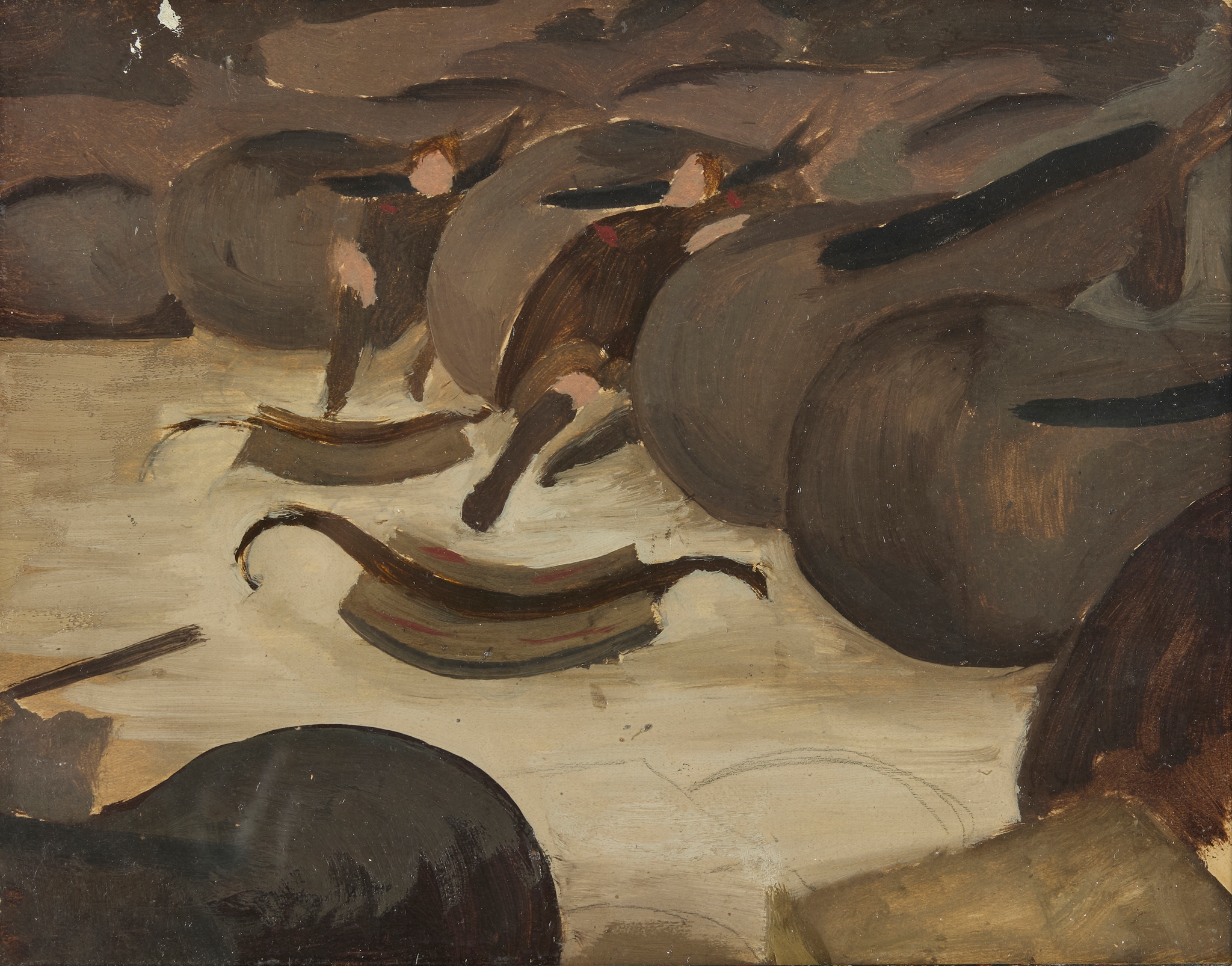
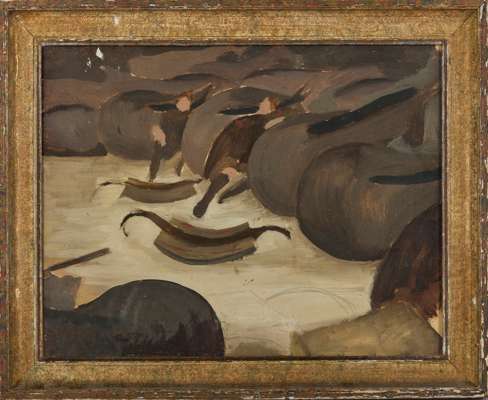
MULES - STUDY FOR ALTARPIECE, SANDHAM MEMORIAL CHAPEL, c.1926-7
Auction: 30 October from 10:00 GMT
Description
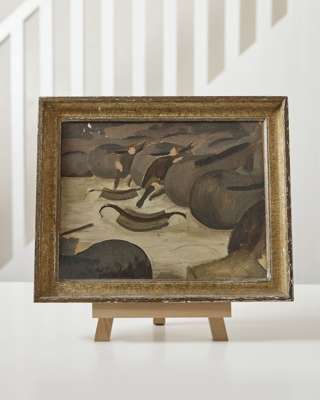
oil on paper
Dimensions
23cm x 29.5cm (9in x 11 ½in)
Provenance
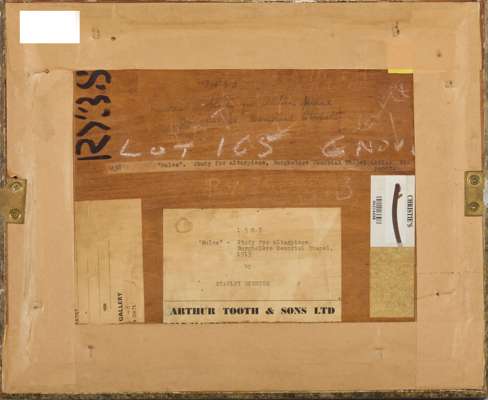
With Arthur Tooth & Sons Ltd, London;
Reacquired by the Artist and then sold directly to Tom Alexander;
The Tom Alexander Collection, thence by direct descent.
Footnote
Exhibited:
Talbot Rice Gallery, Edinburgh, The £40 Art Collection, 23 October - 11 December 2010.
Literature:
Bell, Keith, Stanley Spencer, Phaidon, London, 1992, p.383, cat.121 (illustrated p.73).
The present work is a study for the central panel of Stanley Spencer’s inter-war masterpiece, The Sandham Memorial Chapel at Burghclere, painted between 1927 and 1932. Whilst painted in the mid-20s, long after Spencer had returned from the War Mules retains the immediacy and intimacy of the works the artist painted in 1919, when his experience as a medical orderly on the Macedonian Front was still vivid and fresh, works such as to Travoys With Wounded Soldiers Arriving at a Dressing Station at Smol, Macedonia (1919), commissioned by The Ministry of Information and now in the Imperial War Museum.
Mules feels like it was painted in situ, rather than nearly a decade later back in the safety of his home village of Cookham. In this way, Spencer shares something with his peers – painters and poets - in that, in the years that followed, their shell-lit memories never dimmed, the sound of the guns never muffled. Stylistically, Mules is also closer to Spencer’s more simplified, more roughly painted works of the early 1920s, such as The Last Supper (1920) or The Resurrection, Cookham (1920-1) which war their child-like facture as a sign of modernity, a break from the old world that died in the mud.
As such, Mules could be seen as an independent work, as much as a study, a simple idea simply put, in the loose, frank style Spencer developed in the 20s. (Spencer has been exhibited in Cambridge in 1919 alongside Matisse, Picasso and Modigliani amongst others). This is not to deny, though, that the artist saw it as a study for the top left of the magisterial Resurrection of the Soldiers at Burghclere, where serried ranks of mules lie on the ground, formulating an undulating sea, much as Nash’s hollowed out Messchersmits would in his great painting of the Second World War, Totes Meer. However, in the present work the mules seem at rest, their drivers wedged between them, seeking shelter and comfort, whereas in the Resurrection, one senses now that they too are dead. Amongst them, white crosses sprout up, as the muleteers climb out between their bodies, towards eternal life. In the ‘study’ then, the path between the living and the dead isn’t clear – the discarded saddle in the middle of the composition the only indication of possible violence. Sleep may not be eternal, but instead, to paraphrase Primo Levi, a ‘moment of reprieve’.