Lot 58
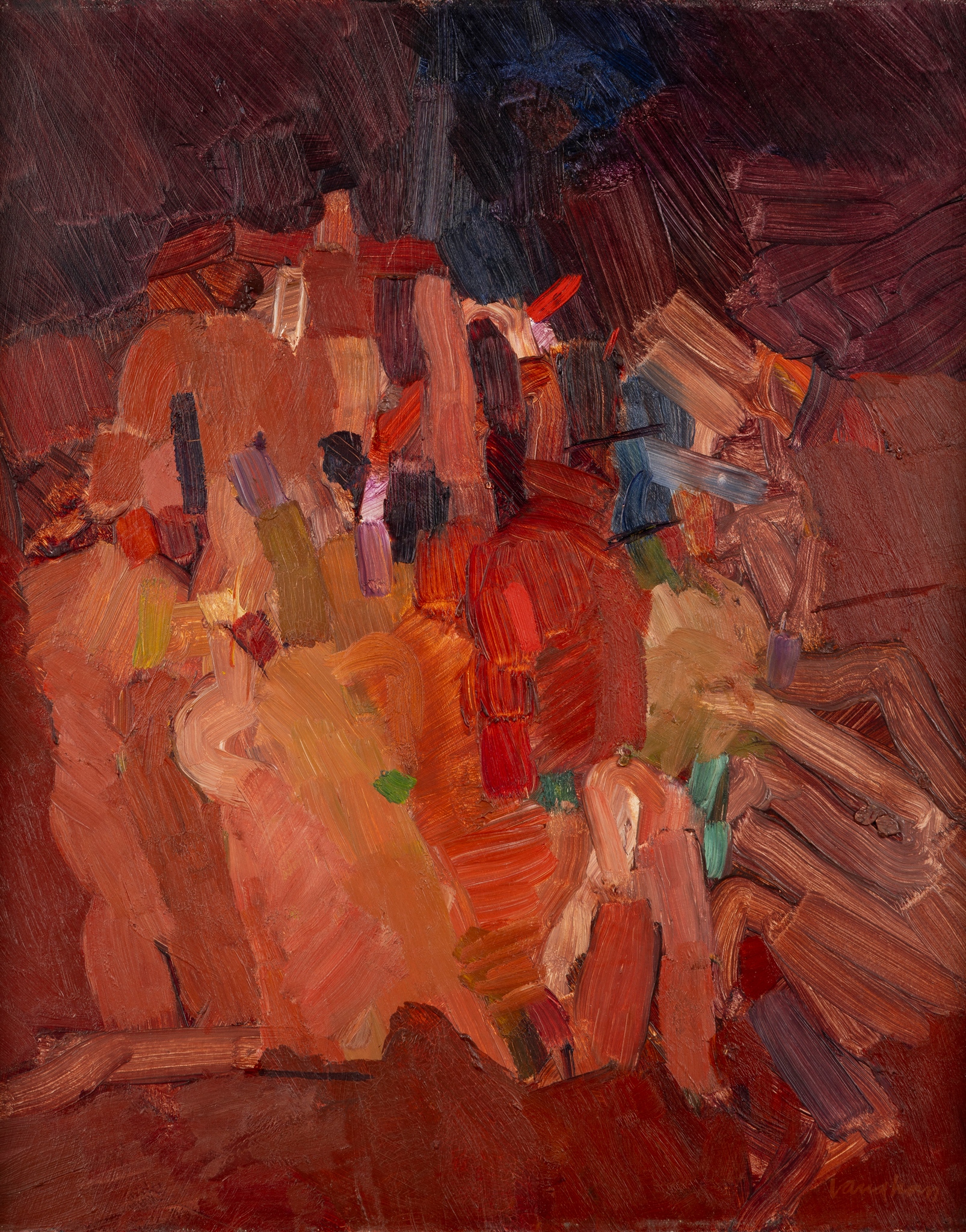
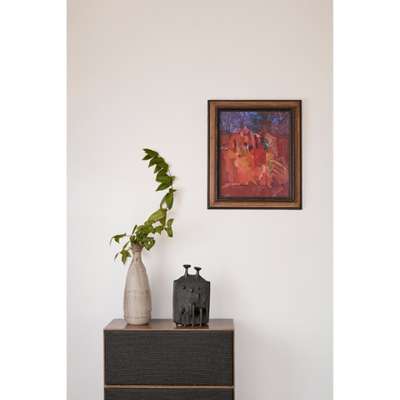
KEITH VAUGHAN (BRITISH 1912-1977) §
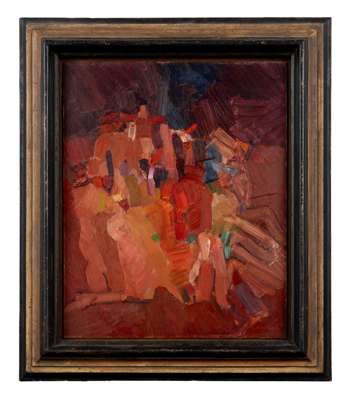
STUDY FOR LAOCOÖN GROUP VIII, 1964
Auction: MODERN MADE | Lots 1 - 422 | Fri 01 May at 10am
Description
signed (lower right), oil on cardboard
Dimensions
44cm x 35.5cm (17 ¼in x 14in)
Provenance
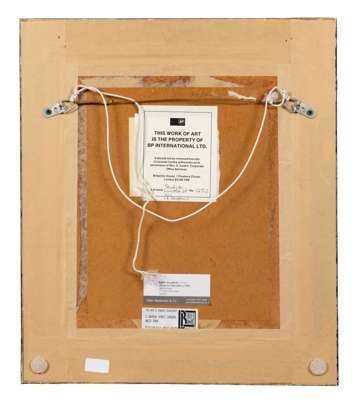
Sir Misha Black;
Private Collection;
Offer Waterman & Co., London, from whom acquired by the present owner.
Footnote
Exhibited:
Marlborough New London Gallery, London, Keith Vaughan: New Paintings, no. 23.
Literature:
Hepworth, Anthony and Ian Massey, Keith Vaughan - The Mature Oils 1846-1977, Sansom & Company, 2014, cat. no. AH456, p.161 (illustrated).
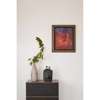
Study for Laocoön was one of a number of works that Vaughan created around the theme – itself the subject of one of the greatest sculptures if antiquity – which he exhibited as part of his solo exhibition at the Marlborough Gallery in London in 1963. It was around this time that Vaughan had also opened out his palette to encompass deep reds and oranges as counterpoints to his more usual dirty blues and greys and blacks. As work like Study for Laocoön, then, is both classic Vaughan, in conception and its concern with the male body and figural groups, but also quite rare, in its high key colour and particularly gestural brushwork.
In the original Homeric myth, Laocoön was a priest in the city of Troy, who tries to warn the Trojans against accepting the wooden horse that has mysteriously arrived outside their gates, even throwing his spear into the horse's side. The gods, of course, were on the Greeks’ side, so punish Laocoön by sending two huge snakes to attack him, crushing him to death along with his two sons. In the famous Greek statue, the Roman copy of which is in the Vatican, this gruesome death is transformed into a tour de force of male anatomy in extreme contrapposto, as Laocoön and his sons manfully resist the coils of the snakes. It’s a powerful image, the sine qua non of any traditional art history, but also a deeply homoerotic image, something that wasn’t lost on Vaughan, who himself was looking to hide same-sex desire in plain sight.
The writer Malcolm Yorke, in his book Keith Vaughan - His Life and Work, in describing this series, hints as much:
“…In the past.. [Vaughan’s]…figures had been as self-possessed as the Greek gods, but now [he] tried to depict the suffering of those who dared to offend the gods. In the Laocoon works the bodies rush together and merge in a scrum from which emerge wildly gesticulating limbs that cannot with any certainty be attributed to particular owners. Outlines have gone, and like the figures themselves the paint is dragged into the dark grounds, overlapped, merged and coarsened. They represented, he said, ‘in supremely dramatic form man’s conflict with his environment and with himself, his own body'. Appropriately serpentine strokes slither wildly to agitate the whole surface and carry energy right into the corners. it is as if Vaughan had been suddenly converted from classical ballet to the wildest extremes of modern dance…” (p.215)
And as Vaughan himself later noted, in 1971, in his journal:
‘In the Laocoon paintings where there is a deliberate state of aggressiveness. I'm not concerned with a classical Poussinesque movement, or a mass in happy association, but a crowd like an Oxford Street mass, jolting, jostling and pushing, when every contour has an abrasive action on every other contour…”