

Lot 2
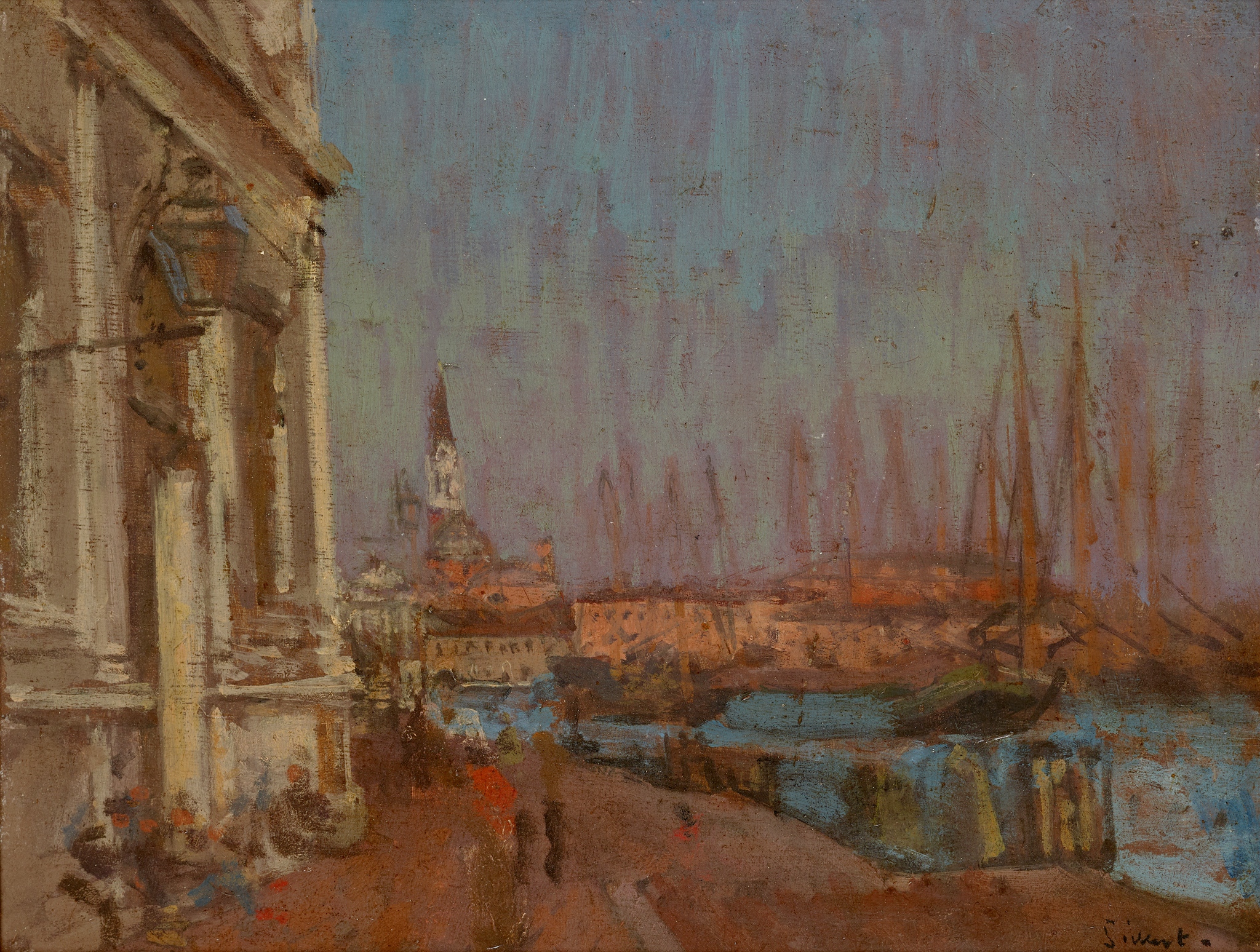
WALTER SICKERT A.R.A. (BRITISH 1860-1942)
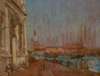
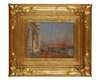
VENICE (SAN GIORGIO MAGGIORE VIEWED FROM THE DOGANA)

Auction: MODERN MADE | Lots 1 - 422 | Fri 01 May at 10am
Description
signed (lower right), oil on panel
Dimensions
18.5cm x 23.5cm (7 ¼in x 9 ¼in)
Provenance
The Fine Art Society, London;
Mr & Mrs Will Richeson Jr, U.S.A.;
The Fine Art Society, London, where acquired by the present owner, 1988.
Footnote
Walter Richard Sickert was born in Munich in 1860, but his family relocated to London when he was a child. Initially, he had aspired to pursue a career in the arts through acting, however, in 1882, he abandoned this path and committed himself fully to painting.
In the 1880s, Sickert studied under James McNeill Whistler (1834 – 1903), and eventually became his assistant. This mentorship proved pivotal in his artistic development, as Whistler encouraged him to move beyond the constraints of detailed realism. Under Whistler’s guidance, Sickert gained the confidence to reject the long-standing traditions of painting exact representations and instead focus on tone and mood, creating the atmospheric quality for which Whistler was renowned.
This tonal influence is particularly evident in Sickert’s depiction of Venice as seen here, where the soft, muted hues of the sky exemplify his tonalist approach. In this painting, he captures a fleeting moment with such subtlety, the figures and gondolas are suggested rather than fully defined, creating a sense of transience and evoking the atmosphere of the city.
Venice had long been a source of inspiration for British artists, however, improvements in travel during this period made Europe far more accessible, allowing painters to spend extended periods in the city, immersing themselves in its culture. It offered a new outlook that combined historical richness with atmospheric beauty, in stark contrast to industrial Britain. The city’s shimmering canals, magnificent architecture, and ever-changing light provided ideal subjects for painters interested in mood, colour, and impression rather than strict realism. For many artists, Venice represented both an escape from modern urban life and a place to experiment with new styles influenced by Impressionism, making it an important destination in the late nineteenth century.
As such, Venice held special significance for Sickert, who spent substantial periods there between 1895 and 1905, producing what are now known as his Venetian paintings. He drew inspiration from the city’s architecture, its interiors, and everyday life. It was in this Venetian series that we see Sickert pay homage to J. M. W. Turner (1775 – 1851). Here, he echoes Turner’s fascination with light, atmosphere, and reflective surfaces, using a technique that blurs solid forms into a mirage of colour and tone. Rather than focusing on precise architectural detail, Sickert, like Turner, emphasised hazy light, shifting reflections on water, and subtle tonal effects. This stylistic borrowing and reinterpretation of Venice as a place of mood and light is considered his homage to Turner. During his time in Italy, Sickert fully explored the effects of light, tone, and atmosphere, honing his skills and developing the distinctive qualities that would come to define much of his work.