Lot 19
DUNCAN GRANT (BRITISH 1885-1978) §
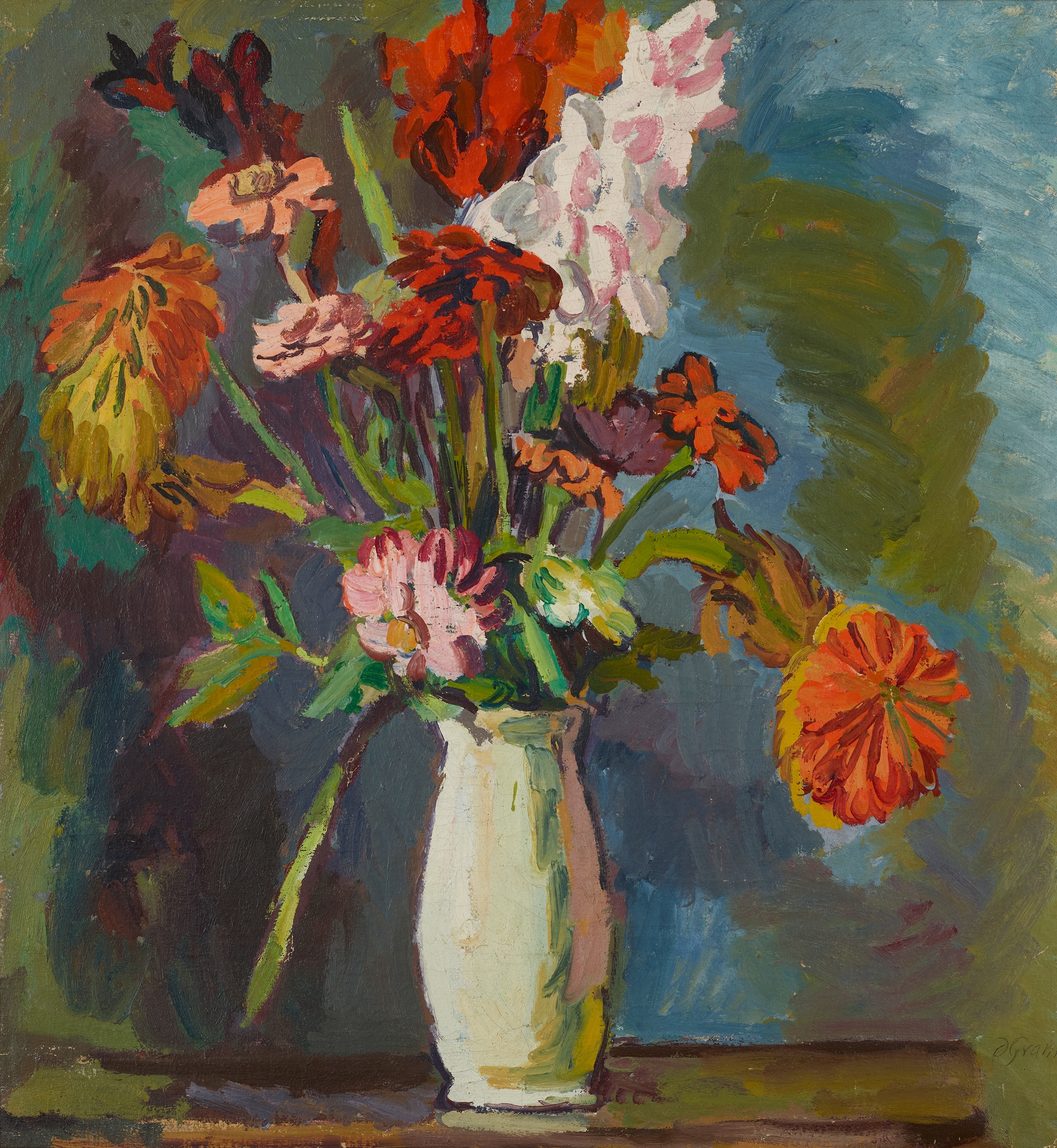
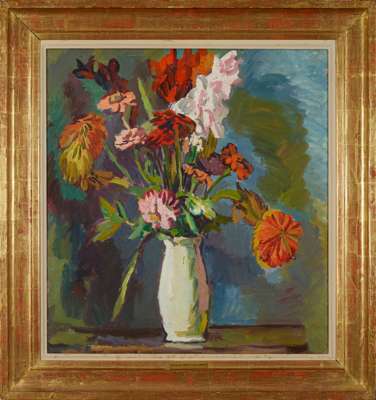
STILL LIFE - FLOWERS, c.1930s
Auction: MODERN MADE | Lots 1 - 422 | Fri 01 May at 10am
Description
signed (lower right), oil on canvas
Dimensions
66cm x 61cm (26in x 24in)
Provenance
The Fine Art Society, London;
Private Collection, U.K.
Footnote
Although born in Rothiemurchus in Scotland’s Cairngorms National Park, Grant is inextricably bound within English art history as a core member of the famed artistic and literary Bloomsbury Group. Indeed, fellow member, the writer Lytton Strachey, was his cousin. After training at the Slade School of Fine Art for just a single term, Grant attended the Académie de la Palette in Paris between 1906 and 1907. Five years later his work was selected by the artist, critic and ‘Bloomsburyite’ Roger Fry for inclusion in his landmark Second Post-Impressionist Exhibition, staged in London in 1912.
In 1916, Grant moved to Charleston farmhouse, near Lewes in east Sussex, with his partner, the writer and publisher David Garnett, the artist Vanessa Bell and her sons with the critic and art historian Clive Bell, namely Julian and Quentin. It was to remain Grant and Bell’s home for the rest of their lives and is now open to the public as a centre of excellence for the legacy of the Bloomsbury Group and their associates.
Still Life – Flowers dates from the 1930s, during the interwar heyday of Charleston when many of the twentieth century’s most progressive artists, thinkers and writers gathered there. Grant and Bell transformed the house and garden into ‘a living, breathing work of art’, painting almost every available surface indoors, where progressive social and artistic ideals could be formulated and lived. (see www.charleston.org.uk/house/). During that decade, Grant’s work was shown regularly in London and he received multiple solo exhibitions including those held at the Lefevre Gallery and Agnew’s. His reputation spread internationally and he was represented in the Venice Biennale of 1932 and at the 1939 World’s Fair in New York. (see Douglas Blair Turnbaugh, Duncan Grant and the Bloomsbury Group: An Illustrated Biography, London, 1987, p.63)
In the midst of this heady creative environment, which was enriched by frequent travel on the Continent, Grant created paintings such as Still Life – Flowers during ‘one of the most productive periods’ in his life. (Frances Spalding, Duncan Grant: A Biography, London, 1998, p.325). Grant’s ebullient treatment – in palette as well as brushstrokes – of his floral subject matter infuses the painting with naturally-lit positivity. The statuesque, plain vase allows the focus to be on the asymmetrical arrangement which emerges from its neck. Stems weighed down by blooming flower heads, combinations of contrasting forms and colours and a freely painted, suggestive background are deftly brought together in a fine example of the still life genre by one of Britian’s most celebrate artists of the last century.