

Lot 111
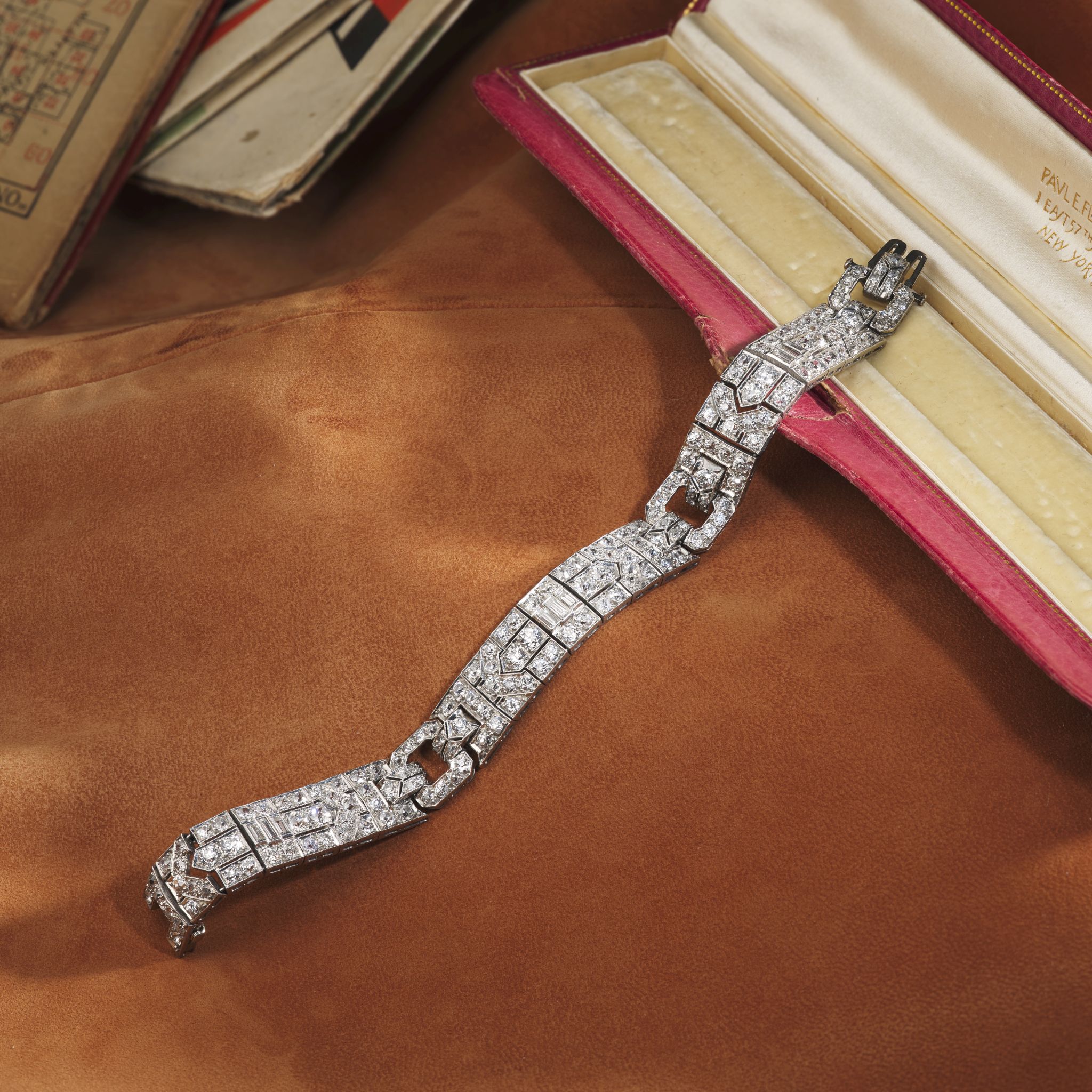
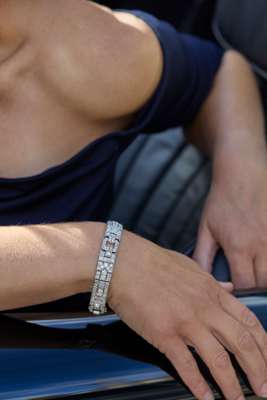
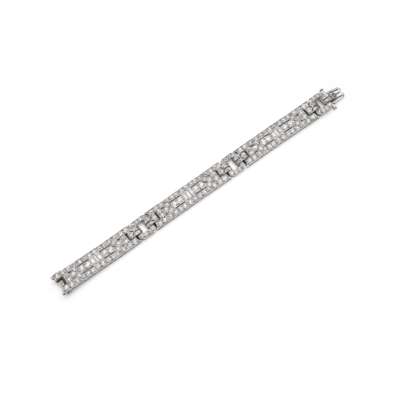
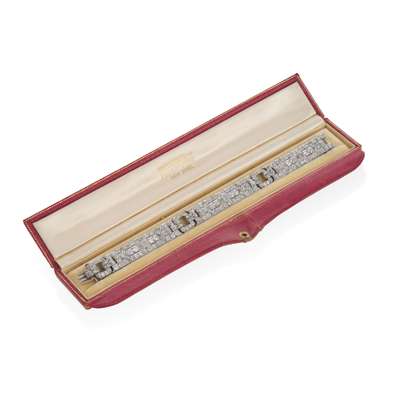
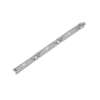
An Art Deco diamond strap bracelet, circa 1930

Auction: 21 October 2026 from 14:00 BST
Description
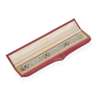
With millegrain and geometric details throughout, the series of articulated links set with cushion-shaped, old brilliant, single and baguette-cut diamonds, to a concealed clasp, diamonds approx. 11.85 carats total, length 18.5cm, cased by Paul E. Flato, 1 East 57th Street, New York
Footnote
Paul Flato (1900 - 1999) was amongst the most visionary and remarkable American jewellers of the 20th century. Born in Texas to a wealthy family, convention never suited him. After an aborted attempt at university, he moved to New York City and began a career in the jewellery world, working for the dealer Edmund Frisch.
Although unable to draw, Flato branched out on his own in 1928 opening his first store at 1 East 57th Street. His design talent was apparent very early on, as was his ability to charm and cultivate high society clients.
Flato's chief designer was Adolph Klety who specialised in creating the more formal platinum and diamond jewellery. However, Flato had a talent for spotting talent, even amongst those who were not formal designers. Two of his more unexpected contributing designers were the socialites Millicent Rogers and Josephine Forrestal.
Rogers was the heir of the Standard Oil fortune, but her personal style and impact on society was legendary. It was her design concept which launched the “puffy heart”. A series of three dimensional heart jewels which become an icon of Flato's repertoire.
Forrestal was the former editor of Vogue magazine and wife of James V. Forrestal, the U.S. Secretary of the Navy. Forrestal was well travelled throughout Europe and brough back numerous antique examples which formed the basis of other Flato designs, such as the “wiggly clips” which employed the classic 19th century en tremblant mounting technique.
According to Marion Fasel, "One of Flato’s endearing characteristics was an ability to tell tall jewelry tales. He liked to recount a story, which he swore was true, about when socialite Florence Gould was seated next to Louis Arpels of Van Cleef & Arpels at a dinner. As she told Mr. Arpels, “Paul Flato is my jeweler,” her necklace came unfastened and fell into her soup."
In the late 1930s one of Flato's primary suppliers was an almost unknown Harry Winston, just starting out in his career. He also employed the young Duke Fulco de Verdura, fresh from launching his career with Coco Chanel. Verdura's unique designs were so popular for Flato that he began marketing them as “Verdura for Flato", undoubtedly helping to give Verdura a platform to launch his own independent career subsequently. A prime example of this collaborative work is the famous aquamarine and ruby buckle necklace now owned by the American actor Jennifer Tilley.
In 1938, Flato relocated to Hollywood where his flamboyant high profile jewels suited the California social scene as well as the on screen aesthetic. His creations appeared in at least five Hollywood films, for which Flato was credited, worn by Katherine Hepburn, Greta Garbo and Rita Hayworth.
Sadly in the 1940s, it came to light that some unscrupulous business affairs had been occurring behind the beautiful exterior of his work and life. Flato ultimately served jail time in both the infamous Sing Sing prison and in Mexico's Lecumberri prison.
Following his release, Flato relocated to Mexico. In 1970 he opened a high end boutique in Mexico City’s Zona Rosa area and spent the next twenty years based there, creating even more extraordinary jewels.
He died in Texas in July 1999.