

Lot 421
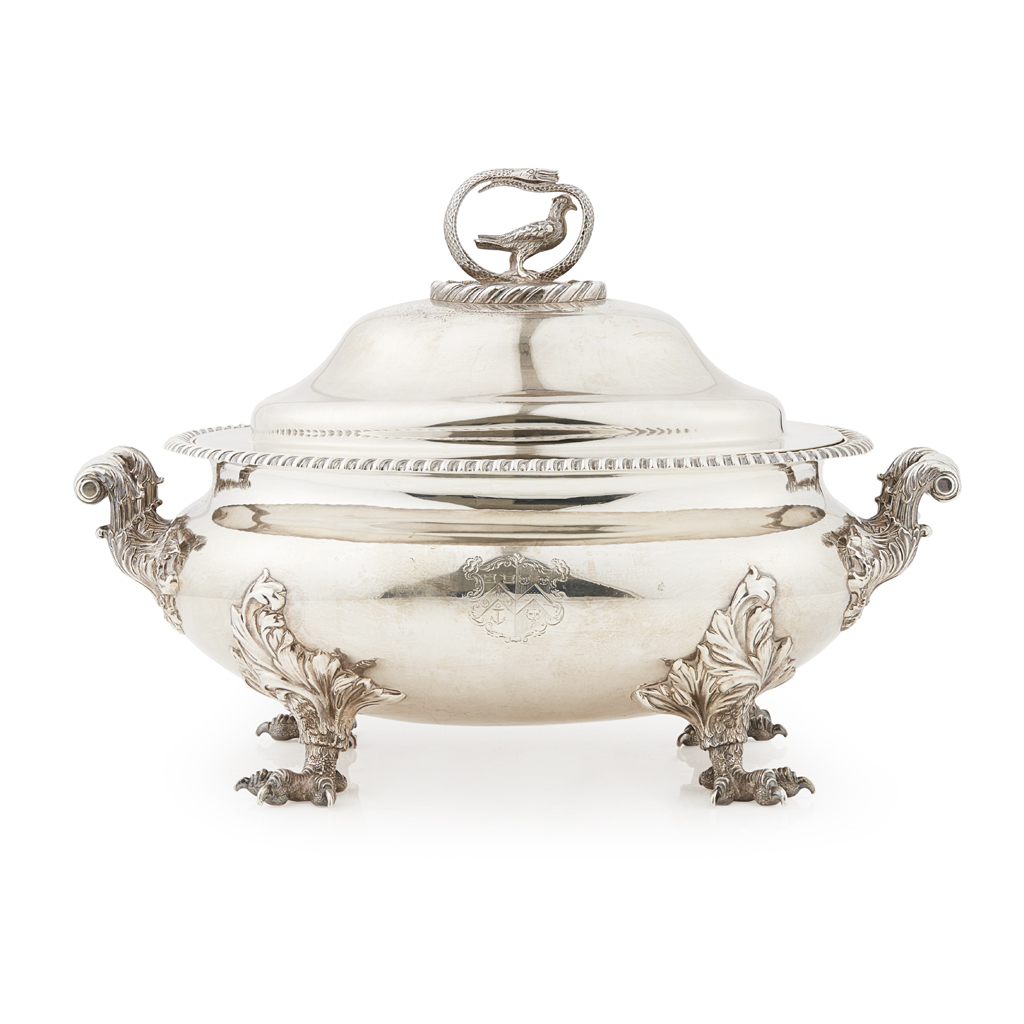
A William IV tureen and cover
Jewellery, Watches, Silver & Coins
Auction: 13 March 2018 at 11:00 GMT
Description
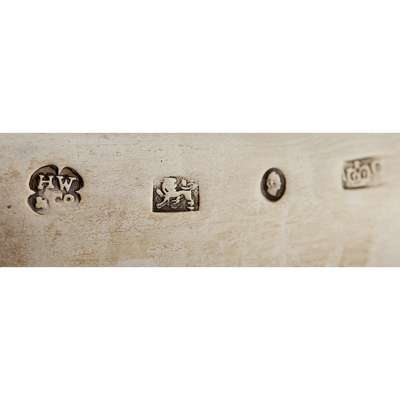
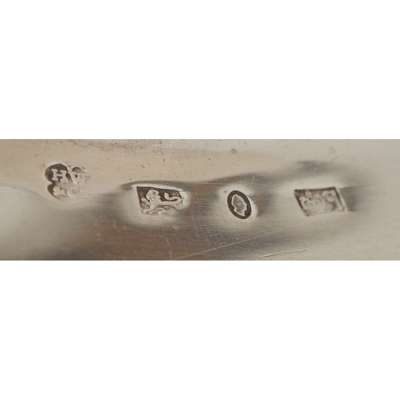
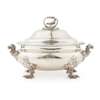
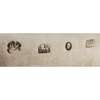
Henry Wilkinson & Co, Sheffield 1836, of oval outline, armorial to front, cast shell and foliate handles, the pull off cover of domed form with gadrooned border, cast pheasant and serpent finial, all raised on four boldly cast claw and foliate feet
Dimensions
Width: 36cm, weight: 88oz approx
Footnote
The armorials are those of the family of Walker impaling Parker. These armorial bearings denote the marshalling of a marital coat showing on the dexter (the heraldic right on the left as you view the piece) the arms of the husband and on the sinister (the heraldic left on the right as you view it) the arms of the wife. These armorial bearings may be blazoned as follows:
Arms:
(on the dexter) Argent on a chevron gules between two anvils in chief and an anchor in base sable a bee of the first between two crescents or (for Walker)
(on the sinister) Gules a chevron between three leopards’ faces or (for Parker)
Crest: On a mount within a wreathed serpent dove statant all proper (as shown upon lid of the tureen below)
These arms undoubtedly commemorate the marriage of Joseph Need Walker (born 30th September 1790 died 15th March 1865) and Catherine Parker (born 9th June 1880 baptised 3rd July 1800 died 7th December 1859). Joseph and Catherine were married on 9th November 1818 at the Parish Church of Christ Church, Tynemouth in the County of Northumberland. Joseph was the eldest son of Joseph Walker, of Eastwood House, near Rotherham in the County of Yorkshire and of Aston in the County of Derbyshire and his wife, Elizabeth Need; whilst Catherine was the daughter of Samuel Walker Parker, of Scott’s House, near Newcastle-upon-Tyne in the County of Northumberland. Given that one of Catherine’s father’s given names was ‘Walker’ it is presently not thought that there is any cousinship or other familial connection between the two families. The Walkers were a wealthy family of industrialists who founded iron and steel businesses in Rotherham during the early to mid-18th Century. During Great Britain’s conflict with France during the Napoleonic Wars, amongst the products the family’s iron and steel manufactories produced were cannon for the Royal Navy which undoubtedly profitably filled the coffers of their various enterprises. Many of these cannons were found aboard Nelson’s flagship HMS Victory at the Battle of Trafalgar in 1805. Some years after their marriage Joseph and Catherine acquired as their marital home, Calderstone Hall (today known as Calderstones House), Childwall, near Allerton not far from Liverpool in the County of Lancashire in 1828. The Walker family retained Calderstone Hall and its surrounding estate until 1875. By the time, Joseph was resident there he was described as a lead shot manufacturer through which means he further consolidated his fortune. As a family, the Walkers prospered greatly through what we now know today as the first industrial revolution in the world.
Another extant example of the impaled arms of Walker and Parker is depicted upon Joseph’s funeral hatchment which was erected in the Parish Church of All Saints, Childwall after his death in 1865