

Lot 118
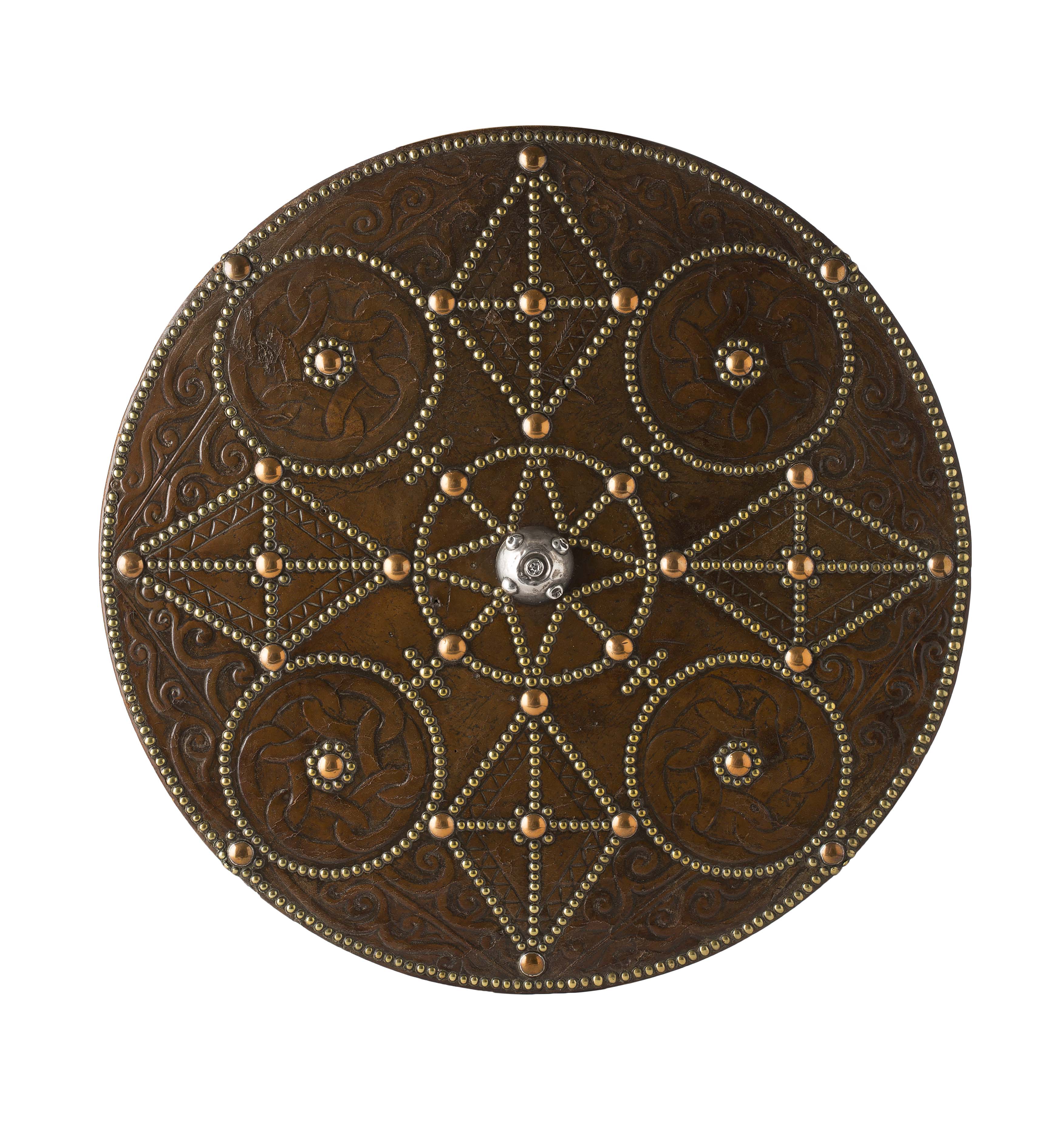
A copy of the Earl of Huntly targe, brass and silver mounted


Jacobite, Stuart, and Scottish Applied Arts
Auction: 13 May 2015 at 12:00 BST
Description
the leather covered wooden circular carcass with a brass domed and studded border enclosing alternating panels of lozenge and circular form, these and the outer borders with tooled Celtic knot work and trailing scrolls, surrounding a central domed and studded silver boss, the reverse with traces of mounting loops
Dimensions
55cm diameter
Footnote
Provenance:
Property of a Gentleman
Notes:
The Highland targe is perhaps the most overlooked yet iconic aspect of a Jacobite's apparel. The targe was as important to the men that bore them as the basket hilted sword, and its use in the deadly 'Highland Charge', which had proved so effective throughout the campaigns, is undeniable.
Their importance at the time, now often overlooked, was obvious, as there are many examples of portraits of important Jacobite figures with their targes and they also feature prominently in poetry of the early 18th century.
"Joyful tidings through the Highlands,
Hosts for conflict arming,
Hammers beating making targes of bossy fine devices"
Taken from Alexander MacDonald's 'A New Song'
Compared to swords, dirks and even pistols the survival rate of these targes is small. It is well recorded that they were often the first item to be discarded upon the aftermath of the defeat at Culloden as men trying to make their escape needed to do so unencumbered of weight, and the sword and dirk were the fighting tools needed if they were captured. Also by the nature of manufacture, they were not the type of items to survive being hidden - as so many swords and dirks were post 1746 - in the romantic thatch of a roof or under floor boards.
It appears that these objects were not provincially or amateur made items but, as with swords, dirks and pistols, centres of manufacture appear to have sprung up. Sadly, no documentary evidence can be found to support this or suggest a location. However, even within the small survival there are features of design and style which must be from the same hand.
While the surface construction perhaps appears simple, the finer details of construction bear out the professional manufacture. Often formed of overlaid twin layers of oak or pine planks to give strength the, leather covering not only bound this structure together but provided a surface to deflect softer blows. The cover to the reverse, also with deer hide, often had packing material between, to cushion the blow and the fur outwards again adding another layer of protection.
The use of the Highland targe appears to have virtually ended with the defeat at Culloden and this signalled the beginning of the loss of Scottish targes.
This example is an obvious direct copy of the famous Earl of Huntly's targe, thought to have been carried at the battle of Sheriffmuir in 1715. Huntly was an important follower of the '15 and raised ,large forces in his Episcopalian lands of North East of Scotland. His targe, now in the National Museum of Scotland (H.LN.52) is one of the finest surviving targes and one of only a very small number silver mounted. While this example shows some differences in minor detail and placement of elements it is obviously copied from it.