

Lot 30
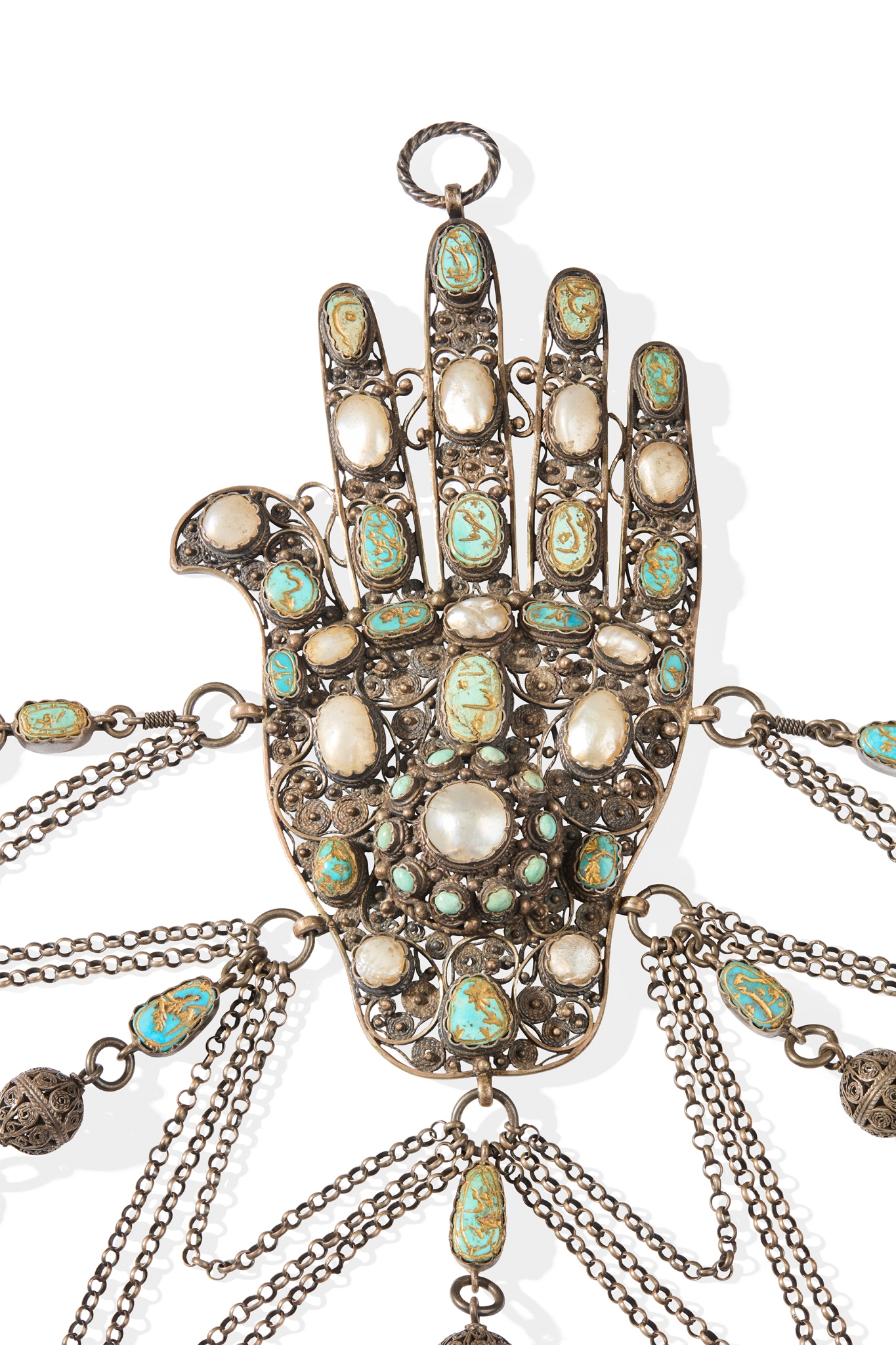
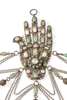
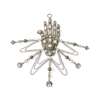
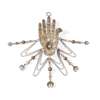
AN IMPRESSIVE QAJAR SILVER FILIGREE TURQUOISE AND PEARL-SET HAND OF FATIMA
PERSIA, 19TH CENTURY
Auction: 09 December 2026 from 14:00 GMT
Description
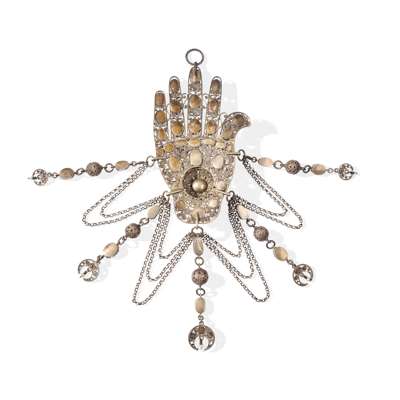
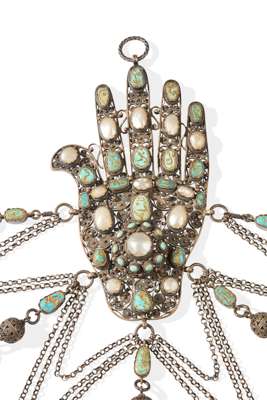
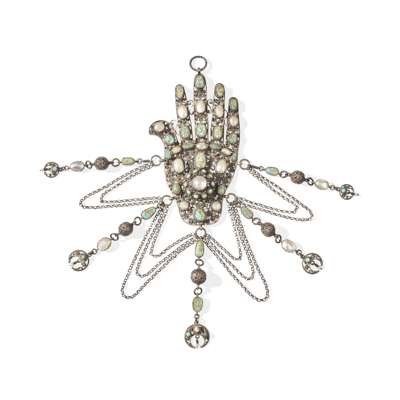
In the typical form of an outstretched hand, the outer frame enclosing silver filigree and granulated decoration, the palm inset with a boss on one side, inlaid with Mabe pearls and engraved turquoises with gold-painted inscriptions and floral motifs, five interconnected hanging chains with pearls, turquoises, filigree spheres and crescent terminals, suspension loop at top
Dimensions
31cm long, 300gr
Provenance
The collection of David Howard Maude-Roxby-Montalto, 14th Duke of Fragnito (b. 1934), gifted by his great aunt Countess Gladys Spetia di Radione (1917-1995).
Footnote
The open hand is one of the oldest and most widely recognised protective symbols, appearing in the ancient Middle East, Buddhist art, and Jewish tradition. In the Islamic world it came to be associated with Fatima, the daughter of the Prophet Muhammad and wife of the fourth Caliph Ali b. Abi Talib, but the ‘Hand of Fatima’ (also known as a khamsa, or ‘five’) has historically been employed by members of the Abrahamic faiths to ward off bad luck. In Shi’i tradition, it is also sometimes referred to as the ‘Hand of Abbas’, after the kinsman and comrade of Husayn whose hands were severed at the Battle of Karbala in 680. Given its protective nature, these hands were often made as banner finials for use in religious processions such as Ashura (Leoni, F. et al, Power and Protection: Islamic Art and the Supernatural, Ashmolean Museum: 2016, pp. 40-41; Akbarnia, L. et al, The Islamic World: A History in Objects, Thames & Hudson: 2018, pp. 60-61, 70-71). The presence of a suspension ring might suggest that this was the purpose of the present piece, or alternatively that it would have been suspended in a private residence. The inscriptions on the turquoises have not been read in full but the word Shah (‘king’) appears several times, suggesting that the text may be benedictory or apotropaic in content. The large boss in the centre of the palm resembles the arrangement of an 18th century Iranian standard in the Victoria & Albert Museum (inv. no. M.11-1958), where the palm contains invocations to the Panj Tan, the five most important figures in Imami Shi’ism.