

Lot 3
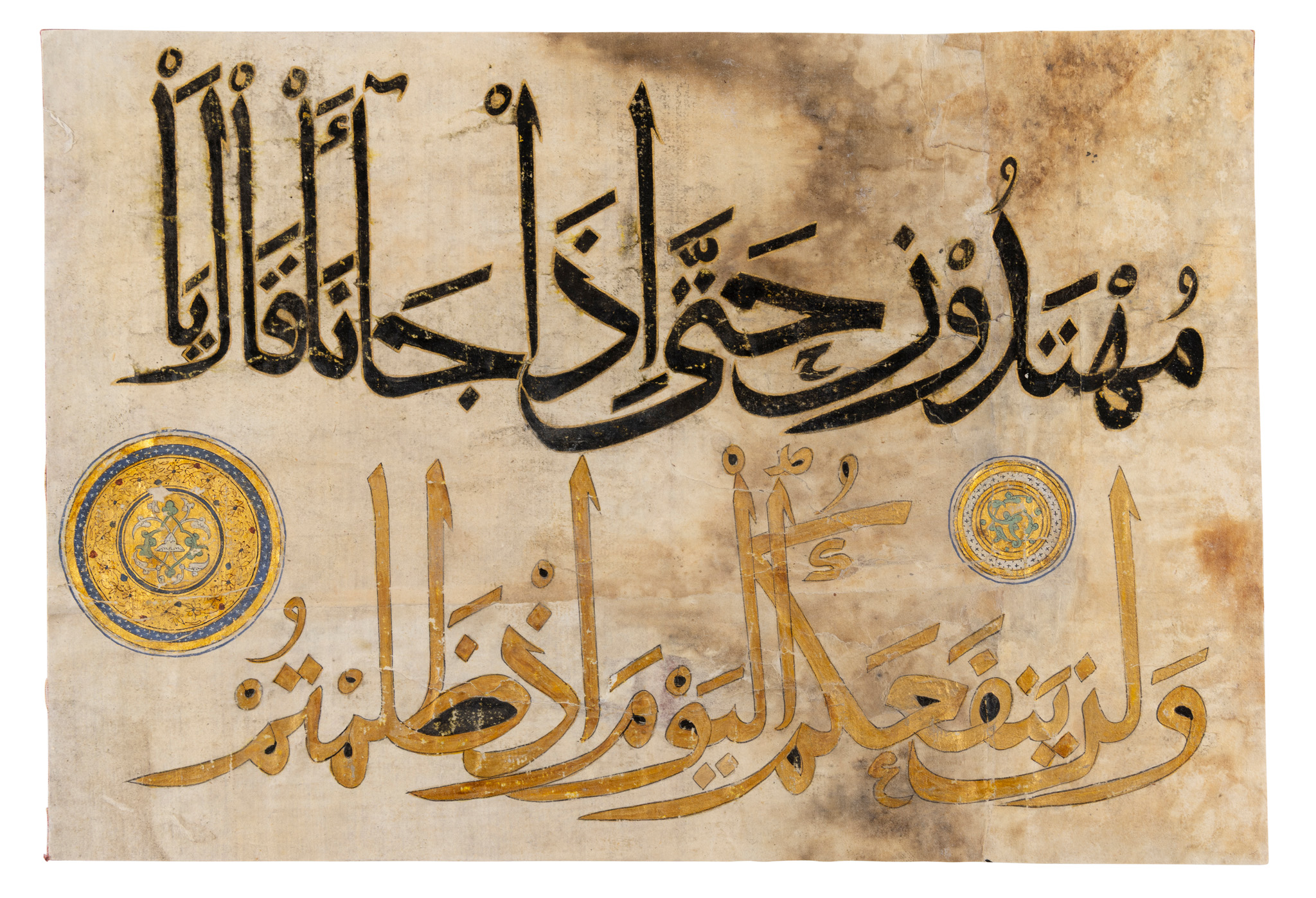
A FRAGMENT FROM THE ULJAYTU QUR'AN
ILKHANID DYNASTY, BAGHDAD, CIRCA 1310
Auction: 09 December 2026 from 14:00 GMT
Description
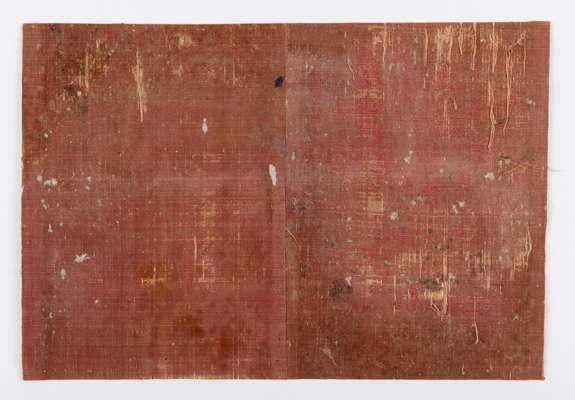
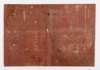
black ink, gold, and polychrome on paper stuck down on stiffened cloth, two fragmentary lines from Qu'ran chapter 43, verses 38-39, in muhaqqaq script, the top line in black outlined in gold, the lower line in gold outlined in black, a smaller roundel between the lines outlined in blue with concentric circles of gold and white and an inner roundel with green split palmettes on gold background, the larger roundel at the end of the second line with a wide gold inner border highlighted with red and blue and an inner roundel of superimposed green and white arabesques
Dimensions
20.8cm x 30.6cm
Footnote
Although fragmentary, this double line gives an idea of the richness and majesty of the Qur’ans produced for Uljaytu (r. 1304-16), the greatest of all the Ilkhanid rulers of Iran. Copied in a majestic muhaqqaq hand, the preferred style for copying the holy text in both the Ilkhanid domains and those of their rivals the Mamluks, this fragment relates closely to other surviving pieces from the same period in collections worldwide. The remarkable illumination can also be attributed to one of the greatest masters of the time.
Following their conversion to Islam in the late 13th century, the Ilkhanids quickly settled into the role of pious rulers and became great patrons of both religious architecture and qur’anic manuscripts. Uljaytu, who was raised a Buddhist, baptised a Christian, and later shifted between Sunni and Shi’i Islam, built a splendid mausoleum for himself in his royal city of Soltaniyeh and commissioned a sumptuous thirty-part Qur’an manuscript for his tomb on very large sheets of paper which contemporaries described as full Baghdadi size. More than a thousand of these huge sheets of paper, which are at the limit of what a single person could lift from the mould, were required to produce this enormous manuscript (Blair, S.S., Islamic Calligraphy, Edinburgh University Press: 2008, pp. 250-52).
Like the mausoleum it once graced, the grandeur of this Qur’an can now only be seen in fragments such as the present example, which appears to have lost at least half of the original lines on the right-hand side. Surviving fragments such as those in the University of Leipzig (inv. no. B. or. 001) show extensive damage, and even complete folios show evidence of trimming and folding at some point in their history. The dispersal of this manuscript must have occurred by the time the fragments in Leipzig were presented to the city’s council library by the publisher Johann Friedrich Gleditsch in 1694.
The illumination of the present lines can be attributed to none other than Muhammad b. Aybak b. Abdallah, who was responsible for decorating some of the greatest Qur’an manuscripts of the age. Often teamed with the calligrapher Ahmad b. al-Suhrawardi, he was active from around 1290-1320 and judging from inscriptions on a folio in the Metropolitan Museum of Art (inv. no 55.44) and the fragments in Leipzig he worked in Baghdad. The arabesques within roundels seen here are very close to those on the frontispiece of a Qur’an illuminated by Ibn Aybak and dated to 1302-08, now in the Chester Beatty Library (inv. no. IS 1614.2, see Carboni, S., and Komaroff, L. (eds.), The Legacy of Genghis Khan: Courtly Art and Culture in Western Asia, 1256–1353, Metropolitan Museum of Art: 2002, p. 131 fig. 158 and pp. 258-59 cats. 63-64). Work on the Uljaytu Qur’an would have been painstaking, with Ibn Aybak taking around three months to illuminate a single volume, or around seven years to complete the work in its entirety (Blair op. cit., p. 253). Although the illumination of the present fragment can be securely attributed to Ibn Aybak, the identity of the calligrapher is less certain. The use of gold and a darker colour for alternating lines of calligraphy is also seen on a folio from the Uljaytu Qur’an in the Museum of Islamic Art Qatar (inv. no. MS.643, see Gonnella, J. (ed.), Museum of Islamic Art: The Collection, Thames & Hudson/Qatar Museums: 2023, pp. 87, 89). While the standard of penmanship is still very high, the somewhat cramped muhaqqaq seen here is not of the quality associated with Ibn al-Suhrawardi. The same has been noted of the folio in Qatar, which has led to the suggestion that, the artist responsible may well have been a member of the royal elite rather than a professional calligrapher (Zakariya, M., “An Ottoman Murakkaa and the Birth of the International Style” in Blair, S.S. and Bloom, J.M. (eds.), God Is Beautiful and Loves Beauty, Yale University Press: 2013, p.20).
Four lines, almost certainly from the same manuscript, were recently sold at Bonhams (Islamic and Indian Art, London, 23 May 2023, lot 2, and Islamic and Indian Art Online, London, 28 November-6 December 2024, lot 1).