

Lot 25
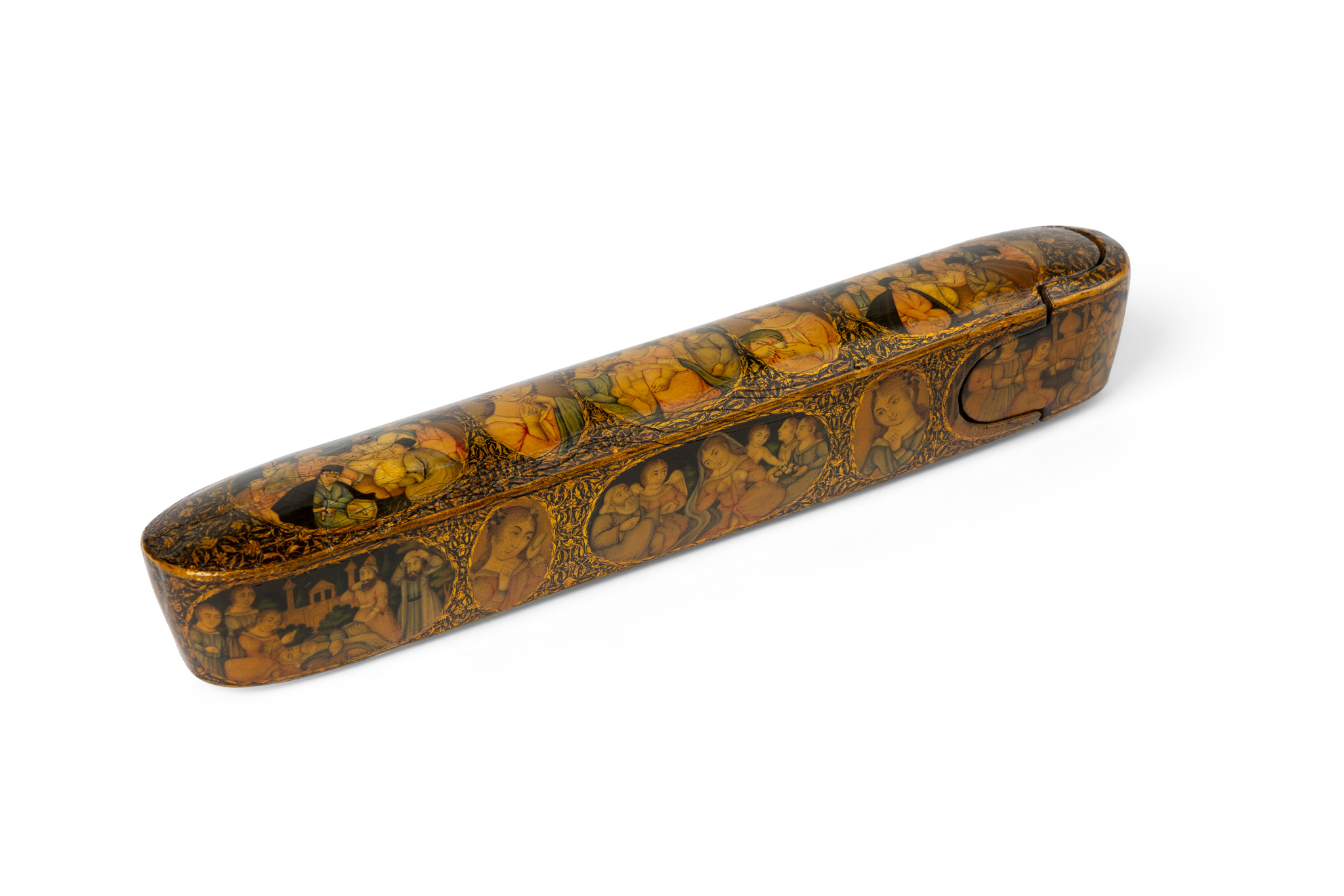
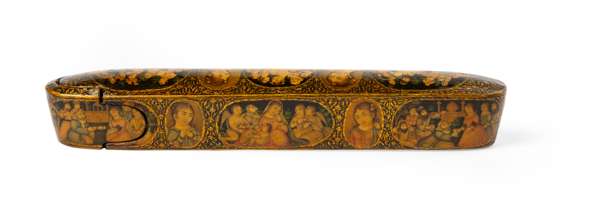
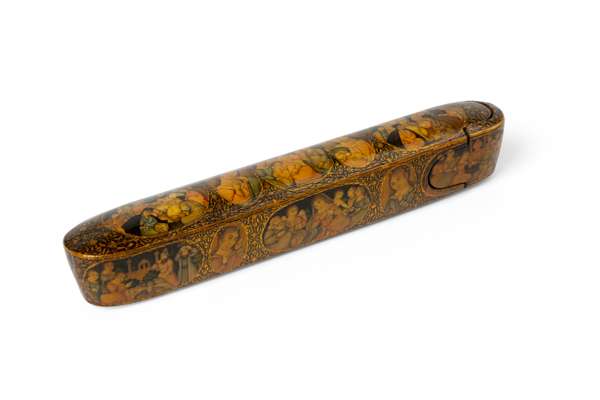
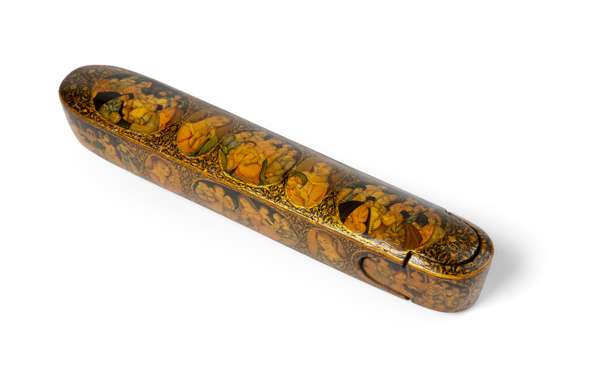
A QAJAR LACQUERED PAPIER-MÂCHÉ QALAMDAN IN THE STYLE OF MUHAMMAD ISMAIL
PERSIA, 19TH CENTURY

Auction: 09 December 2026 from 14:00 GMT
Description
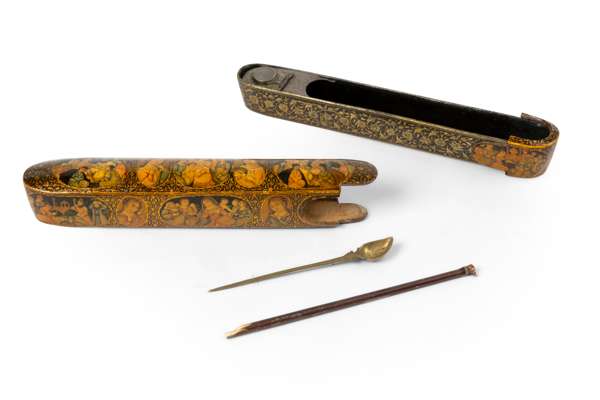
of typical form with rounded ends and sliding aperture, the surfaces profusely decorated with a series of alternating oval bust medallions with female portraits, and larger oval cartouches comprising figural groups, a hybrid of European and Persian figures, on a ground of scrolling gilt floral and leafy designs, two calligrapher's tools including a small spoon included in the pen box
Dimensions
22cm long, spoon 26cm long
Footnote
Muhammad Ismail was a distinguished Qajar-period artist, renowned for his refined painting technique, exceptional attention to detail, and high-quality artistic craftsmanship. His work reflects a distinctive blend of cultural influences, combining traditional Persian artistic conventions with elements drawn from European and other artistic traditions. Through this fusion of styles, Ismail created paintings that demonstrated the cultural exchange and artistic diversity of the Qajar era, while maintaining the elegance, richness, and decorative qualities characteristic of Persian art. He was based in Isfahan and we may assume that this penbox was made there. Penboxes of the present type, referred to as qalamdan-i kayani (‘royal penbox’), are notable for their style of decoration. This consists of figural scenes extending to the base of the cover, and sometimes even to the sides, base and sometimes to the inside of the sliding drawer. Such pieces are too fine to have been mass-produced and were almost certainly made to order for discerning customers.
A penbox of this type is in the Victoria & Albert Museum (inv. no. 763-1876) is signed by Muhammad Ismail (Diba, L.S., and Ekhitar, M. (eds.), Royal Persian Paintings: The Qajar Epoch, 1785-1925, I.B. Tauris: 1998, pp.229-30). Another penbox by the same artist, but with rectangular rather than rounded ends, is in the Khalili Collection (inv. no. LAQ 39, see Rogers, J.M., The Arts of Islam: Masterpieces from the Khalili Collection, Thames & Hudson: 2010, p. 385 cat. 468). Both are decorated with scenes from the life of the Qajar official Mu’tamad al-Dawla and must have been made before his death in 1847.