

Lot 16
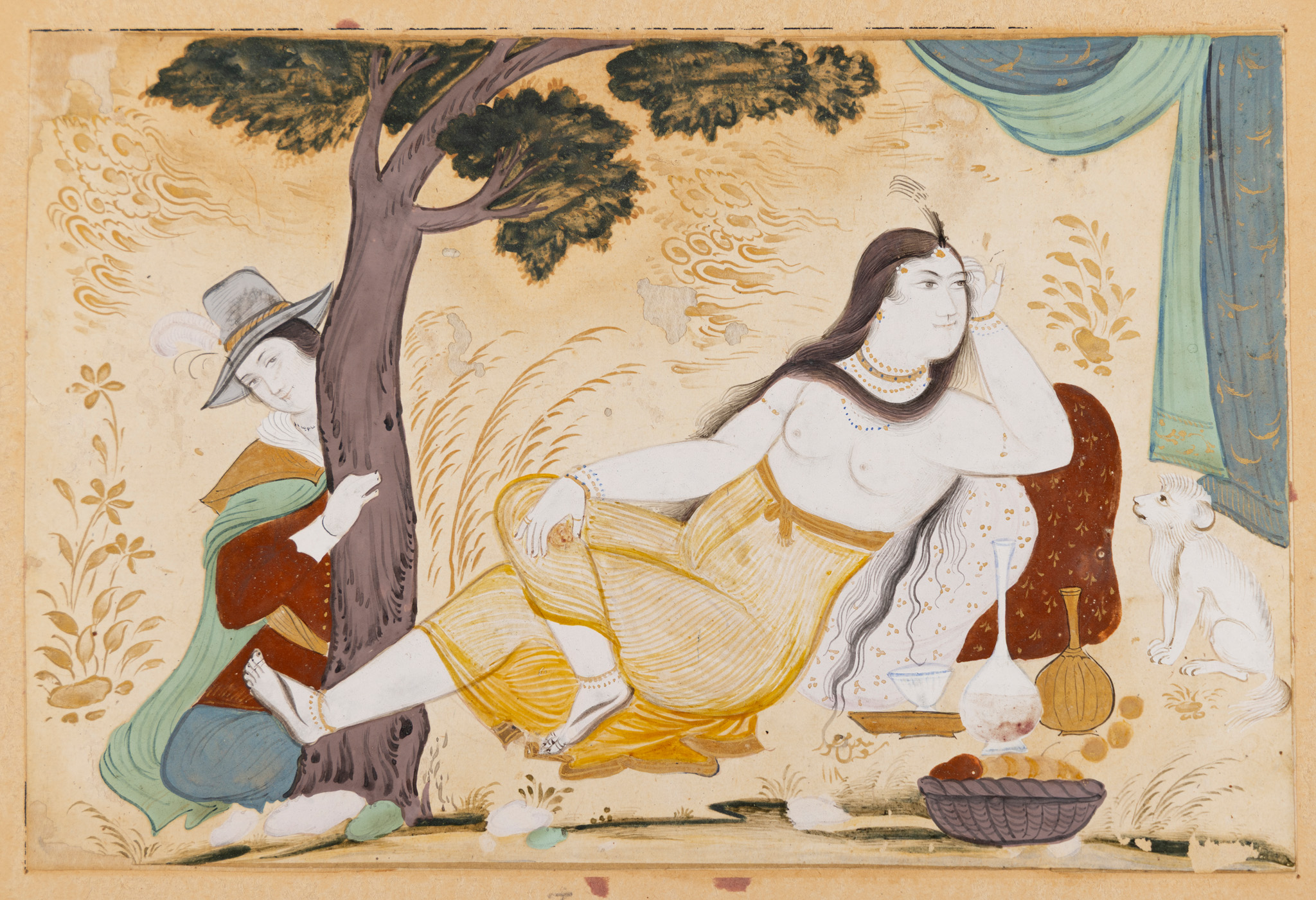
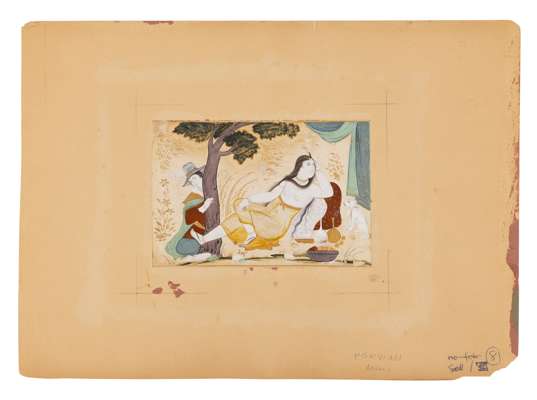
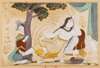
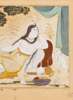
A COURTESAN RECLINING AGAINST A BOLSTER WITH A YOUNG ADMIRER WATCHING HER BEHIND A TREE
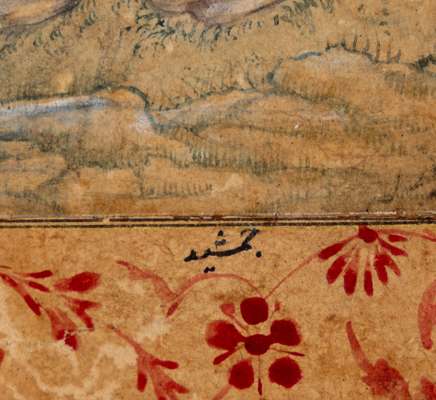
PERSIA, SIGNED 'MU'IN MUSSAVIR' AND 'DATED AH 11[0]8'/AD 1696-97
Auction: 09 December 2026 from 14:00 GMT
Description
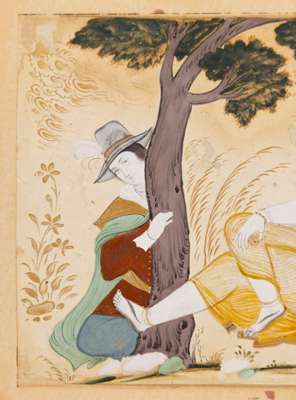
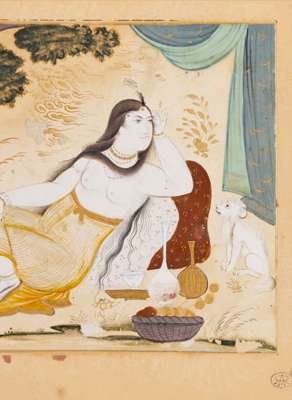
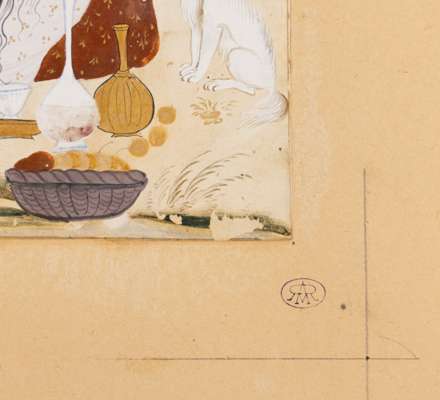
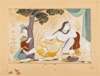
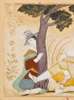
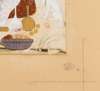
gouache heightened with gold on paper, depicting a reclining courtesan resting on a bolster and looking to the left, her upper half unclothed and lower half covered with a diaphanous gold wrap, gold jewellery elements around her hair, neck, upper arms, wrists, and ankles, the remains of a picnic spread below her, a man in European dress watching her from behind a tree at centre, a white lapdog waiting expectantly at left, stylised background of leaves, plants, and clouds in gold, inscribed and dated in gold below the lady, the border with the monogram of AR
Dimensions
12cm x 18.4cm
Provenance
Alexis Hubert Rouart (Paris, 1839-1911).
Property of a deceased distinguished private collector, London; acquired by the owner from Olympia Auctions, 19 July 2026, Lot 46 (catalogued as Qajar).
Private collection, Spain.
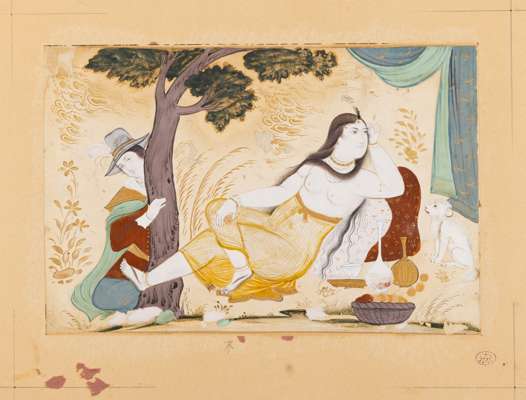
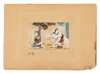
The distinctive mirrored ‘AR’ monogram in the lower left corner is that of Alexis Hubert Rouart. Having made his money in manufacturing, Rouart became a celebrated art collector specializing in European painting and modern works on paper, particularly lithographs. His extensive collection also featured Asian art including Indian sculptures, Japanese lacquer and prints, Chinese bronzes, and Islamic paintings. In May 1911, his collection was dispersed through a series of auctions at Paris's Hôtel Drouot. A painting of a kneeling prince attributed to Mu’in and dated Rabi al-Awwal 1054/ May-June 1644, also bearing Rouart’s monogram, was recently sold at Christie’s (Art of the Islamic and Indian Worlds Including Rugs and Carpets, London, 24 October 2024 lot 75).
Footnote
This wonderfully lively painting is a late masterpiece by Mu’in Musavvir, the most important and prolific of all Safavid painters working in the second half of the 17th century. He studied with the legendary Riza-yi Abbasi, but while his early works show their debt to his teacher, Mu’in’s unique style was apparent from the beginning of his career. For the first twenty-five years he produced mainly manuscript illustrations before turning to single-page works in the 1660s, but his technique remained consistent over this exceedingly long period even as European and Indian influences became stronger in Persian painting.
There is a distinct element of humour contained within this image. The languid courtesan’s air of faintly amused detachment contrasts with the eager, naughty energy of the foreign voyeur watching from behind the tree. His expression is echoed by that of the small dog, which also gazes longingly at her. A somewhat unreal, even theatrical air is enhanced by the draped curtain in the upper right-hand corner, and the reason for the lady’s drowsy appearance is suggested by the remains of the picnic laid before her which include a mostly empty decanter of red wine. The European man’s clothing is vividly rendered in Mu’in’s distinctive set of warm colours, with a splendid set of feathers in the brim of his gold-braided hat, a gold overgarment, green cape, maroon jerkin with gold buttons, and blue-grey trousers. He most closely resembles an earlier depiction by the same artist of a European youth holding a Persian pot, formerly in the collection of Prince Sadruddin Aga Khan (Welch, A., Arts of the Islamic book: the collection of Prince Sadruddin Aga Khan, Cornell University Press: 1982, pp. 122-24 no. 40 and Christie's, 28 October 2025, lot 85). However, while the clothing and facial features of both young men are very similar, their inner worlds could not be further apart. In the earlier picture, the youth is languid and somewhat vacant, standing in the slightly curved posture typical of such compositions; in the present painting, he is full of life and mischief in a manner which only a masterly painter such as Mu’in could have captured. The closest comparison for the courtesan is found in a pair of paintings by Mu’in, one dated 1075/1664-65 and the other 1084/1673, both of which were sold at Sotheby’s (Arts Of The Islamic World, London, 24 October 2018 lot 64 and Oriental Manuscripts and Miniatures, London, 23 April 1997 lot 30). The pose, plumed hair ornament, sheer gold fabric from the waist down, and half-finished picnic below are present in each, with only the placing of hands and feet as well as the use of a water pipe in the other works as major differences. The pairing of a young man in European dress with a lady with an Indian headdress is seen in a double-page composition which separates two sections of the Shahnamah, now in the Khalili Collection (inv.nos. MSS 1000.1-2), signed by Mu’in and dated 2 Dhu'l-Qa‘da 1058/18 December 1648 (Piotrovsky, M.B., and Rogers, J.M. (eds.), Heaven on Earth: Art from Islamic Lands, Prestel: 2004, pp. 130-31 nos. 80-81).
The very painterly background, blank but for a few leaves and clouds picked out in gold, is typical of Mu’in’s output and can be seen in paintings such as The Nawab Mirza Muhammad Baqir and his son Mirza Husayn (1085/1674) and The royal physician, Hakim Shafa’i (15 Muharram 1085/21 April 1674), both of which were in the collection of Prince and Princess Sadruddin Aga Khan (Canby, Princes, Poets & Paladins: Islamic and Indian paintings from the collection of Prince and Princess Sadruddin Aga Khan, British Museum Press: 1998, pp. 86-89 nos. 59-60).
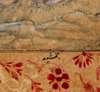
The use of gold to write his signature, which reads mashaquhu Mu’in Musavvir 11[0]8 (“Mu’in Musavvir drew it, 11[0]8”), occurs at least twice elsewhere in Mu’in’s body of work, including a portrait of a young man kneeling in the British Museum (inv. no. 1969,0616,0.3) and a drawing of a lion and qilin dated 26 Jumada al-Awwal 11[0]9/10 December 1697 in the Aga Khan Museum (inv. no. AKM112). Both the present work and the drawing in the Aga Khan Museum can therefore be placed among Mu’in’s final efforts and demonstrate his undimmed skills even at the very end of a long and fruitful career (Canby, ibid., p. 89 no. 61).