

Lot 1
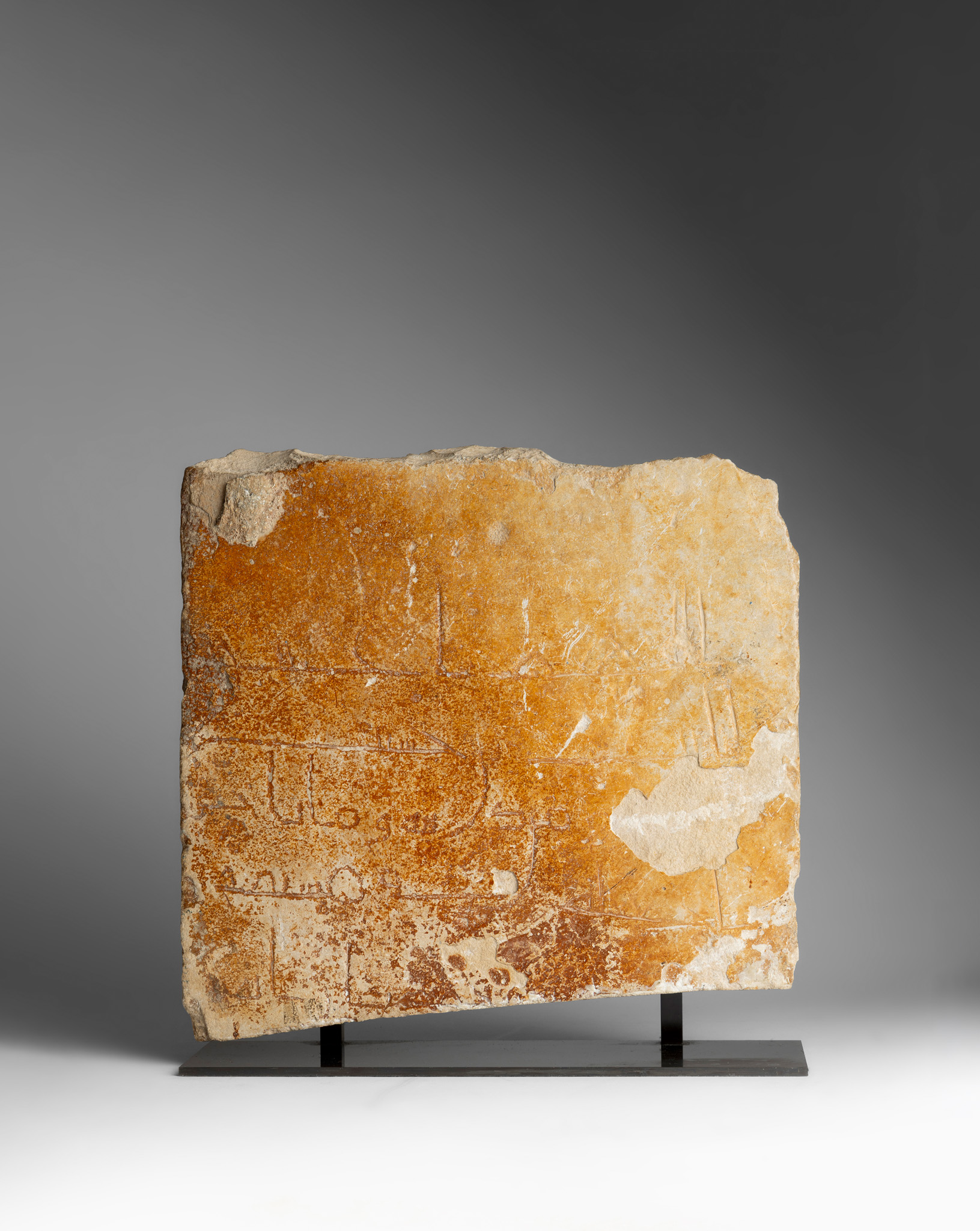
AN EARLY ISLAMIC INSCRIBED FRAGMENTARY TOMBSTONE
HIJAZ OR GREATER SYRIA, CIRCA AD 700
Auction: 09 December 2026 from 14:00 GMT
Description
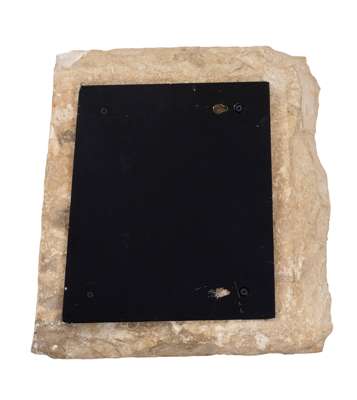
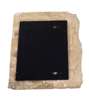
of irregular square form, the front face inscribed with five partially legible lines of text and another partial line below, some weathering and chipping, mounted
Dimensions
33cm x 35cm
Provenance
Formerly, the collection of Oliver Hoare (1945-2018).
Bonhams, Islamic and Indian Art, 7th October 2014, lot 17; from whom acquired by the present owner.
Footnote
This tombstone is a rare example of an inscription from the very early Islamic period outside of museum collections. The text itself is difficult to read, due both to damage and the non-professional nature of the writing, but the legible part reads Allahum aghfir/li-Nasib(?) b. Hasib/...madina wa ma.../... (“Oh God forgive him/Nasib(?) b. Hasib/... city and what.../...”). Although no date is given in the inscription, the letter forms point to the late 7th or early 8th century. Many of these can be seen in the first word, including the right-facing foot of the initial alif, the triangular ha with a parallel line inside it, and the final mim written as a triangle with a short horizontal tail. Very close comparison can be made with inscriptions found northeast of Medina, which have been dated to around 700-50 (Donner, F., “Some Early Arabic Inscriptions from Al-Hanakiyya, Saudi Arabia” in Journal of Near Eastern Studies Vol. 43, No. 3 (Jul., 1984), pp. 181-208). The style of the inscription relates, albeit in a slightly less refined manner, to objects produced outside of the early Islamic Hijaz including the milestone from Jerusalem in the name of the caliph Abd al-Malik (r. 685-705) now in the Musée du Louvre (inv. no. AO 4087, see Bittar, T., Pierres et stucs épigraphiés, Réunion des Musées Nationaux: 2003, p. 36-39 no. 1). This means that Greater Syria, which was closely connected to the Hijaz, could also be a possible place of origin for the present tombstone.