

Lot 85
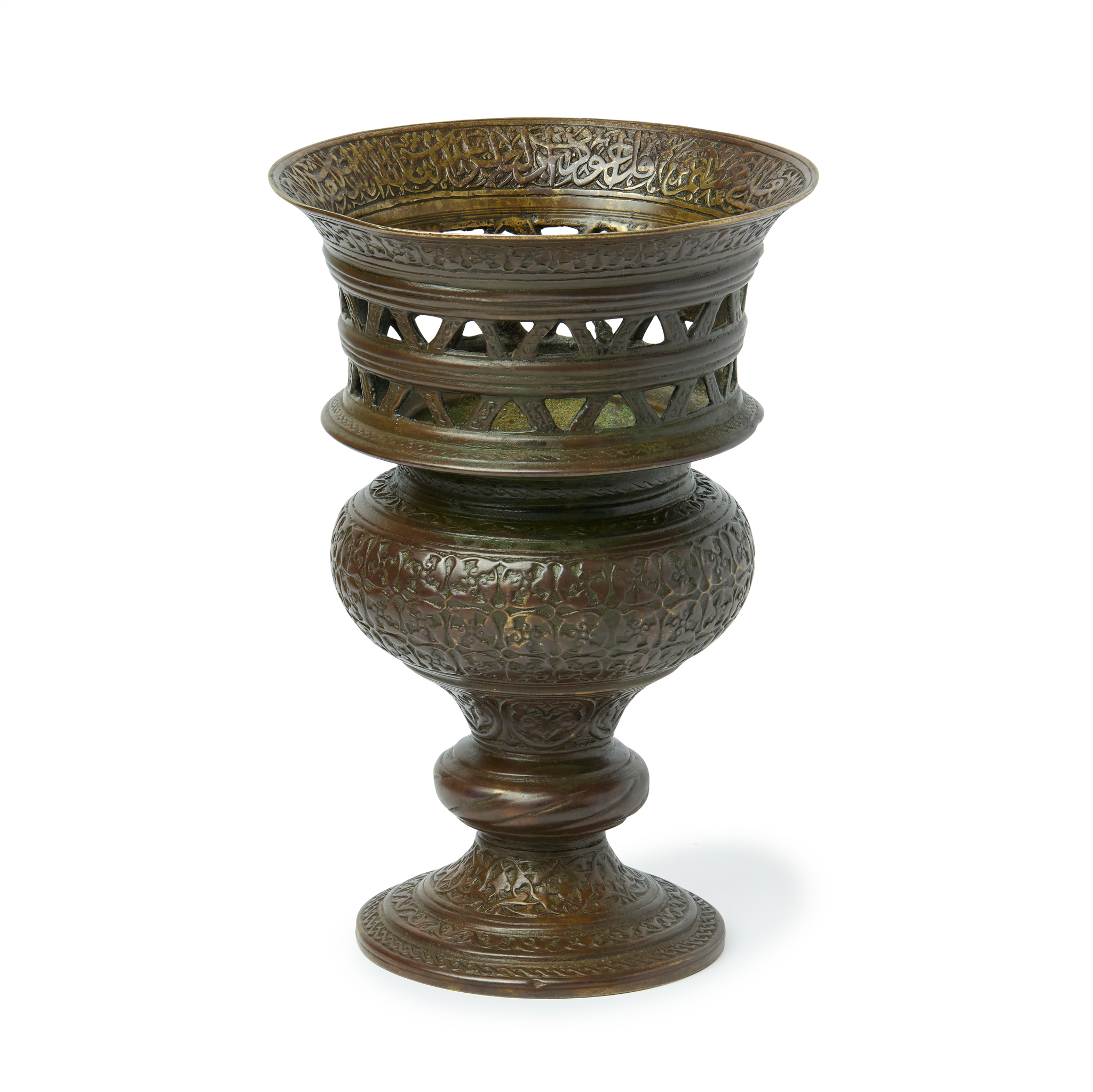
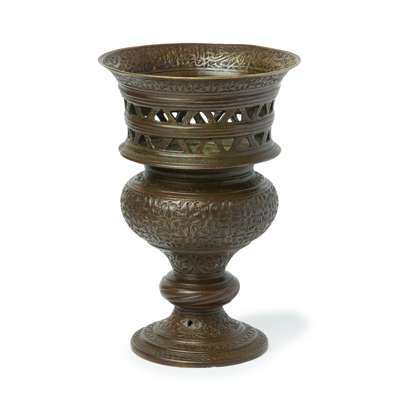
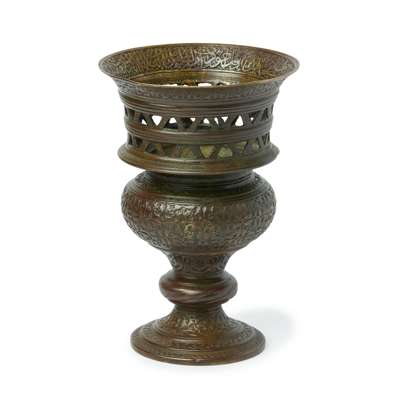
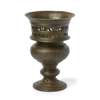
A RARE DECCANI BRONZE VASE OR INCENSE BURNER
INDIA, DECCAN, 16TH CENTURY
Auction: 10 June 2026 from 14:00 BST
Description
of bulbous baluster form with openwork neck and slightly flaring mouth, the body engraved and decorated with repeat floral designs, palmettes and trefoil designs, the inside of the rim finely engraved in Persian script with verses from Qur'an chapter 114, al-Nas
Dimensions
19.2cm height; 13.3cm diameter
Footnote
The shape, decoration, and epigraphy of this elegant vase or incense burner strongly suggest an attribution to the Deccan Sultanates of India during the 16th century. These polities – comprising Ahmednagar, Berar, Bijapur, Bidar, and Golconda – were heavily influenced by Persian and Central Asian culture, and often Shi’a in their religious orientation. They were also fabulously wealthy, with access to raw materials as well as skilled craftsmen.
The exact form of this vessel is not repeated in other known examples. It somewhat resembles a spittoon or incense burner in the Metropolitan Museum of Art (inv. no. 2007.287) in the outline of its lower part, with the splayed foot rising to a rounded knop and then out again to the main body [Haidar, N., and Sardar, M., Sultans of Deccan India 1500–1700: Opulence and Fantasy, The Metropolitan Museum of Art: 2015, pp. 128–29 no. 51]. An incense burner with an openwork arcade at the top as seen here was offered at Sotheby’s and attributed to the 16th century Deccan through comparison with the fretwork seen in the Islamic architecture of southern India [Sotheby’s, Arts of the Islamic World, London, 5 April 2006, lot 151]. The inscriptions around the inside of the rim, meanwhile, are closest to those on a pair of spouted vessels, one in the Metropolitan Museum of Art (inv. no. 2014.689) and another formerly in the Stuart Cary Welch Collection [Haidar and Sardar, op. cit., pp. 266-67 no. 159; Sotheby’s, The Stuart Cary Welch Collection. Part I, Arts of the Islamic World, London, 6 April 2011, lot 141]. This vessel is therefore an important and beautiful addition to the small body of inscribed metal pieces from the pre-Mughal Deccan.