

Lot 74
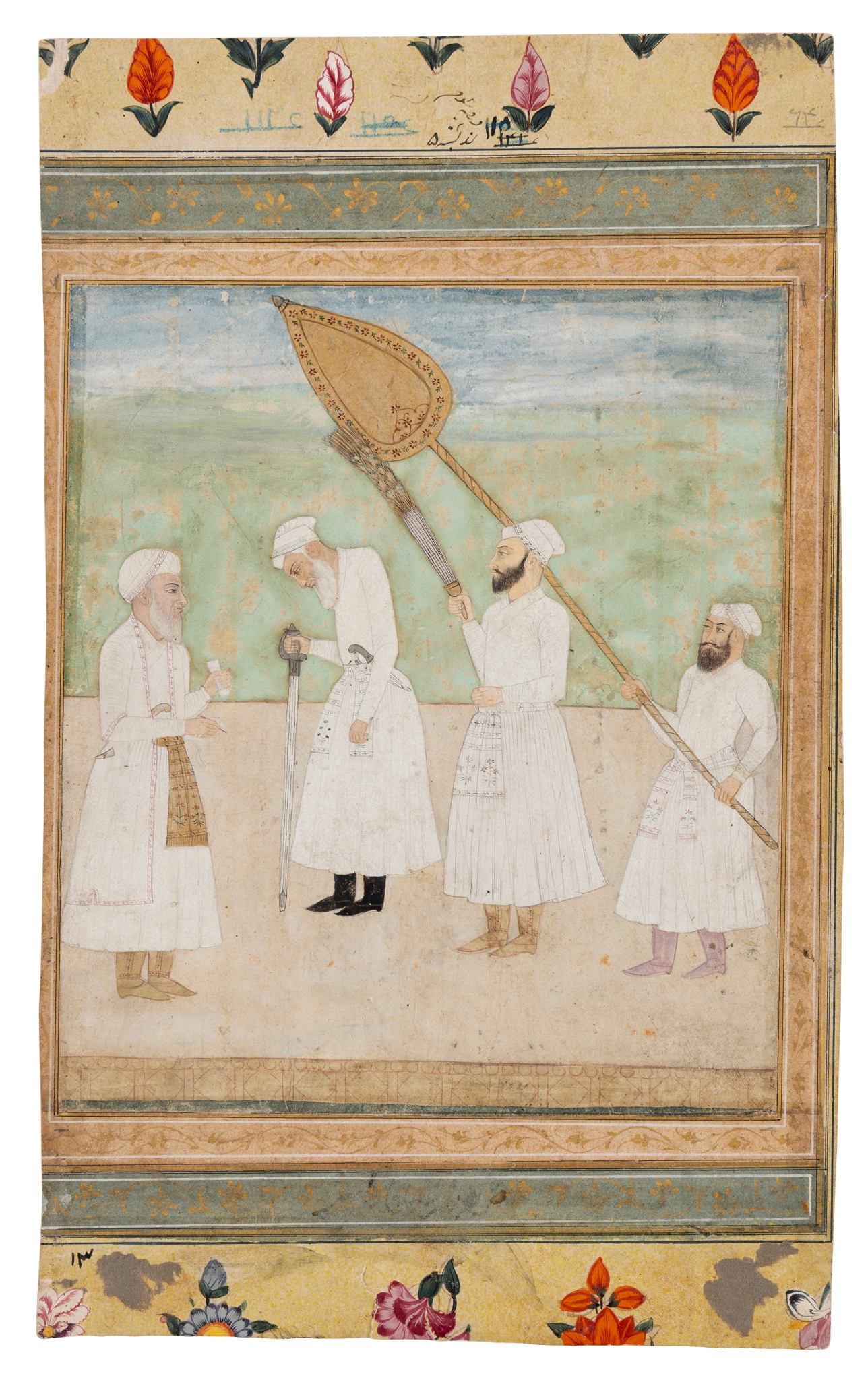
A MUGHAL ALBUM PAGE: THE ELDERLY AURENGZEB WITH COURTIERS
MUGHAL INDIA, CIRCA 1700
Auction: 10 June 2026 from 14:00 BST
Description
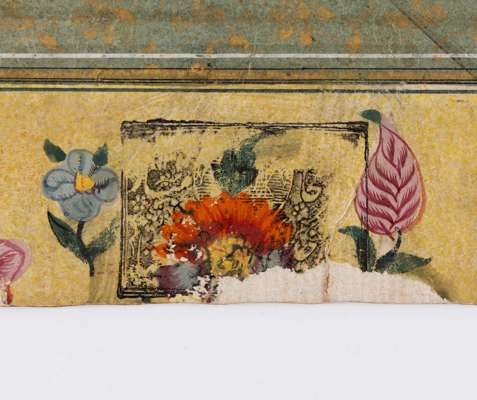
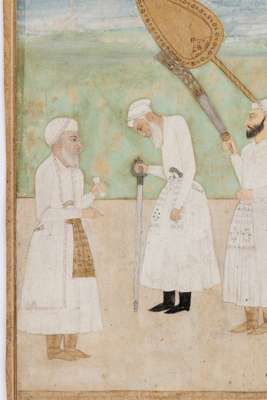
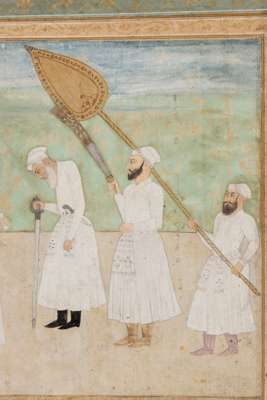
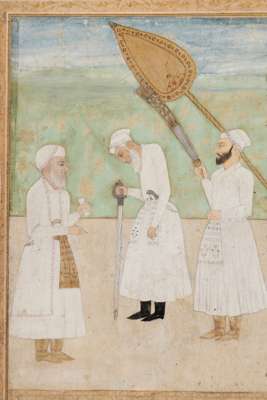
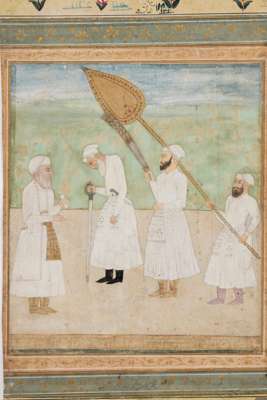
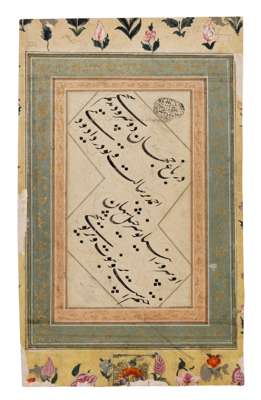
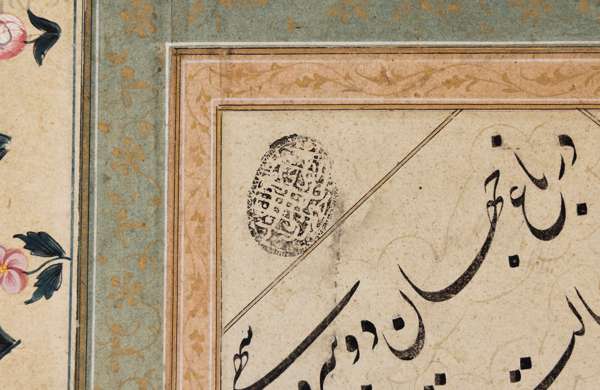
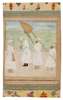
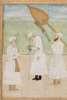
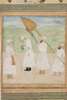
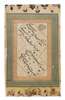
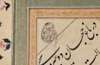
gouache on paper heightened in gold, mounted on to a polychrome floral-decorated album page, depicting an elderly Aurangzeb stooped over his sword, dressed in a white jama with a jade-hilted dagger tucked into his patka, two attendants behind him, one holding a chowrie, and the other holding a royal banner high over his head, a bearded man facing him, possibly his son, Azam Shah, verso with a quatrain in praise of Imam Ali, written in diagonal lines in elegant nasta'liq script in black ink, a visible library seal impression within the panel, of a certain 'Abd al-Rahman, another seal impression in the margin of the album page, possibly dating the latter to circa AH 1208/ AD, mounted, framed and glazed
Dimensions
Album page 31.9cm 19.2cm; image 20.3cm x 17.7cm
Provenance
By repute, the Nawab of Bahawalpur.
Private UK collection.
Footnote
This fine portrait of the Mughal emperor Aurangzeb (1618-1707) shows the piety of the ruler in his later years. Aurangzeb is shown standing stooped accompanied by two attendants and a royal courtier with all four figures dressed in white, demonstrating the emperor's devout Muslim faith and rejection of the world’s luxuries. An accomplished linguist and scholar, he mastered several languages at a young age with a preference for Persian and immersed himself in the knowledge of the Qur'an, following the daily practise of the hadith. Aurangzeb was highly trained in military combat and administration and during his reign, the Mughal empire reached its greatest extent, dominating and stretching across the Indian subcontinent. His obsession with conquering the Deccan and further campaigns led to artists from the Mughal studios being influenced by the Deccani schools but others too in Rajasthan and the Punjab Hills.
Although the padshah is depicted as simply attired and nearly defeated by age, this image is not devoid of the imagery of power. His attendants carry the chowrie (flywhisk) and chhatri (parasol) originally derived from Hindu notions of divine kingship, which were later adopted as part of Mughal regalia [Khare, G.H., “Emblems of royalty in art and literature” in Annals of the Bhandarkar Oriental Research Institute, Vol. 58/59 (1977-1978), pp. 683-689]. Aurangzeb himself holds, or rather leans, on a sword of firangi type with a long straight blade and distinctive basket handle. This may symbolise his martial prowess and determination to conquer, as a similar weapon appears alongside him in a contemporary painting in the Victoria & Albert Museum (see below).
The verso carries a Persian quatrain written in nasta’liq, arranged in the chalipa (diagonal) format on a gold-sprinkled and illuminated background. The panel is framed by an inner border with gold floral patterns and an outer border with larger, hand-painted floral motifs. The poem is a devotional quatrain praising the Prophet Muhammad (referred to by his celestial name, Ahmad) and his cousin and son-in-law, Imam Ali (referred to as Haydar, “The Lion”). The author of this specific quatrain has not been identified, but anonymous devotional ruba’iyat are extremely common in the muraqqa calligraphic tradition, where the beauty of the script often mattered more than the fame of the poet. The verso also bears at least two seal impressions. The first, stamped on the upper right-hand side of the calligraphic panel, is an oval seal with a background of floral scrollwork. Its shape and style are typical of eighteenth-century late Mughal or Awadhi (Lucknow) seals. The second, partly effaced by the 18th century border decoration, may belong to an earlier owner.
For comparison and in particular a portrait of Aurangzeb reading from the Qur'an see Falk, T., and Archer, M., Indian Miniatures in the India Office Library, Sotheby Parke Bernet: 1981, pp. 89-90, nos. 138 (i-v). Early 18th century paintings showing the emperor in old age include those in LACMA (inv. no. M.72.88.1), one in the Victoria & Albert Museum (inv. no. CIRC.225A-1922), and another in the British Library (inv. no. Johnson Album 2, no. 2). This exceedingly fine muraqqa page is an important addition to the group and shows the excellence of Mughal painting into the later period of their rule.