

Lot 35
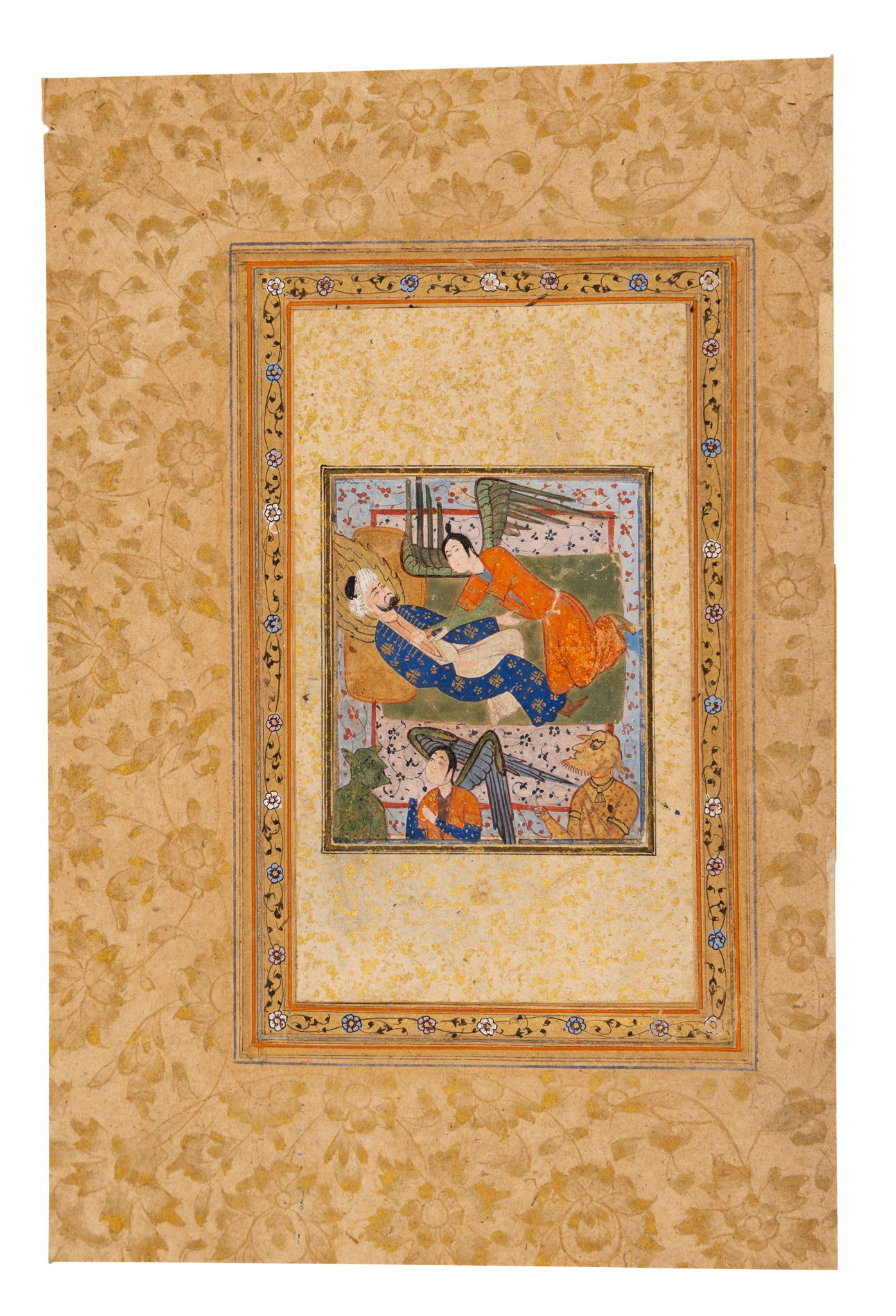
A SAFAVID ILLUSTRATION TO THE LIFE OF THE PROPHET ‡
PERSIA, SHIRAZ, CIRCA 1560-70
Auction: 10 June 2026 from 14:00 BST
Description
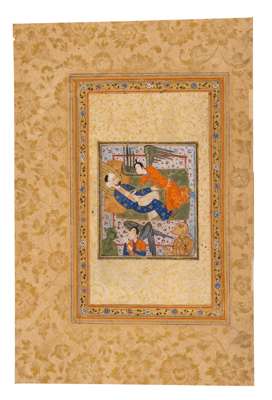
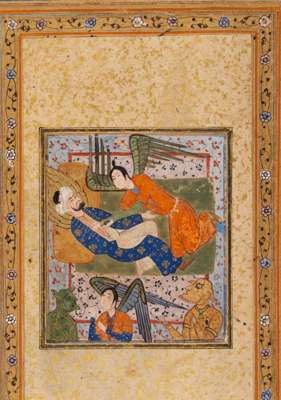
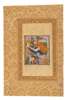
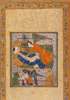
gouache and gold on paper, depicting a prophet dressed in a blue and gold robe and white turban, lying down with a flame behind his head, an angel dressed in orange is tending to him, below in the foreground another angel is flanked by a green and yellow demon, mounted on to a speckled gold album page, with a narrow floral border and a Mughal-style wide gold outer border, framed and glazed
Dimensions
21.2cm x 14cm
Provenance
Private collection, Spain.
Footnote
This unusual scene corresponds to an episode from the life of the Prophet Muhammad where he is awakened by the Archangel Gabriel to accompany him on the Mi’raj (ascension to heaven). This reading of the painting is supported by the fact that there is a bolster and bed on which the Prophet lays, with Gabriel approaching as if to rouse him. The appearance of two demons or jinn below is not in keeping with the normal imagery of this scene, but they may have been intended to heighten the miraculous and unearthly aspect of this angelic visitation.
A closely related painting showing the Prophet awakened by Gabriel is now in the British Library (inv. no. Johnson MS., MS. 888; Ethe 1437, fol. 109v). Originally from a Khamsa of Qasimi attributed to Qazvin c. 1580, this scene shows the Archangel leaning over Muhammad, who reclines on a large bolster [Taşkent, A., and Kancal-Ferrari, N. (eds.), The Ascension of the Prophet and the Stations of His Journey: The Miʿrāj and the Three Sacred Cities of Islam in Literature, Music, and Illustrated Manuscripts in the Ottoman Cultural Environment (vol. 2), Dergâh Yayınları: 2021, p. 583 cat. 1]. The British Library image is much more typical of Safavid depictions of the Prophet, in that his face is covered by a white veil rather than fully exposed. Angels with similarly angular wings in shades of green and red can be seen in a Kulliyat of Amir Khusraw Dihlavi attributed to Shiraz or Yazd c. 1580, also in the British Library (inv. no. Ms. Add. 21104, fol. 317r) [Gruber, C., “Between Logos (Kalima) and Light (Nur): Representations of the Prophet Muhammad in Islamic Painting” in Muqarnas 26 (2009), pp. 229-62, p. 244 fig. 9]. The jinn at the lower edge of the image resemble the supernatural beings which regularly appear in mid-16th century Falnamas such as an example attributed to Qazvin in the Chester Beatty Library (inv. no. MS 395) [Farhad, M., and Bağcı, S. (eds.), Falnama: The Book of Omens, Thames & Hudson: 2009, pp. 152-53 cat. 38].