

Lot 134
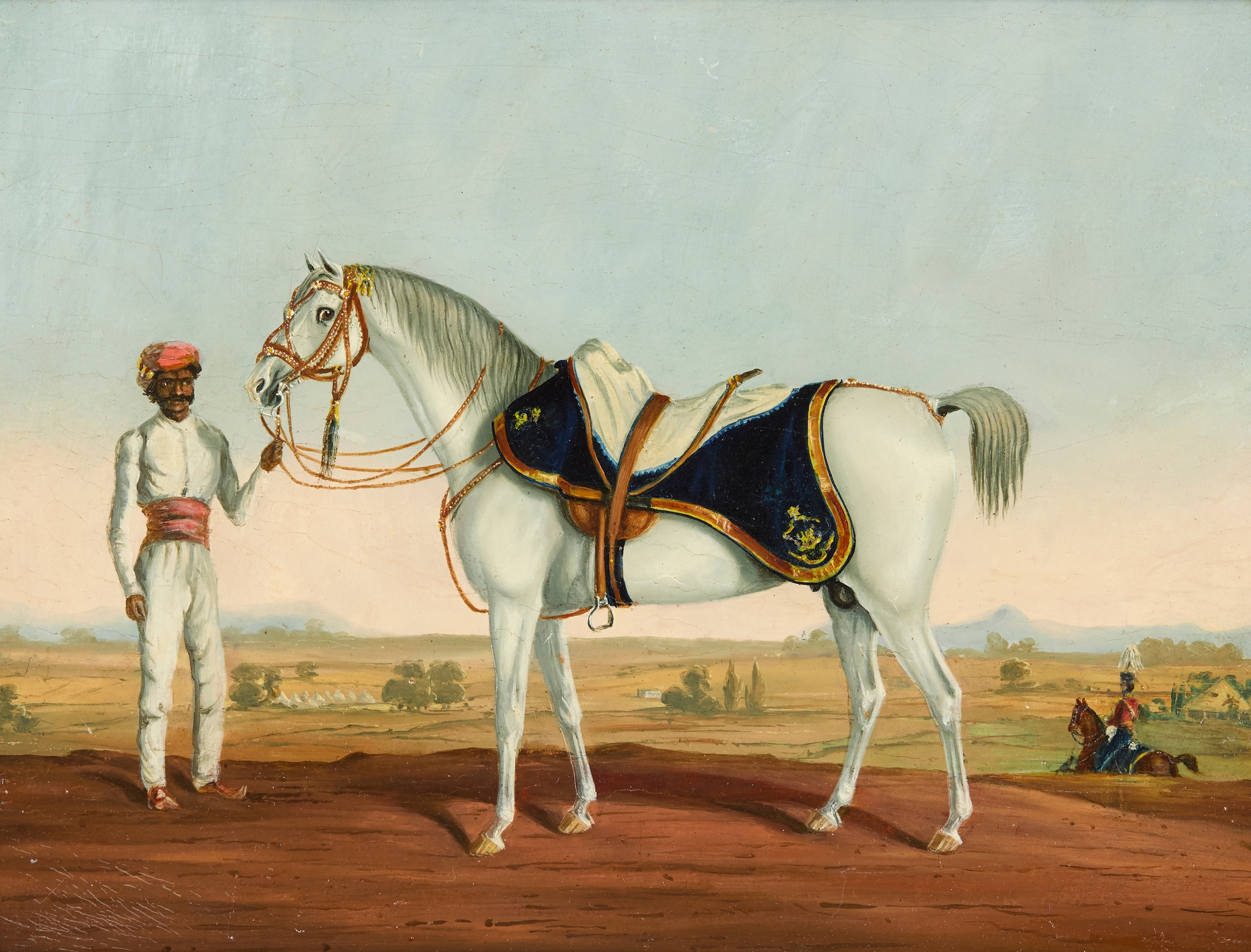
COMPANY SCHOOL: FRANCIS CLIFTON FYERS' HORSE AND GROOM
CIRCLE OF SHAYKH MUHAMMAD AMIR OF KARRAYA, INDIA, PUNE, CIRCA 1838
Auction: 10 June 2026 from 14:00 BST
Description
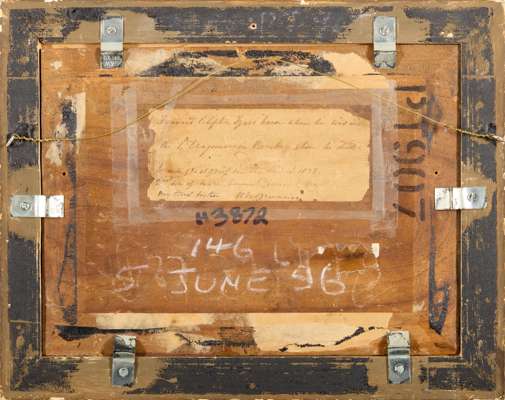
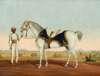
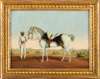
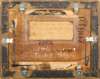
oil on panel, depicting a groom holding a caparisoned white stallion facing left, calvary officer in the right background, old hand written note on reverse: Francis Clifton Fyers' horse when he was in the 4th Dragoons in Bombay where he died to our great grief in the end of 1838; (in a separate hand) 2nd son of Major General Thomas Fyers, R.E. my third brother R M Brownrigg, framed
Dimensions
22.6cm x 30.4cm
Provenance
Christie's, Visions of India, 5 June 1996, lot 146.
Private collection, Aberdeenshire.
Footnote
This striking portrait of a white stallion and its attentive carer immediately conjures up images of a bygone era. Silhouetted against empty plains and a large sky the painting emphasises the muscular features of this magnificent horse and leaves us wondering about the identity of its owner. The golden insignia, dark blue saddle blanket and presence of a lone calvary man cantering into the distance connect this military painting with the 4th (The Queen’s Own) Regiment of (Light) Dragoons. This elite fighting force initially raised in 1685 was trained to fight both on horseback and foot and served in India and Afghanistan between 1822 to 1842.
Horse and Groom shows strong stylistic similarities to the work of Shaykh Muhammad Amir of Karraya, widely acknowledged as 'by far the most talented and original' of all Calcutta painters specialising in work for the British (M. Archer, Company Drawings in the India Office Library, HMASO, London, 1972, plates 29 and 30). His distinctive style is easy to recognise: refined portraits of the servants who kept the great Calcutta villas running, and even more accomplished depictions of dogs and horses, often shown as prize animals posed with their grooms against landscaped backgrounds. In many of these pictures he creates distinctive curved shadows which are also evident in Horse and Groom. Shaykh Muhammad Amir's success enabled him to create a large studio employing many artists to work in his style to satisfy the ever-increasing demand for his work. For further examples see, S.C. Welch, Room for Wonder, Indian Painting during the British Period, New York, 1979, nos. 21-23 and W. Dalrymple (ed.), Forgotten Masters, Indian Painting for the East India Company, London, 2019, pp. 118-130.
On the reverse of this picture is an old handwritten note which provides a historical insight:
Francis Clifton Fyers' horse when he was in the 4th Dragoons in Bombay where he died to our great grief in the end of 1838; (in a separate hand) 2nd son of Major General Thomas Fyers, R.E. my third brother R M Brownrigg.
Whilst not much is known about Francis Clifton Fyers this intimate portrait of his horse and groom serve as a poignant reminder of a family steeped in military tradition and a unique period of history.