

Lot 112
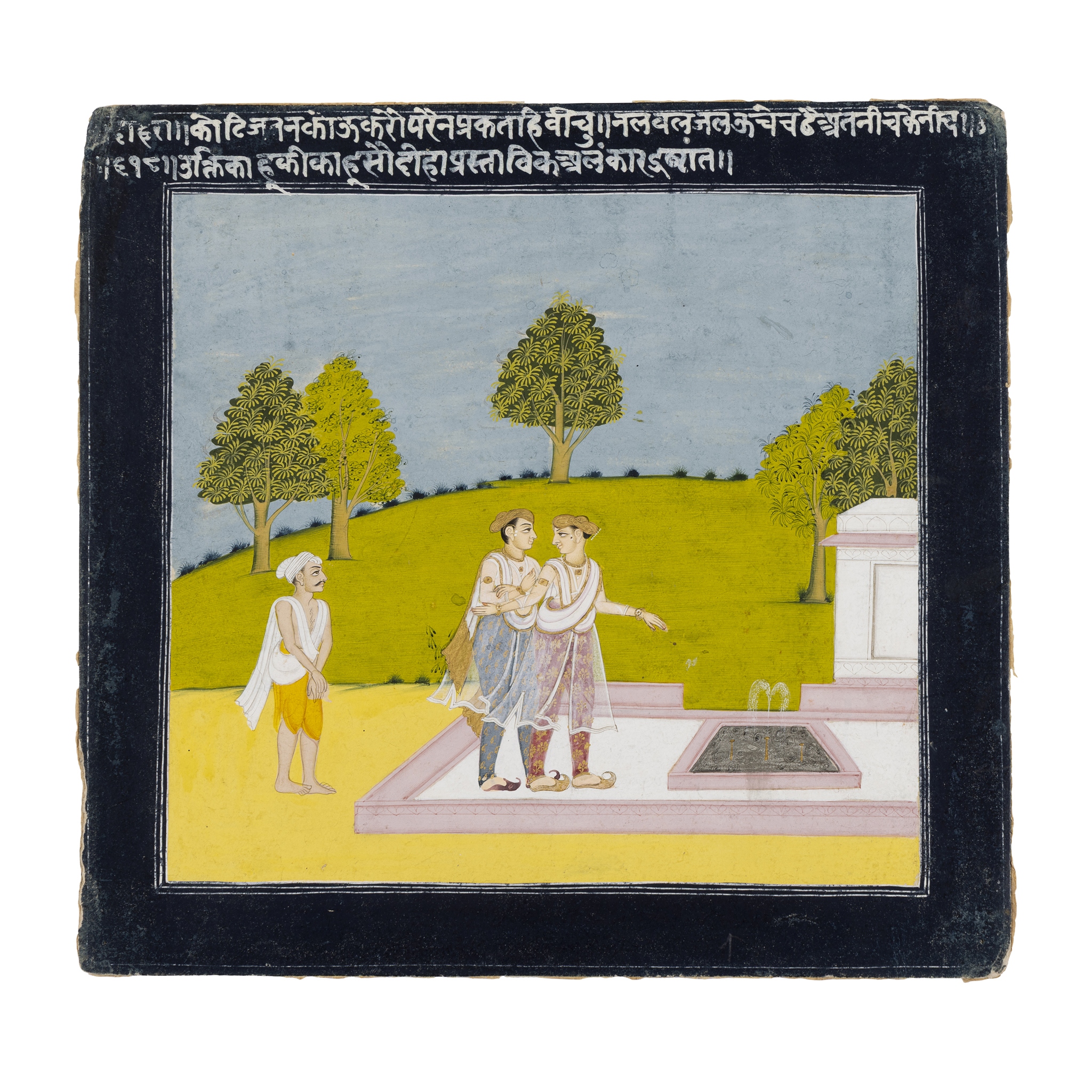
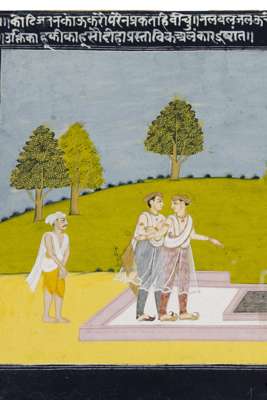
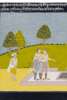
AN ILLUSTRATION TO THE SAT SAI OF BIHARI: MALE FIGURES BY A FOUNTAIN WITH AN ATTENDANT
INDIA, DATIA, CIRCA 1780
Auction: 10 June 2026 from 14:00 BST
Description
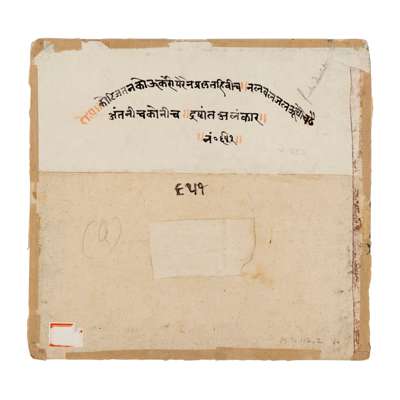
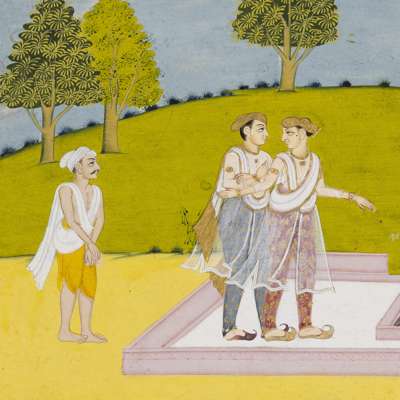
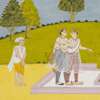
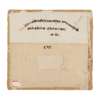
gouache on paper heightened with gold on paper, within a dark blue margin with white margin rules, inscribed with two lines of devanagari script in white, illustrating two noblemen in gold turbans, standing side by side next to a fountain wearing transparent jamas over red, blue and gold pantaloons, an attendant dressed in orange and white robes stands behind them, all set in front of a green hillside with trees and shrubs and blue sky, verso with three lines of red and black devanagari, mounted, glazed and framed
Dimensions
Folio 22.6cm x 23.9cm
Footnote
This refined composition portrays two noblemen strolling in close embrace across the marble terrace of a sandstone fountain, their gazes fixed deeply upon one another. The moment carries a subtle sensuality and a quiet sense of romance. An attendant stands to the left, while in the background, gentle hills stretch into the distance, scattered with trees.
The Sat Sai, or “Seven Hundred” couplets (1662) by Bihari Lal, is a Hindi poetic work that explores the many emotional states of lovers, much like Keshav Das’s Rasikapriya (1581). While some verses celebrate Krishna, others depict anonymous lovers, shifting between the divine and the worldly.
According to Stuart Cary Welch and Milo Cleveland Beach, Datia in Bundelkhand - an eastern region of Central India - was granted as a fief in 1626 to Bhagwan Rao, the son of Birsingh Deo. A Ragamala series from the early eighteenth century may have originated there, while inscribed works from the reign of Rao Indrajit reveal a synthesis of Mughal influences and earlier Central Indian traditions. Portraits of Rao Shatrujit - during whose reign the present painting was most likely produced - are published in N. C. Mehta, Studies in Indian Painting (1928).
For other examples of this Sat Sai series, see Stella Kramrisch, Painted Delight: Indian Paintings from Philadelphia Collections, 1986, pp. 102 and 178, no. 95; Stan Czuma, Indian Art from the George P. Bickford Collection, 1975, no. 75, Stuart Carey Welch and Milo Cleveland Beach, Gods, Thrones and Peacocks, 1965, no. 43. For a painting from a closely related, earlier Sat Sai series, dating to circa 1750, see W. G. Archer and Edwin E. Binney, 3rd, Rajput Miniatures from the collection of Edwin Binney, 3rd, 1968, p. 65, no. 50.