

Lot 34
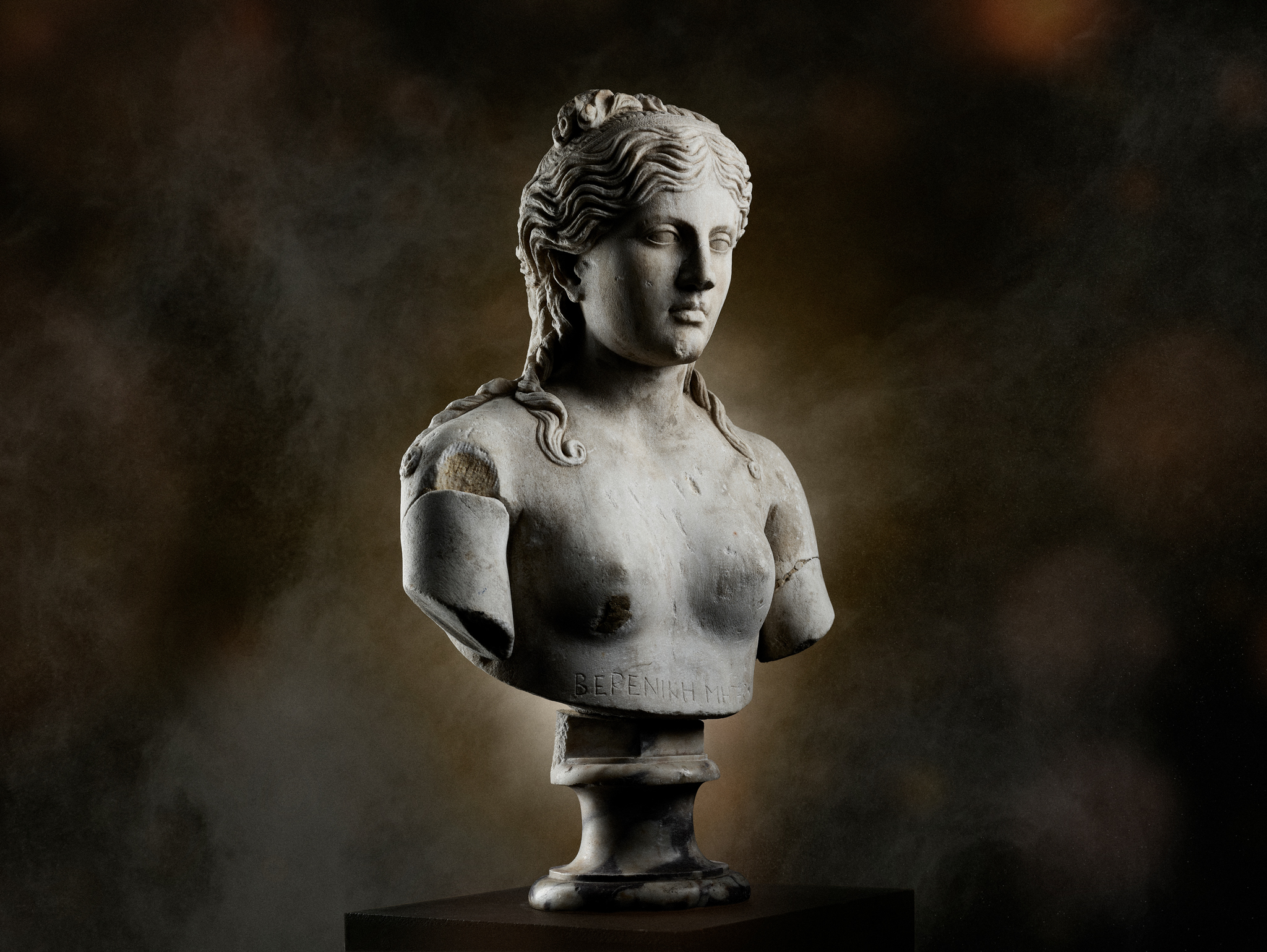
THE WILTON HOUSE APHRODITE
LATE 1ST - EARLY 2ND CENTURY A.D.
Auction: 28 May 2026 from 13:00 BST
Description
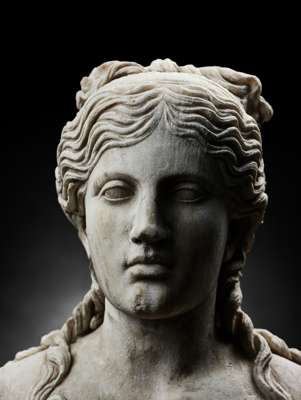
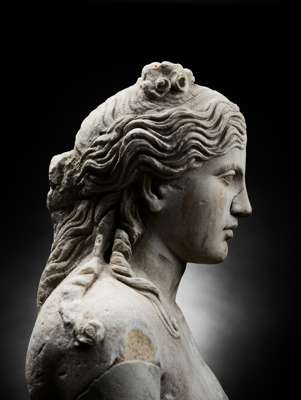
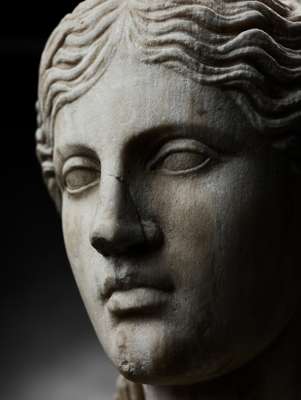
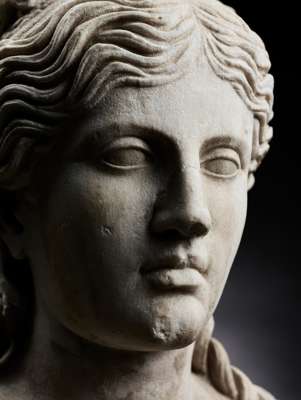
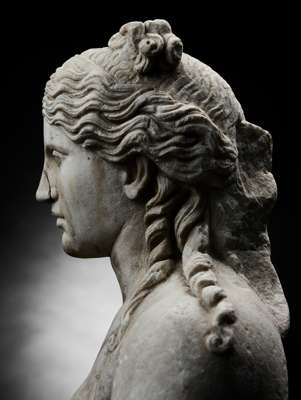
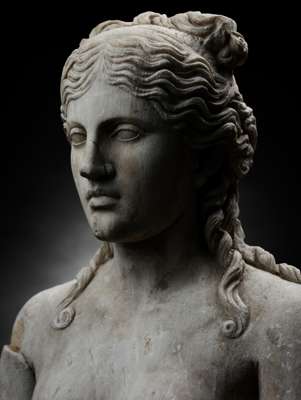
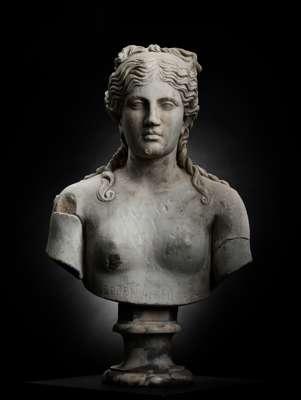
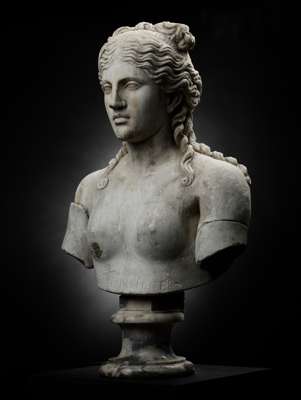
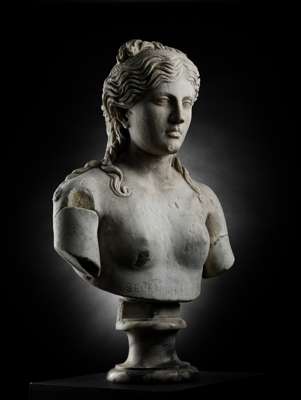
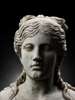
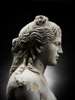
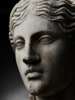
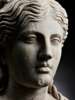
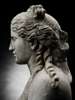
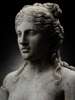
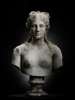
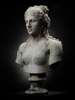
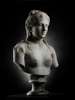
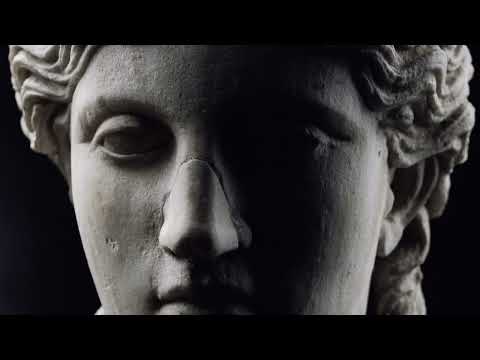
Rediscovered after six decades, the Wilton House Aphrodite boasts over 200 years of unbroken provenance. Dating to the first - early second centuries A.D., the sculpture depicts Aphrodite with a composed, introspective gaze directed straight ahead. The body and head are original to one another, the sculpture having originally formed part of a full-length figure, a rare survival among Roman marble sculpture. The face is softly modelled, with gently arched brows, a straight, well-defined nose, and heavy-lidded eyes that convey a serene, idealised calm. The mouth is small, with subtly articulated lips, lending the features a restrained sensuality characteristic of Roman interpretations of Greek originals. Her hair is carefully arranged and finely carved, parted at the centre and drawn back in undulating waves that frame the face before being gathered behind the head. Loose strands are worked in low relief along the temples, while longer, softly curling locks descend over the shoulders, contrasting with the shorter ringlets articulated at the nape of the neck.
The sculpture is first definitively recorded in the collection of Henry Herbert, 10th Earl of Pembroke, by 1751, when it was published in R. Cowdry’s A Description of the Pictures, Statues, Bustos, Basso Relievos, and Other Curiosities at the Earl of Pembroke’s House at Wilton, where it is described as “Berenice the Mother; her Hair in a particular Manner.”
It is, however, most likely that the bust entered the collection considerably earlier, during the tenure of Thomas Herbert, 8th Earl of Pembroke, a noted antiquarian who was responsible for assembling the greater part of the Wilton antiquities collection. The bust is most probably recorded in the drawings made by William Stukeley in 1724 for his Catalogue of Marbles and Sculpture at Wilton in the Collection of Thomas Herbert, 8th Earl of Pembroke with Drawings. In this manuscript, a closely related sculpture is illustrated which, although inscribed on its base as “Poppaea,” bears an extraordinary similarity to the present bust, notably in the refined treatment and arrangement of the hair. Michaelis (1882) later records a single bust identified as “Poppaea” in the Wilton collection; however, the description he provides does not correspond to the sculpture depicted by Stukeley in 1724. In light of this discrepancy, it seems most plausible that the bust illustrated by Stukeley is in fact the present example, and that the attribution and inscription of “Poppaea” reflect an early misidentification.
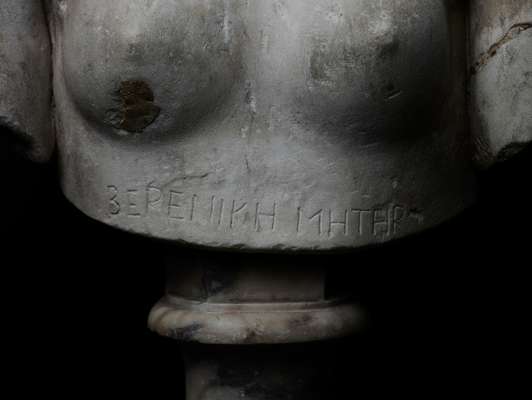
Regardless, further evidence for the bust’s presence at Wilton House during the period of the 8th Earl is provided by the Greek inscription carved on the surface, reading “BEPENIKH MHTHR” (Berenice Mother). This attribution is erroneous, but closely parallels other misidentifications within the Wilton collection at this time. Such inscriptions were added at the direction of the 8th Earl as part of his well-documented practice of reassigning identities to ancient sculptures according to his own interpretations. In discussing these Wilton labels, Peter Stewart has observed that the names were retrospectively imposed and that some inscriptions are so crudely cut that it is plausible the Earl himself undertook the carving, rather than employing a professional stone cutter.
The form of the socle on this example has also been noted by Stewart to resemble those associated with the Mazarin collection, suggesting a possible provenance from that celebrated assemblage. Michaelis, writing in 1882, records that one of the most extensive acquisitions made for Wilton House consisted of a large group of marbles from the Mazarin collection in Paris, acquired in the early decades of the eighteenth century, when the Palais Mazarin was being reorganised for John Law’s financial enterprises.
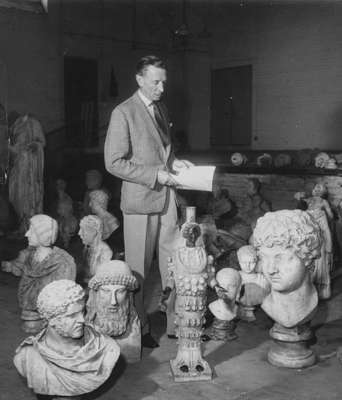
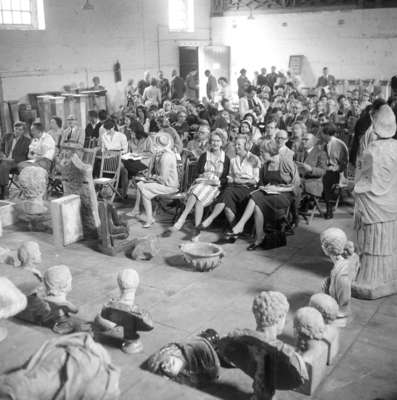
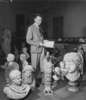
The bust was published on several further occasions during the eighteenth century and remained at Wilton House until its eventual sale at Christie’s in 1961, in the dispersal of a significant portion of the Wilton antiquities. In that sale it appeared alongside a number of important Roman sculptures and was erroneously catalogued as a work of the seventeenth century. It was pictured in a photograph published in The Times in June 1961 prior to the sale, depicting the incumbent (16th) Earl, Sidney Herbert, alongside several notable pieces (it can be seen in the background to the left of Herbert).
Combining refined workmanship with a compelling sense of calm idealisation, the present bust stands as a fine example of Roman portrait sculpture informed by Classical Greek prototypes, and reflects both the aesthetic tastes of the early Imperial period and the rich and complex collecting history of one of Britain’s most important aristocratic collections. Examples from the Wilton House collection have since been dispersed and now occupy places in a number of the world’s most renowned public institutions and distinguished private collections.
Dimensions
46.6cm tall (excl. socle), 60.1cm (inc. socle)
Provenance
Possibly part of the collection of Cardinal Mazarin (1602-1661)
Thomas Herbert, 8th Earl of Pembroke (1656 – 1733), Wilton House, Wiltshire, possibly acquired from the above
Sidney Herbert, 16th Earl of Pembroke (1906 – 1969), Wilton House, Wiltshire, by descent from the above
Sold Christie’s, London, July 3rd 1961, lot 60
Published:
R. Cowdry, A description of the pictures, statues, busto's basso-relievo's, and other curiosities at the Earl of Pembroke's house at Wilton, 1751, p. 48.
Martyn, Thomas, The English connoisseur : containing an account of whatever is curious in painting, sculpture, &c., in the palaces and seats of the nobility and principal gentry of England, both in town and country, volume II, 1766, p. 148.
J. Kennedy, A description of the pictures, statues, bustos, basso-relievos, and other curiosities at the Earl of Pembroke's house at Wilton : in the antiques of this collection are contain'd the whole of Cardinal Richelieu's and Cardinal Mazarine's, and the greatest part of the Earl of Arundel's; besides several particular pieces purchas'd at different times, Salisbury, 1769, p. 49.
Richardson, George. Ædes Pembrochianæ: a new account and description of the statues, bustos, relievos, paintings Medals, and other antiquities and curiosities in Wilton-House. 1788, p. 61.
The Times, London, June 1961