

Lot 529
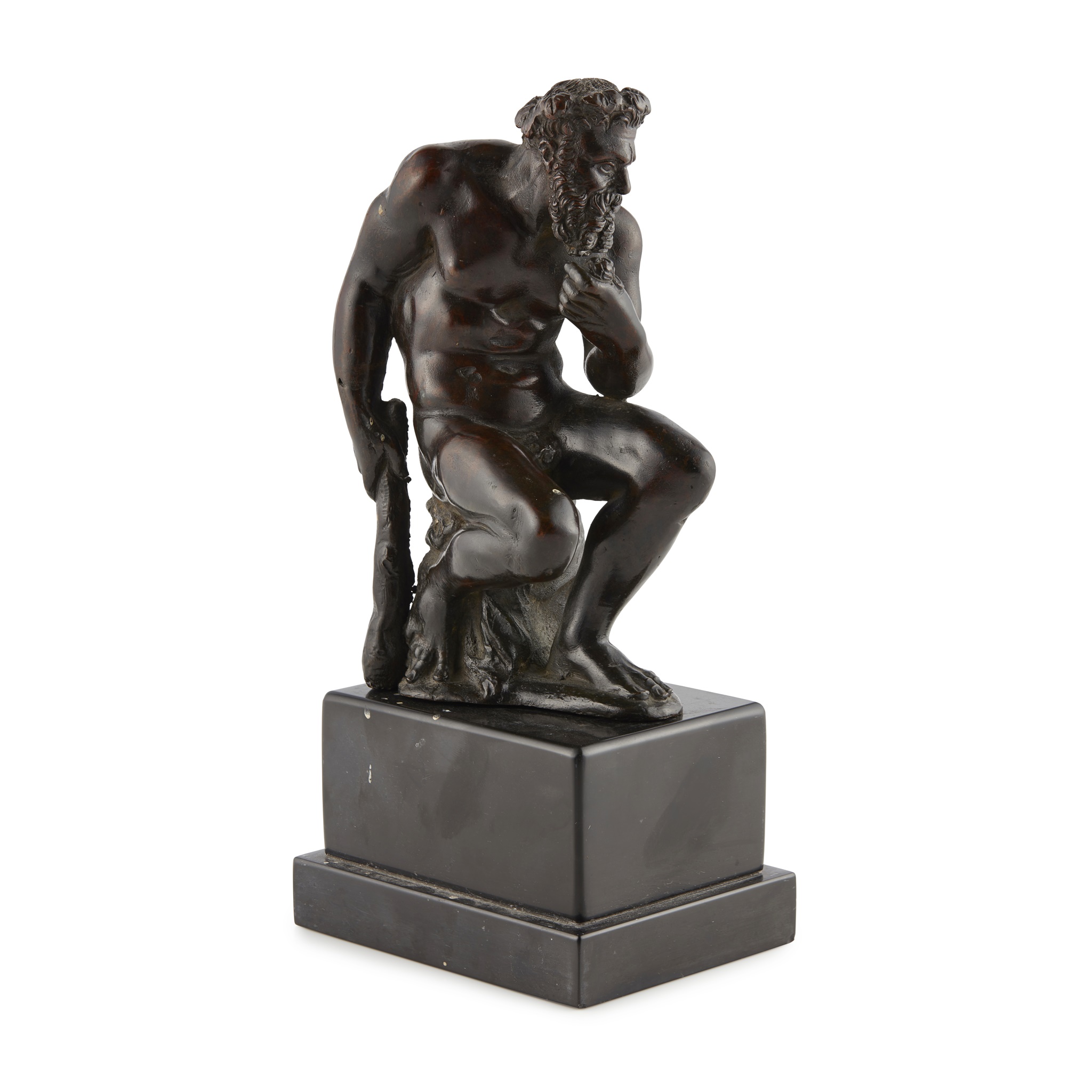
NETHERLANDISH OR GERMAN BRONZE FIGURE OF SEATED HERCULES
17TH/ EARLY 18TH CENTURY
Auction: 20 November 2019 from 10:00 GMT
Description
dark brown patina, raised on a stepped black marble plinth
Dimensions
17cm high, 24cm overall
Footnote
Note: Hercules is shown sitting on a rock covered by the pelt of the Nemean lion, one of his most recognisable attributes. His posture, with the fine and realistic rendering of the lean, muscled body and the powerful curve of the back is reminiscent of a long-standing sculptural tradition that leads the path from the late fourth century Greek sculptor Lysippos to Auguste Rodin’s The Thinker in the 20th century.
While the lion’s pelt and wooden club make it clear that the sculpture is meant to be the Greek hero, the other attributes are more uncommon. The wreath encircling his head is probably made from the leaves of the white poplar tree, which was consecrated to Hercules according to Roman mythology: he destroyed the giant Cacus on Aventine Hill, which was covered in white poplar trees. After his triumph, he wound a branch of the tree around his head as a token of victory. In the Roman Hercules cult, people offering ritual sacrifices to him were always crowned with the leaves of this tree. What he is holding in his left hand is harder to distinguish, but it could be the apples from the garden of the Hesperides, relating to Hercules’ eleventh labour.
Undoubtedly inspired by the Roman marble fragment known as the Belvedere Torso in the collection of the Vatican Museum, this bronze figure of a resting Hercules is just one of countless examples of artworks based on the Roman original. The 1st Century Roman fragment, itself a copy of a lost Greek original of the 3rd or 4th century BC, was praised and studied after its discovery in the 15th century. The torso was so well regarded by Michelangelo that it became known as ‘The School of Michelangelo’. Facsimiles in plaster and print were circulating from the 16th century, with engravings producing a reversed image of the torso, as seen in an engraving by Netherlandish artist Jan de Bisschop (1628-1671), [Fig. 1], from Signorum Veterum Icones. For artists unable to travel to Rome, engravings were crucial for establishing a visual repertoire of classical references. In the present example, the sculptor has incorporated the torso into a study of Hercules, while the original subject is still debated. A compositionally similar bronze of Christ as the Man of Sorrows, attributed to the circle of Adriaen de Vries (1556-1629), on Loan to the Fitzwilliam Museum, utilises the same twisted torso as the present lot and is indicative of the 17th century Netherlandish school of sculpture. A bronze of the same subject sold Bonham's, London, 15 April 2008, lot 27.