

Lot 425
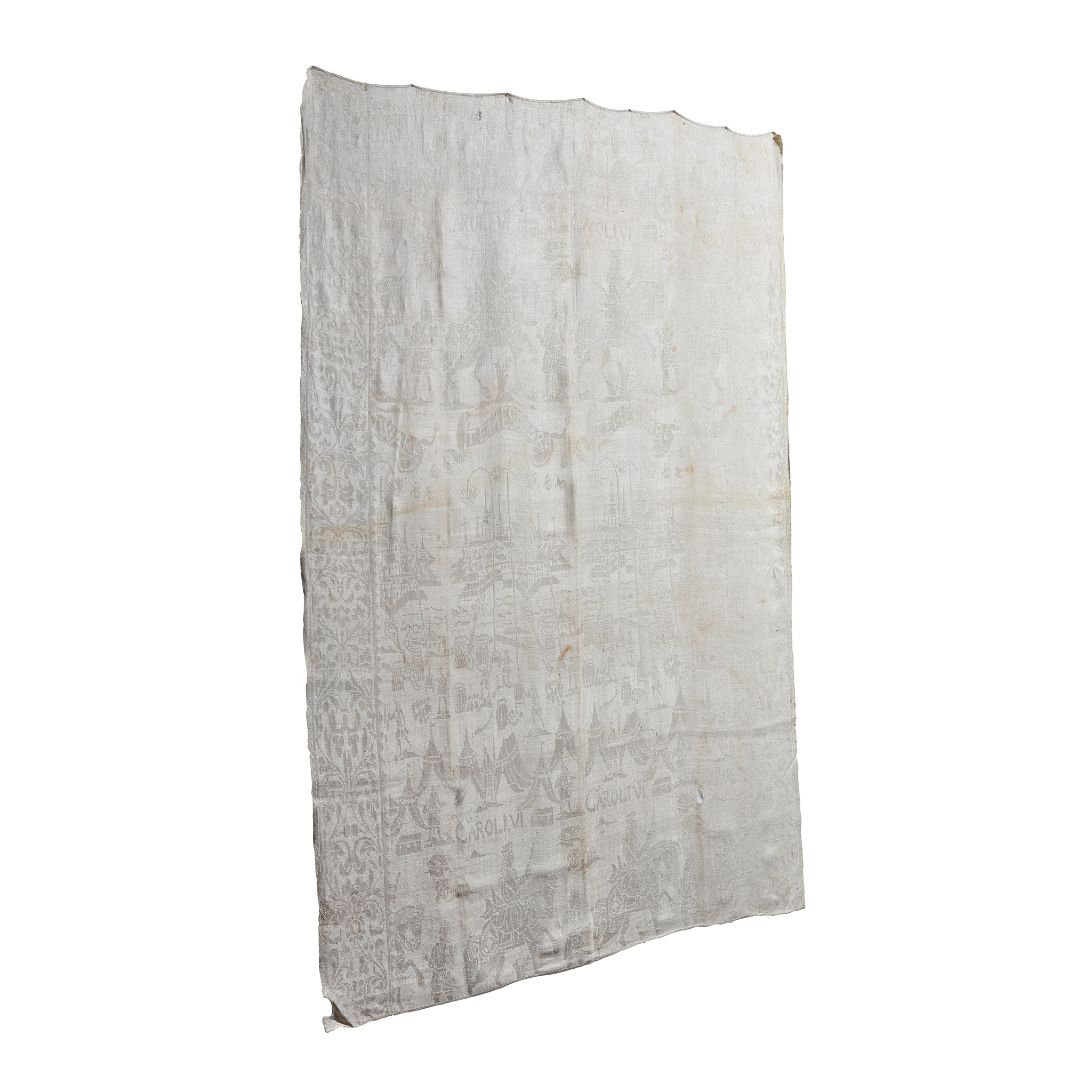
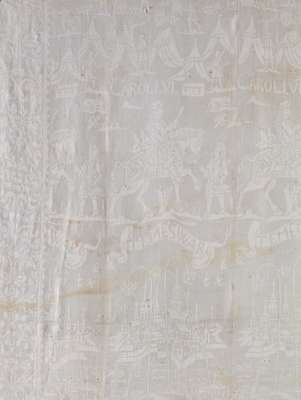
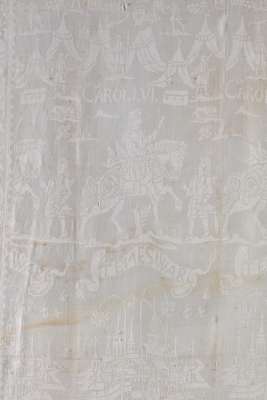
FINE LINEN DAMASK NAPKIN, HOLY ROMAN EMPIRE
EARLY 18TH CENTURY




Auction: Five Centuries Day Two | Thurs 14th May | Lots 298 to 596
Description
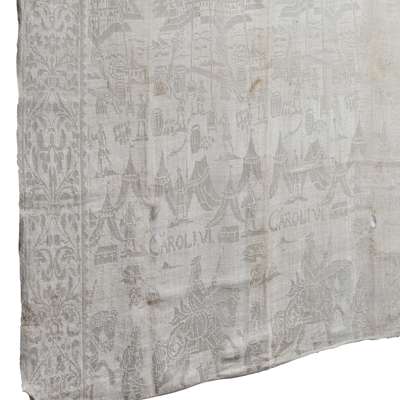
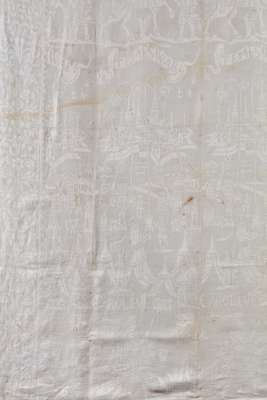
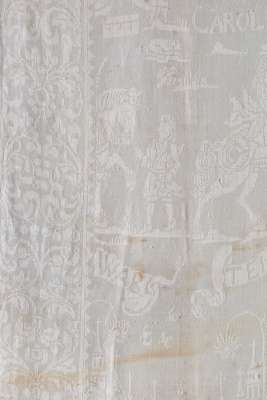
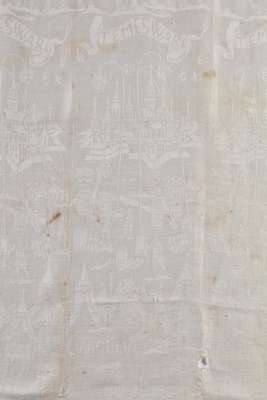
likely Low Countries, Austro-Hungary or Bohemia, depicting the Holy Roman Emperor, Charles VI, at the Siege of Temesvar (1716), woven with a repeating design of the Emperor on horseback with a scene the besieged city and a field of tents and attendants below, framed with banners ‘Temeswar’ and ‘ Caroli. VI.’, the sides with a wide border of foliate arabesques and a chequered outer selvedge edge, the top and bottom edges hemmed by hand to top and bottom edges with very fine stitching, one corner with a small yellow stitched initial ‘S’ with five cross stiches below
Dimensions
105cm long, 85cm wide
Footnote
For a linen damask tablecloth of very similar design and period, depicting Prince Eugene at the Siege of Belgrade (1717), see V&A, London, Accession Number 368-1890
In the early sixteenth century damask table linen, with its elaborate reversible patterns, had been reserved for the church and the upper echelons of society, including royalty, the nobility and the very rich. As the century progressed, however, the textile industry grew, with linen weaving centres flourishing in Flanders in the Southern Netherlands and Haarlem in Holland. As a result, the use of table linen by merchants, tradesmen, and others of the middle and upper classes grew, so that by 1600 most of these households had at least one complete set of table linen, comprising one or more tablecloths, and a number of napkins. Household inventories of the time, often listing more napkins and tablecloths than sheets and pillowcases, show the importance of table linen in households. Such items were accumulated by families over many years and passed down the generations.