

Lot 44
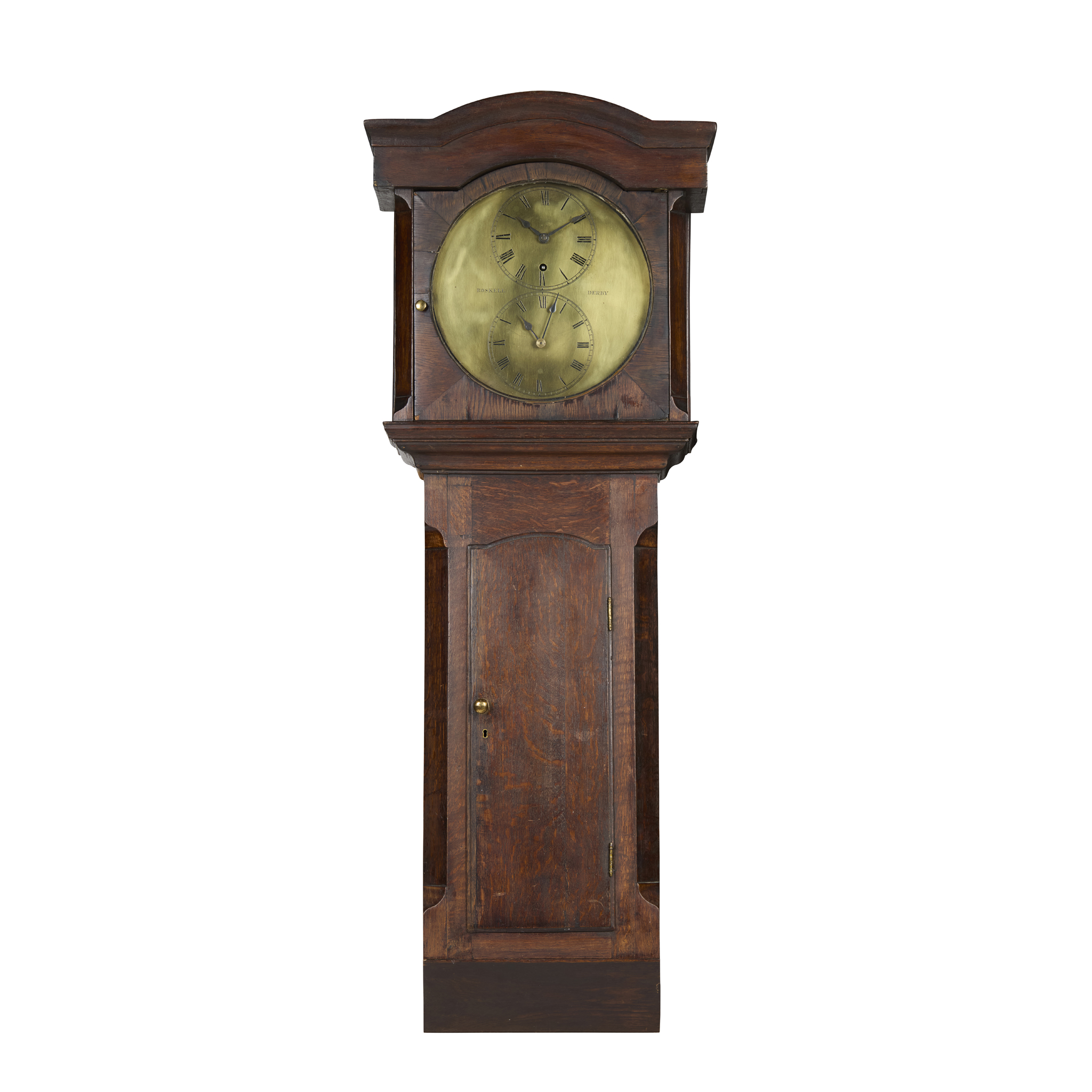
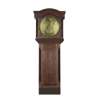
VERY RARE EARLY VICTORIAN DOUBLE DIAL 'MILL' WALL CLOCK, BY ROSKELL, DERBY
CIRCA 1855-1862
Auction: Day One | Wed 12th November 2025 at 10am | Lots 1 to 338
Description
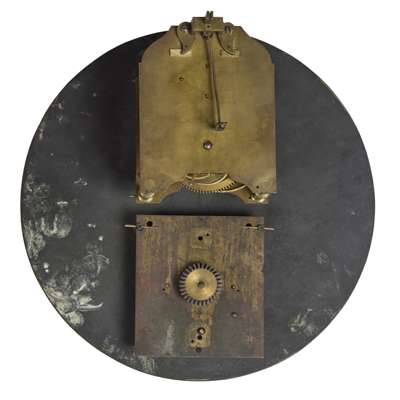
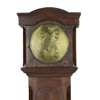
the 13 inch circular brass double dials both with Roman numerals, engraved ROSKELL/ DERBY, the dark stained oak case with arched moulded pediment, the dial flanked by canted angles, the short trunk with a moulded arched door and also flanked by canted angles, the upper dial with a single train timepiece movement, the lower dial operated by revolving gearing from the backplate
Dimensions
139cm high, 52cm wide
Footnote
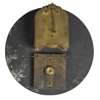
This double dialled clock was made specifically for the purpose of recording the operational running time of mill machinery. The rear of the lower movement has a backplate which would have been connected (via take-off work geared to revolve once a minute) to the mechanism of the mill. The dial would then index the hours that the machinery would have been running throughout that day. The upper dial is for actual mean solar time driven by a separate single train and pendulum. Theoretically if the mill had been running at optimum capacity at all times the indicated time for that day would have been correct, and both the upper 'time' and lower 'mill' dials would be synchronised at the end of the working day. Naturally, in practice, there will have been times when the machinery would have been inoperative (or running slow), hence by the end of the day the 'mill time' would have been lagging behind. By recording the difference between the two the amount of 'running time' lost would have been obtained. Generally, it appears that very few 'mill clocks' seem to have survived although John Robey mentions a complete example by Whitehurst made for Green's Mill, Derby, as well as two other similar incomplete examples. Unfortunately, it is not known for whom/which mill the current lot was made, however when first put to use it was probably deemed an invaluable tool bearing in mind the high degree of competition that would have existed between the numerous potteries and mills operating in and around Derbyshire and Staffordshire at the middle of the 19th century.
John Whitehurst FRS founded his Derby firm in 1737 and on his death in 1788 the business passed to his nephew John Whitehurst II (1761-1834) who in 1809 took into partnership his own son, John Whitehurst III, trading as John Whitehurst & Son until 1834. John Whitehurst III continued the firm until his own death in 1855 after which it was run by Roskell of Liverpool until closed in 1862.
The present mill clock has been suggested to have been made for the mill at New Lanark. Robert Owen, the Welsh utopian socialist and philanthropist that was in partnered ownership of New Lanark, was on friendly terms with William Strutt FRS and around 1820 stayed him and his extended family at his Derby town house, St. Helen's. It is mentioned in one of Strutt's daughters' letters, describing the visit and how, although like-minded radicals, the Strutts were a family that liked to enjoy themselves socially (Thomas Moore (1779-1852), Irish writer and poet, also entertained them at about this time) but they found their weekend entertaining Owen notably tiresome and ennui settled in quickly.
The Strutts were customers of the Whitehurst firm, situated only a few hundred yards from St. Helens and there are examples of, or references to, various types of mill clocks by the 2nd & 3rd Whitehursts, and it is possible that New Lanark was provided with one or two then, and may, after Owen's departure, have ordered others from the firm later. It is notable that the case of the present clock is consistent with clocks the Whitehurst firm were producing 40 years earlier, with little effort to conform to the latest fashions of the late 1850s. Possibly because it was made similarly to a clock that was previously ordered or acquired for New Lanark.
We are grateful to Dr Maxwell Craven FSA, for his assistance in the provenance attribution of this lot. Author of ‘John Whitehurst of Derby: Clockmaker and Scientist, 1713-88’ Mayfield Books, 1996, and ‘John Whitehurst: Innovator, Scientist, Geologist and Clockmaker’, Fonthill Media Ltd, Stroud, 2015