

Lot 294
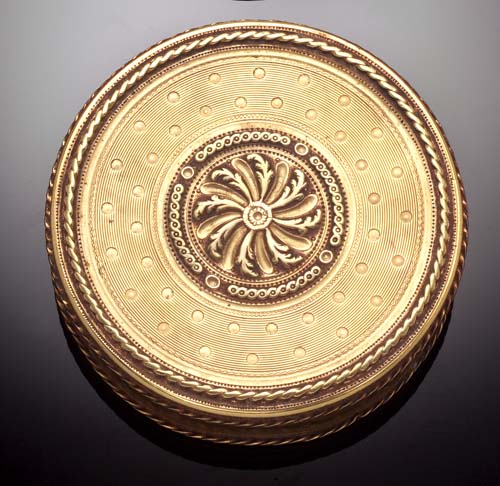
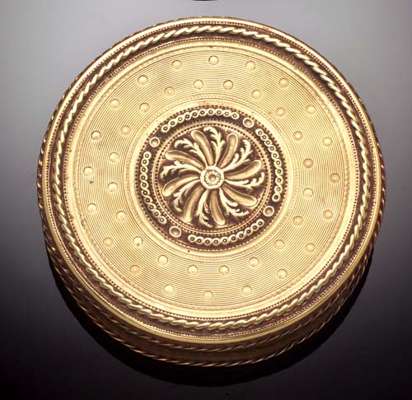
92nd Regiment - A French early 19th century gold snuff box,
Auction: 8 December 2004 at 12:00 GMT
Description
of circular form, with engraved and applied decoration, the interior of the lid inscribed "To Capt Ross 92nd Reg from Chas Grant of Jamaica"
Dimensions
72mm diameter, 19mm high, 4oz
Footnote
No record is easily available of the date of birth of James Kerr (or Ker) Ross. He was commissioned ensign in the 92nd (or Highland) Regiment of Foot on 19th March 1807. The dates given for his promotion to lieutenant vary but he had seniority in that rank from either 4th May 1808 or 21st July 1808; he remained in the rank of lieutenant in the 92nd for the next ten years, being commissioned captain in the 92nd on 22nd October 1818.
He transferred to the half-pay of the 7th Regiment of Foot (or Royal Fusiliers) on 9th December 1819 and to that of the 42nd Regiment of Foot (or Royal Highlanders, the Black Watch) sometime in 1820. He transferred from half-pay in the 42nd to full pay in the rank of captain on 31st May 1821 and remained with the 42nd until transferring to the unattached list as a half-pay captain on 27th December 1827.
Ross remained on the half-pay list until his death in 1872, being steadily promoted by brevet as follows: major, 7th June 1831; lieutenant-colonel, 9th November 1846; colonel, 20th June 1854; major general, 1st May 1861; lieutenant-general 19th November 1870. He was appointed a Knight of the Royal Hanoverian Guelphic Order (KH) in 1837. His death was reported in The Times on 11th June 1872.
Ross saw action in the Peninsular War between 1811 and 1814, serving at the engagements at Arroyo dos Molinos; Badajos; Almaraz; Madrid; Vittoria; Pass of Maya; Valley of Bastan; Aire; Pyrenees (wounded); Nivelle; Nive; Heights of La Costa; Orthes; Toulouse. He received the Military General Service Medal 1793-1814 with the six clasps Vittoria, Pyrenees, Nivelle, Nive, Orthes and Toulouse as well as the Portuguese war cross for six engagements. In 1815, he was present at the battles of Quatre Bras (wounded) and at Waterloo (wounded) and received the Waterloo Medal 1815. His medals were sold by Bearnes & Waycott, Torquay, in 1975.
It is probable that Ross went with the 92nd when the regiment was posted to Jamaica in April 1819. Initially stationed at Up Park Camp in the parish of St Andrew, Jamaica, the regiment suffered very severely indeed from yellow fever between its arrival in Jamaica in June 1819 and the ending of the epidemic in November of that year, losing 10 officers and 275 other ranks to the disease. It may have been as a result of this epidemic that Ross returned home to transfer temporarily to the half-pay list late in 1819.
A Charles Grant of the parish of St Andrew in Jamaica has been identified and so it is probable that it was he who gave the gold box to Ross in 1819. He may have been the Charles Grant who had served as an officer in the 6th West India Regiment between 1807 and 1816 but who was, in 1819, on half-pay
Further research would be required to establish the reason for the gift of the box, to confirm the identity of Charles Grant and to embellish the above details of the life and career of Lieutenant-General James Kerr Ross. It may, though, be worthy of note that, as a result of the number of vacancies caused by the deaths of officers in the 92nd through yellow fever in 1819, Sergeant-Major William Grant of the regiment was commissioned ensign and appointed adjutant in November 1819. If Charles Grant and William Grant were related, then the gift of the gold box might have been in recognition of some influence that Ross exerted in getting William Grant (who had served in the 92nd since 1800) commissioned.
Stephen Wood MA FSA.