

Lot 131
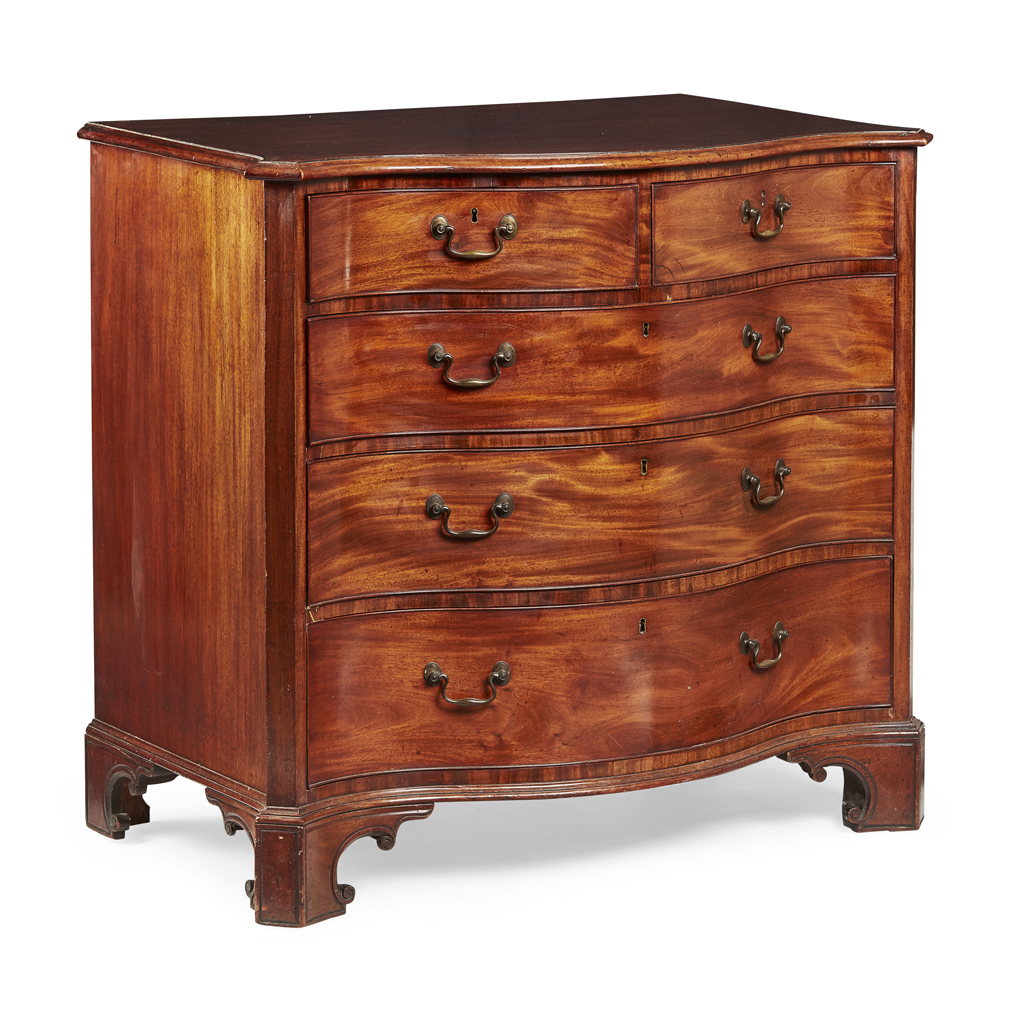
FINE SCOTTISH GEORGE III MAHOGANY SERPENTINE CHEST OF DRAWERS, ATTRIBUTED TO THE WORKSHOP OF FRANCES AND WILLIAM BRODIE
18TH CENTURY
Auction: 20 April 2016 at 11:00 BST
Description
the serpentine top with a moulded edge above two short and three long graduated drawers, raised on scroll carved bracket feet
Dimensions
103cm wide, 94cm high, 58cm deep
Footnote
Note: The 18th century Scottish father and son cabinet makers Francis and William Brodie specialised in domestic furniture including cabinets, chests of drawers, and mirrors. Francis was regarded in his time as Edinburgh's leading cabinet maker. Accounts show that he may have been in partnership with his son from 1764, and they are recorded working together as Brodie & Son in the Edinburgh Street Directory, 1773-74. Both father and son held the title of Deacon of the Incorporation of Wrights, and William acted as a member of the town council.
William Brodie is now remembered mainly for having led a double life. Despite inheriting the business from his father in 1782, in addition to a sum of £10,000, Brodie ran up great debts through two mistresses, numerous children and a gambling habit. Taking advantage of his respected position as craftsman and locksmith, he would make impressions of clients' keys and return to burgle them. In 1788, along with three other men, Brodie attempted his most audacious robbery:, to steal the revenues of Scotland from the excise office in Edinburgh. Two of his associates who were caught and tempted with a reward for information, named Brodie as the mastermind. He was eventually caught in Holland where he had fled. A lantern and 25 lock picks were used in evidence against him, some of which were found hidden on Salisbury Crags on Arthur's Seat. As a result, Brodie was hanged at the Old Tolbooth on Edinburgh's High Street before a crowd of 40,000 people. William Brodie's scandalous life and death is said to be the inspiration for Robert Louis Stevenson's Dr. Jekyll and Mr. Hyde.
There are few pieces of furniture attributed solely to William Brodie, with most pieces attributed to Francis, or to the partnership of Brodie & Son. A mahogany clothes press, part of the collection at the National Museum of Scotland, bears similarities to the distinctive carvings on the bracket feet to the present lot. Previously attributed to William based on an inscription inside the drawer, current scholarship points to Francis Brodie as the probable maker.