

Lot 176
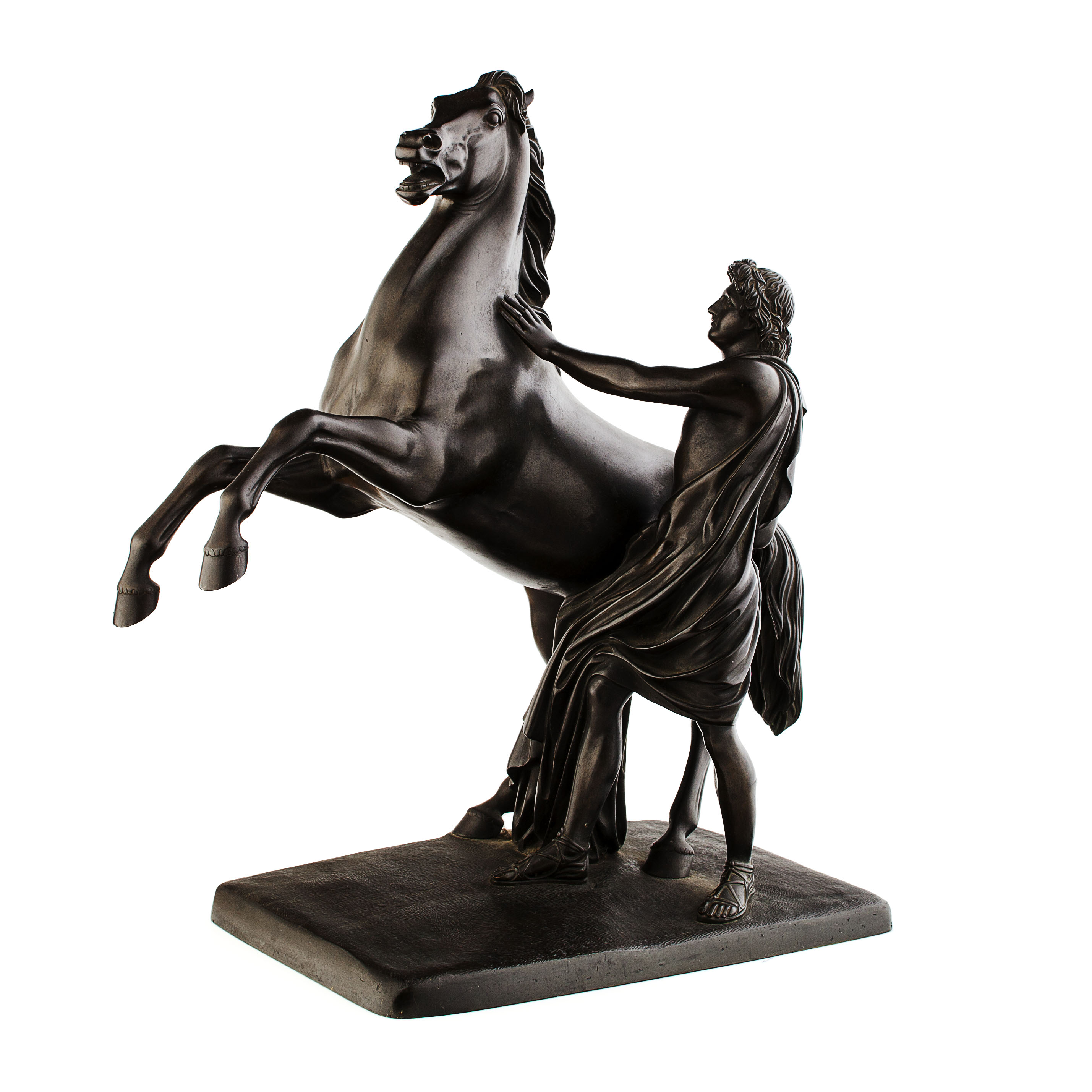
SIR JOHN STEELL, RSA (SCOTTISH, 1804-1891)
ALEXANDER TRAINING BUCEPHALUS, 19TH CENTURY
Auction: 14 January 2015 at 11:00 GMT
Description
bronze, inscribed JN. STEELL SCULPT EDINBR. 1833
Dimensions
51cm high
Footnote
Note:
The son of an Edinburgh sculptor, Sir John Robert Steell (1804-1891) worked at the top of his profession, creating sculptures destined to be landmarks of his native city. A member of the Royal Scottish Academy and appointed sculptor to Queen Victoria, there is little Steell failed to achieve in his career. His statue of Sir Walter Scott for the Scott Monument on Prince's Street, was the first marble statue ever commissioned in Scotland from a native artist.
Beginning in his father's shop age fourteen, he went on to study at the Edinburgh Life Academy and soon began independent sculptural projects. After travelling to study in Rome in 1829 he was overwhelmed with commissions on his return, mainly from wealthy residents requiring busts. Having established his reputation, he began work on one of his finest and most famous sculpture, Alexander Taming Bucephalus. Commissioned by the North British Fire and Insurance Company, the piece was first carved in wood and displayed in London. This brought him the attention of not only a wider public but also influential patrons, and though he received numerous requests to stay in London, he was resolute about returning to Edinburgh. He was conscious of his responsibility to develop Scotland's artistic character and his foundry was the first in Scotland to introduce artistic casting.
The sculpture's subject is taken from one of the early defining moments in Alexander the Great's life. The legend tells of how an untamable horse was presented to King Phillip, Alexander's father. After the king refused the beast, a twelve year old Alexander claimed that he could tame the horse. He took the reins and spoke softly to it, turning him to face the sun as he realized Buchephalus was afraid of his own shadow.
Through a lack of finances the statue's journey from inception to realization would take over fifty years and Steel would only live for eight years after the large version was finally cast in 1883. The huge bronze was presented to the city of Edinburgh in 1884 and originally resided in St. Andrew Square until it was moved to the City Chambers in 1916. This reduction would have been cast as part of a group in Steell's workshop, probably in 1833.