

Lot 473
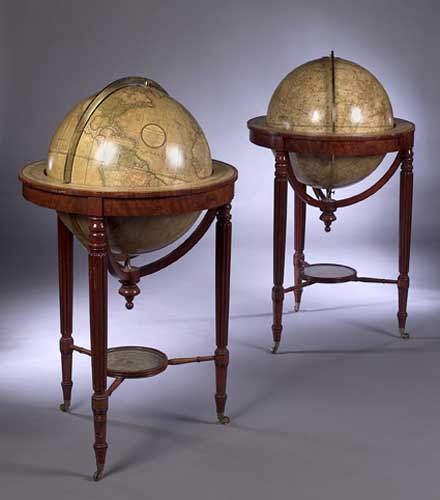
A pair of early 19th century 21inch terrestrial and celestial library globes, by J&W Cary, London
Auction: 26 March 2003 at 11:00 GMT
Description
each mounted on mahogany stand comprising triform cradle support with turned pendant, plain frieze and three ring turned and reeded tapering legs terminating in brass caps and castors, joined by compass stretchers, the globes encircled by engraved brass meridian rings and surmounted by hour discs; the terrestrial globe inscribed "Cary's NEW TERRESTRIAL GLOBE, EXHIBITING The Tracks and Discoveries made by CAPTAIN COOK; Also those of CAPTAIN VANCOUVER on the NORTH WEST COAST OF AMERICA; And M. DE LA PEROUSE, on the COAST OF TARTARY, TOGETHER with every other Improvement collected from Various Navigators to the present time. LONDON: Made & Sold by J & W. Cary Strand March 1, 1815 WITH ADDITIONS AND CORRECTIONS TO 1823"; the celestial globe inscribed "CARY'S New and Improved CELESTIAL GLOBE, ON WHICH Is carefully laid down the whole of the STARS AND NEBULAE, . . . LONDON Made & Sold by J & W. Cary No. 181 Strand Mar. 1, 1799"
overall diameter 72cm, height 120cm
Footnote
Provenance: Acquired for Sheffield Park, Sussex, in the 1960s.
John Cary, a map publisher, and his brother William, an instrument maker, founded the firm of J&W Cary in the late 18th century. They produced their first globes in 1791 and by the end of the century had established themselves as one of London's most eminent and successful globe manufacturers. The firm was continued well into the 19th century by John Cary's two sons, John Jnr and George, who maintained its reputation for excellence.
The celestial globe has a longer history than the terrestrial globe. Greek and Roman authors mention the existence of celestial globes and Archimedes is recorded as having used one in the third century BC. The first terrestrial globe, on the other hand, was produced around 150 BC.
In the 15th century Nuremberg became the first major centre of globe production in modern Europe, the earliest known celestial globe dating from 1444, and the earliest surviving terrestrial globe dating from 1492. This globe depicted the known world and was produced just before Columbus's voyage to the New World.
Globe-making subsequently flourished in the Netherlands in the sixteenth century but by the end of the eighteenth century British cartographers and globe-makers were the most prominent, reflecting Britain's naval dominance at that time. They were essential items for an educated gentleman's library of the late Georgian period.
Various Cary globes are illustrated in Elly Dekker and Peter van der Krogt Globes from the Western World Zwemmer London 1993.