

Lot 289
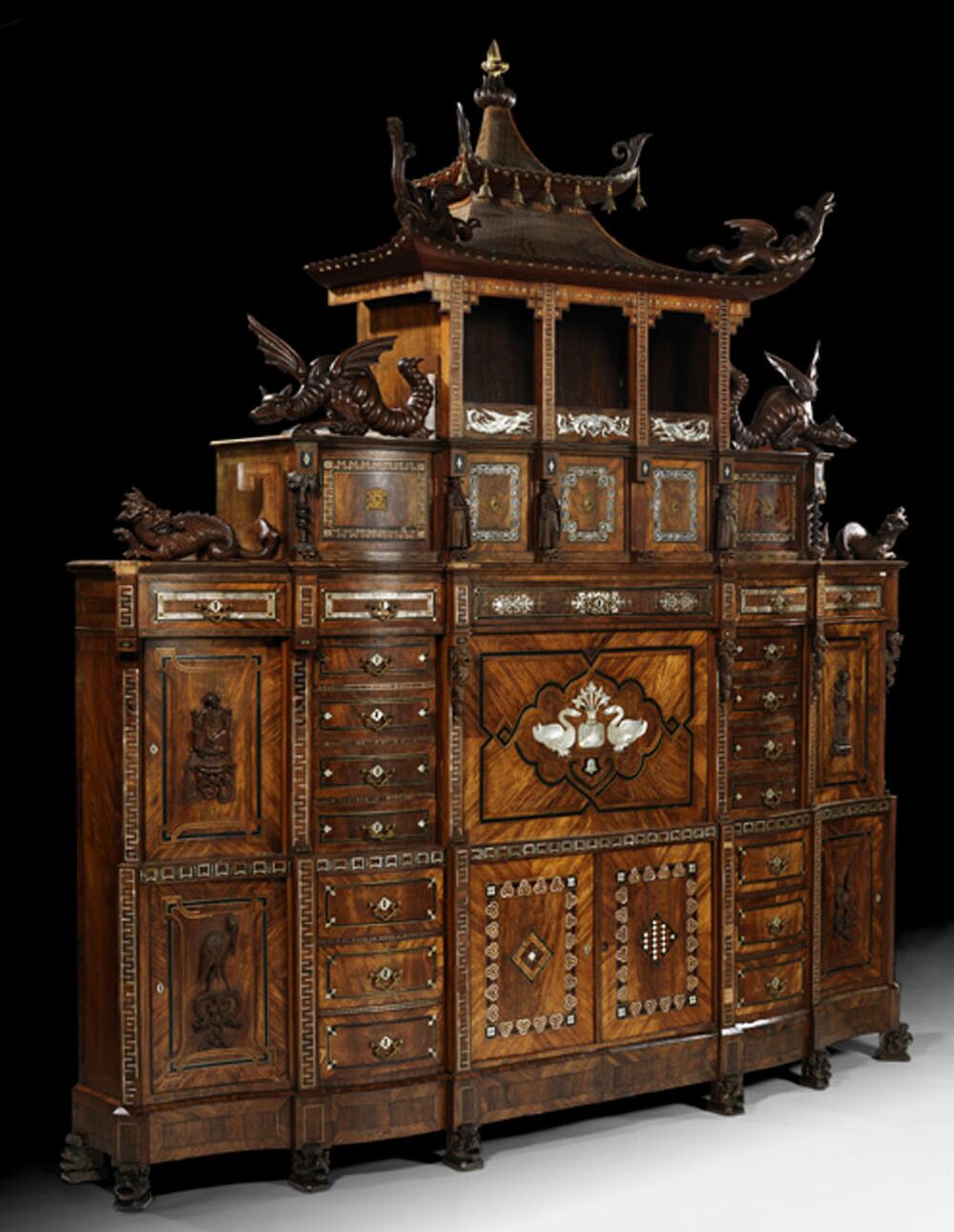
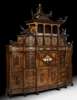
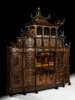
A important kingwood, padouk, mahogany and rosewood writing cabinet, circa 1880 Attributed to Gabriel Viardot (1830-1906)
Auction: 24 September 2008 at 12:00 BST
Description
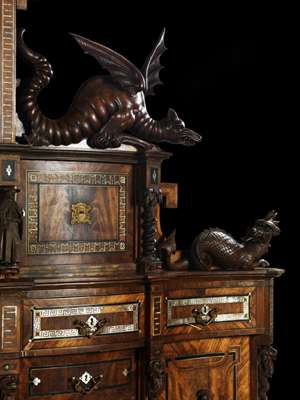
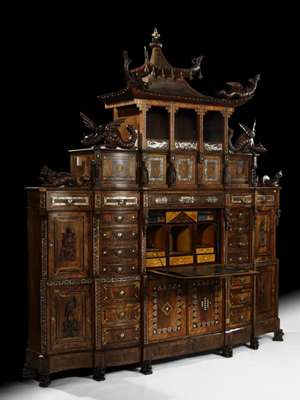
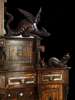
in the Japanese taste, inlaid and banded with mother of pearl, ebony and strung in brass, the pagoda roof hung with bells and with stylised marlins to the corners, above three recesses with mother of pearl inlaid draweres flanked by crouching winged dragons looking down on younger dragons, above three cupboard doors divided by figures of Oriental men and flanked by larger outer cupboards, the central lower section with a drawer and fall front with entwined banding and central mother of pearl birds and flowering vase above a bell dated '1860', above a pair of cupboard doors enclosing sliding trays, the fall front revealing a central mirror panel of recess with chequer floor and sliding out to reveal twelve drawers, flanked by apertures and six burrwood drawers, the lower side sections comprising a cupboard door modelled as four dummy drawers above three drawers with two outer cupboard cupboard doors with applied carved birds and seated figures, the whole raised on a plinth base with grotesque mask feet
Dimensions
275cm wide, 297cm high, 48cm deep
Footnote
Gabriel Viardot is largely remembered for his particular version of Asian style furniture, and was advertised as créateur des meubles dans le genre chinois et japonais. He exhibited widely, including at Crystal Palace in 1851, and was both participant and jury member for the 1867, 1878 and 1889 International Exhibitions in Paris. His major success was at the 1889 Parise Exposition Universelle where the firm was awarded a gold medal.
The cabinet is typical of pieces by Gabriel Viardot. Beginning his career as a wood carver, he took over the family firm from his father Charles in 1861. By 1870 he specialized in exotic furniture influenced by Chinese and Vietnamese styles, Vietnam being one of France's most important colonies. In 1860, he was located at 5, rue du Grand-Chantier, later moving to several locations including 36, rue Rambuteau where objects d'art et de fantaisie were sold and finally to 36, rue Amelot where he stayed until the end of the century. Around 1885 he employed about 100 men.