

Lot 533
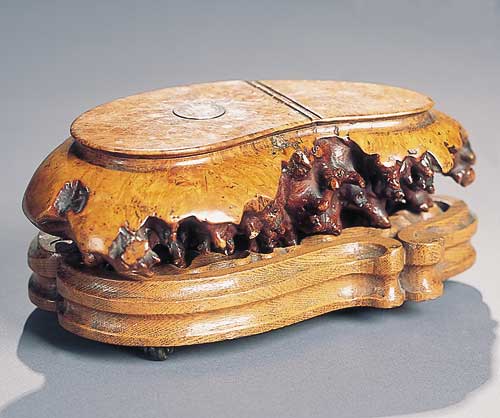
A Scottish 19th century burr elm snuff mull
Fine Antique Sale Featuring Arms and Armour
Auction: 8 December 2001 at 11:00 GMT
Description
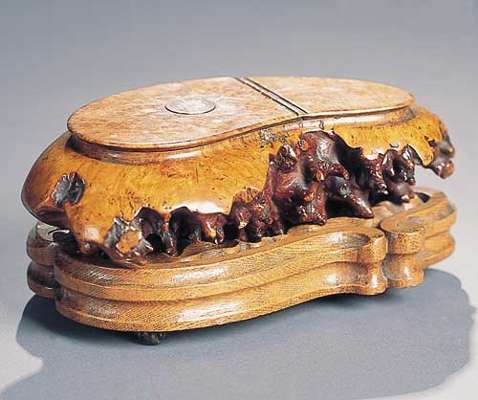
one from a Collection of Scottish Burrwood Snuff Boxes, stamped Geo. Sinclair, Bonnington, of shaped kidney form, the hinged split lid bearing silver plaque inscribed 'Col. Robert Ross to George Ross of Pitcalnie 1835', 23cm long; together with an elm coaster of reciprocal auricular form within C and S scroll border, on brass and leather castors (2)
22cm long
Sold for £3,200
Footnote
"To such a height with some is fashion grown
They feed their very nostrils with a spoon"
18th century satirical verse
"As snuff taking is merely an idle dirty habit, practised by stupid people in the endeavour to clear their stolid intellect,and is not a custom particularly offensive to their neighbours, it may be left to each individual taste as to whether it be continued or not"
Tips on Etiquette 1854
The practise of taking snuff taking was well established in Scotland by the early 17th century and continued well into the Victorian era, although as the quotation above makes clear it was falling out of fashion. Scottish snuff was however reknowned as being particularly pure and the habit continued longer here, as is illustrated by this magnificent collection or burr and root wood boxes.
Edward Pinto, great authority on treen, advanced the opinion that "burrs are notoriously difficult to identify", but these all seem to be formed from trees commonly found in Scotland, particularly elm, which produces very good burrs. Several of the boxes are stamped 'George Sinclair, Bonnington', a recorded maker who worked in Angus so can be associated with the Stiven's of Laurencekirk.
Bibliography
Edward H Pinto Treen and other Wooden Bygones London 1969
Edward H Pinto and Eva R Pinto Tunbridge and Scottish Souvenir Woodware London 1970
Brian Cole Boxes; Collecting for Tomorrow London 1976