

Lot 421
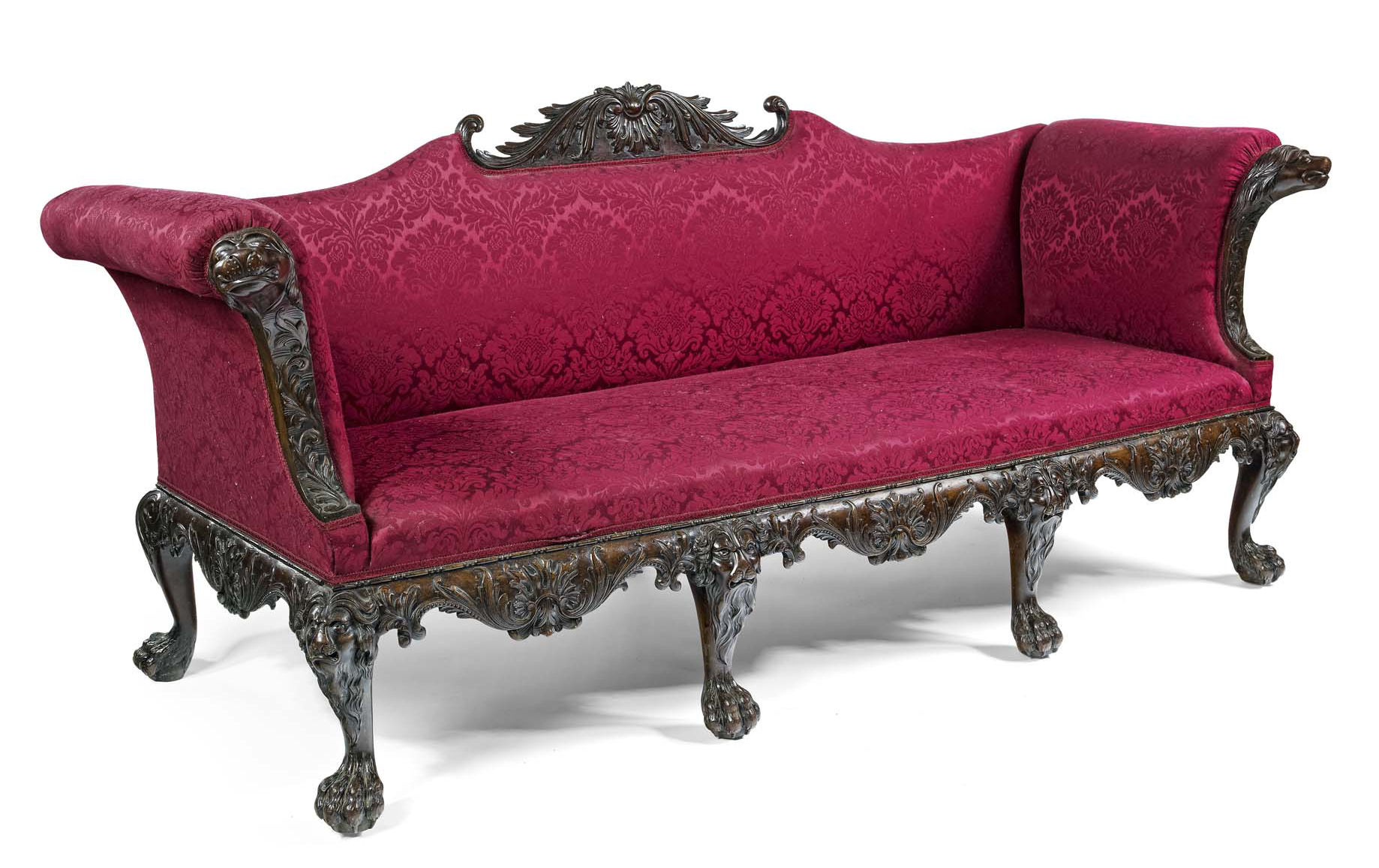
FINE CARVED MAHOGANY SETTEE
IN THE GEORGE II MANNER
Fine & Decorative Furniture and Art
Auction: 30 September 2009 at 12:00 BST
Description
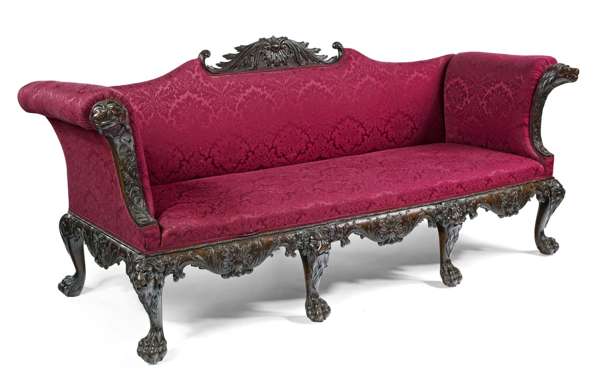
the shaped back centred by an acanthus and shell carved cresting, with out scrolling arms with dog's mask facing, above a stuffed over seat, raised on lion's mask carved cabriole legs ending in hairy paw feet and united by an acanthus carved wavy apron
Dimensions
216cm wide
Footnote
This settee is also near identical design to the celebrated suite now divided amongst some of the world's finest public and private collections. The suite's provenance prior to the 20th century has yet to be established but Symonds states that Moss Harris acquired a set of twelve chairs soon after the First World War which he proceeded to sell singly and in pairs. Harris certainly illustrates one in his book 'The English Chair'. However, in 1906 Macquoid illustrated a single chair as the property of Messrs Isaacs, who later became Moss Harris, so the firm obviously had an interest earlier than this. He also illustrates a sofa (colour Pl. XXXIV) from the same suite as the property of Frank Partridge; this is the only recorded appearance of the sofa.
A pair of armchairs were sold at Sotheby's in 1962 (March 30, lot 159) which included one from the collection of HH Mulliner (sold Christie's July 10, 1934 lot 92, also illustrated in Brackett p.229.); and two further pairs from the collection of HJ Joel were sold at the Childwick Bury house sale in 1978 (Christie's May 1, lots 76 and 77). In terms of published examples whose whereabouts are known, the Philadelphia Museum of Art has a single chair (Acc. No. 47-20-3) which was acquired from the collection of Francis P Garvan in 1929, and there is a pair in the Jon Gerstenfeld Collection which were acquired through Hotspur Ltd and may be one of the above mentioned pairs.
There is also a pair of chairs in the Metropolitan Museum of Art of near identical pattern which were acquired in 1964 from Irwin Untermeyer (Acc. Nos. 64.101.978 & 979). Untermeyer had bought them separately, one having belonged to Colonel Lindley Marcroft Scott (sold Sotheby's April 21, 1950 lot 64) and the other to Percival Griffiths at Sandridgebury (sold Christie's May 10,1939 lot 191); it is of note that Sandridgebury is very near Childwick Bury (see above). One of the examples in Brackett (p.214), and that in Edwards, is attributed to the collection of J Thursby Pelham, and is one of this type (this example has in the past been confused with the chair in the Philadelphia Museum of Art). A near identical pair of chairs, presumably from the same suite, was sold in these rooms 30th June 2001, lot 491 (£27,000)
Macquoid suggested the hand of Giles Grendey, presumably by comparison with the linen press in the collection of the Victoria and Albert Museum (see Coleridge pl. 373) which has panelled doors in Grendey's characteristic style and legs and aprons very similar to this settee. This attribution is widely discounted now although the correlation between the press and the settee is interesting.
Bibliography
William Rieder 'Highlights of the Untermeyer Collection of English and Continental Decorative Arts' 1977 No. 136.
Herbert Cescinsky 'English Furniture of the 18th Century' London 1910 vol II pp.65-67 fig.62
Mulliner 1924 fig.12
RW Symonds 'Connoisseur' LXXIX 1927 p.231 no.XIV
RW Symonds 'Apollo' June 1930 p.366 fig.IX
RW Symonds 'English Furniture from Charles II to George II' London 1929 pp.41,191,209 figs.20,148,168
RW Symonds 'Antique Collector' XXIX 1958 pp.97,99 fig.1
Percy Macquoid 'The Age of Mahogany' 1906 p.120 pl.IV
Ralph Edwards 'Dictionary of English Furniture' 1954 vol I p.265 fig.124