Lot 241
C.F.A. VOYSEY (1857-1941)
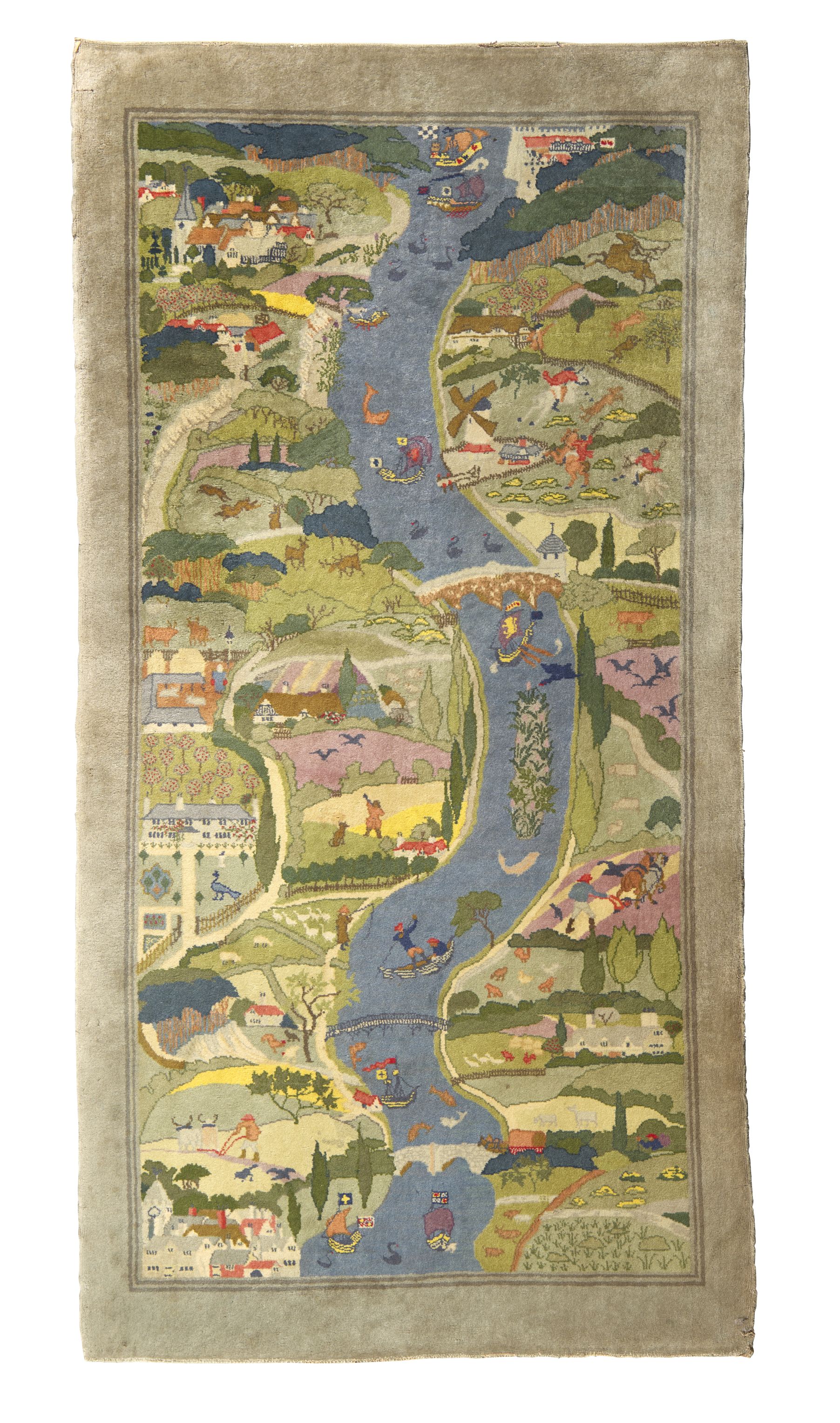
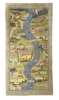
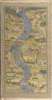
THE RIVER RUG, CIRCA 1903
Auction: Design Since 1860 Day One | Wed 14th October | Lots 1 to 245
Description
Turkish-knotted wool, cotton warp, wool weft, woven by Yates & Co., Wilton
Dimensions
242cm x 123cm
Provenance
Philip and Beatrice Barendt, and by family descent
Footnote
Literature: Brandon-Jones J. et al., C.F.A. Voysey: architect and designer 1857-1941, Lund Humphries 1978, p. 117, D39
Haslam M., Arts & Crafts Carpets, David Black 1991, pp. 132-134, figs. 116 & 117 and front cover illustration
Livingstone K. et al., C.F.A. Voysey: Arts and Crafts Designer, V&A Publishing, London, 2016, pp. 142-145, pls. 184, 185 and 186 illus.
Livingstone K., The Bookplates and Badges of C.F.A. Voysey, Crab Tree Farm Foundation, 2011, fig. 47, 48
Victoria & Albert Museum Collection, accession no. T.71-2014
The River Rug or The River Mat is one of C.F.A. Voysey's most remarkable and unusual carpet designs, revealing both his imagination and the breadth of his artistic vision. Unlike the highly stylised repeating patterns of birds, animals and foliage for which Voysey became renowned, this design presents an intricate bird's-eye view of a meandering rural landscape, transforming the carpet into a richly detailed pictorial map. Probably intended as a hearth rug, the composition is filled with engaging narrative details that invite close inspection. Villages, cottages and farmhouses are scattered across the landscape alongside cultivated fields, winding roads and bridges, while boats travel along the river and figures can be imagined carrying out everyday riverside activities. Hidden amongst these scenes appears to be a miniature representation of Voysey's own house, The Orchard, possibly intended to delight young children as much as to decorate the home.
The design stands apart from the majority of Voysey's textile and carpet work, much of which was produced commercially and characterised by carefully balanced, repeating motifs inspired by nature. Throughout his career, Voysey became one of the leading designers of the Arts & Crafts movement, creating wallpapers, woven textiles, printed fabrics and carpets distinguished by their clarity, simplicity and harmonious compositions. His carpets typically employed stylised floral and foliate forms arranged in rhythmic, symmetrical patterns that complemented domestic interiors while reflecting his belief that beauty should be an integral part of everyday life. The River Rug, however, demonstrates a more imaginative and narrative approach. The rug has often been compared to the sixteenth-century Sheldon tapestry maps of English counties, whose embroidered landscapes similarly combine geography with decorative artistry. When Voysey's own example of the rug was exhibited at the Arts & Crafts Exhibition Society in 1903, critics noted its resemblance to Chinese textiles, reflecting the broad range of artistic influences that informed his work; that rug is now held at the Victoria & Albert Museum in London (accession no. T.71-21). The River Rug remains one of the most distinctive examples of Arts & Crafts carpet design, admired for its originality, craftsmanship and the intimate, almost storybook quality of its richly imagined landscape.
The current example, never before offered for sale, was made for Philip and Beatrice Barendt. Philip Barendt, a London-based insurance broker and business owner, was a notable client of Voysey. Voysey was commissioned to make various alterations to his Hampstead house at 72 Fitzjohn's Avenue, between 1901 and 1909, where he also designed furniture and decorations. It is likely that he also commissioned Voysey to supply The River Rug around this time. In 1914 Barendt again employed Voysey's services, this time to produce designs for remodelling and extending White Cliffe or The Fairway (later High Gaut) at St Margaret's-at-Cliffe, Kent. He also designed a bookplate for Barendt and his wife Beatrice, and later, a bookplate for their daughter Beryl. An example of each was given to the V&A by Voysey in 1912 and in 1927 (accession nos. E.296-1913 and E.246-1926).