

Lot 190
ARTS & CRAFTS
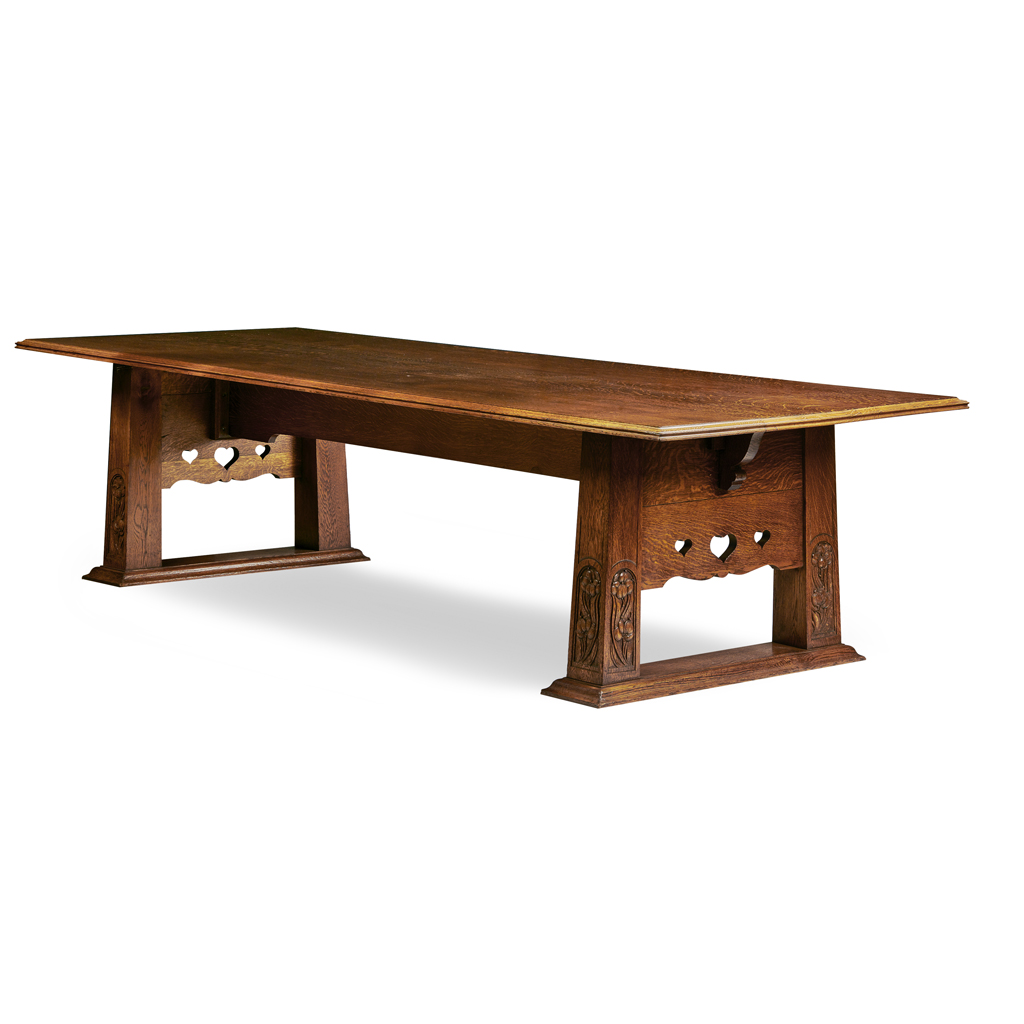
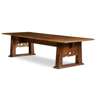
LARGE OAK REFECTORY TABLE, CIRCA 1902
Auction: 6 April 2016 at 12:00 BST
Description
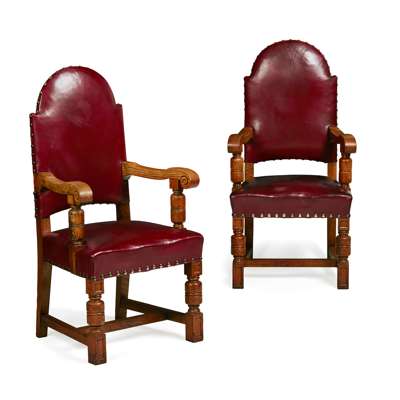
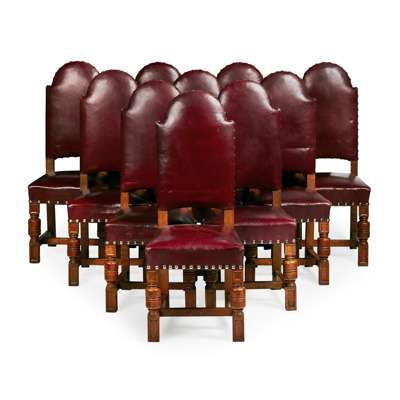
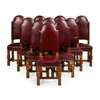
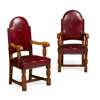
the rectangular planked top with moulded edge, supported by shaped brackets and square tapered legs carved with panels of stylised flowering foliage, enclosing deep apron pierced with three heart motifs and linked by platform stretchers, 305cm long, 74.5cm high, 111cm deep; together with a SET OF TWELVE OAK DINING CHAIRS, CIRCA 1902, including two carvers, each with arched leather upholstered backs with close nailed decoration, raised above corresponding upholstered seats on turned and blocked legs united by stretchers, carvers 61cm wide, 118.5cm high, 56cm deep approx.; chairs 48cm wide, 115cm high, 46cm deep approx. (13)
Footnote
Provenance: Sir John Auld McTaggart, 'Kelmscott' Springkell Avenue, Glasgow
Literature: The Studio Yearbook, 1906, page 7 where illustrated
Haslam, Malcolm 'Arts & Crafts Carpets', p. 130, fig. 81
The Art Journal 1901, commentary on the Glasgow International Exhibition, 1901 by Lewis F. Day
Sir John Mactaggart (1867-1956), the Glaswegian property developer and builder, was instrumental in the residential development of Glasgow's West End, and no less than 300 tenements were built by his company at the end of the 19th and the first half of the 20th century. In 1900 he commissioned the architect John Nisbet (1868-1951) to design a large new house for his own use, to overlook Springkell Avenue in Glasgow. Mactaggart was an admirer of William Morris, and named this new house 'Kelmscott' in homage to the Arts & Crafts leading advocate. Nisbet, a long-time collaborator with Mactaggart, had been a student and classmate of Charles Rennie Mackintosh at Glasgow School of Art. For this commission he incorporated Scots Baronial and English Queen Anne elements in his design, and the house was decorated and furnished with pieces from the leading Arts & Crafts designers and artists of the day, including Frank Brangwyn, from whom Mactaggart is said to have commissioned two paintings. The house is now a Grade B listed building and retains many of its original features, including an impressive installation of stained glass by Oscar Paterson.
The present oak dining table was part of the original furnishings supplied for 'Kelmscott', and its undeniable Arts & Crafts origins can be seen in its visible construction, pronounced brackets, heart shaped pierced details and distinct stylised foliate carved panel legs. A photo of the table in situ, which appeared The Studio Yearbook of 1906, captioned Drawing Room designed by John Nisbet, shows it in an interior incorporating influences of the Arts & Crafts, Art Nouveau, and Historical Revival movements. The designer of the table has, by repute, been linked to Sir Frank Brangwyn. It is certainly likely to have been a special commission for the new house, perhaps supervised by Nisbet himself, with the chairs chosen to complement the scheme. The table stands on a Celtic Revival Donegal carpet by Alexander Morton & Co. for Liberty & Co.; on the dado rail rests a brass charger, probably by W.J. Neatby and on the table is placed a glass bowl by James Powell with metal elements by W.A.S. Benson, whose stand at the recent Glasgow International Exhibition of 1901 had been such a critical success. Elsewhere the house features furniture by Liberty & Co. and Wylie & Lochhead and a Glasgow Style embroidered panel by Ann McBeth is incorporated into the fire surround in the Drawing Room.