Lot 101
ALEXANDER RITCHIE (1856-1941), IONA
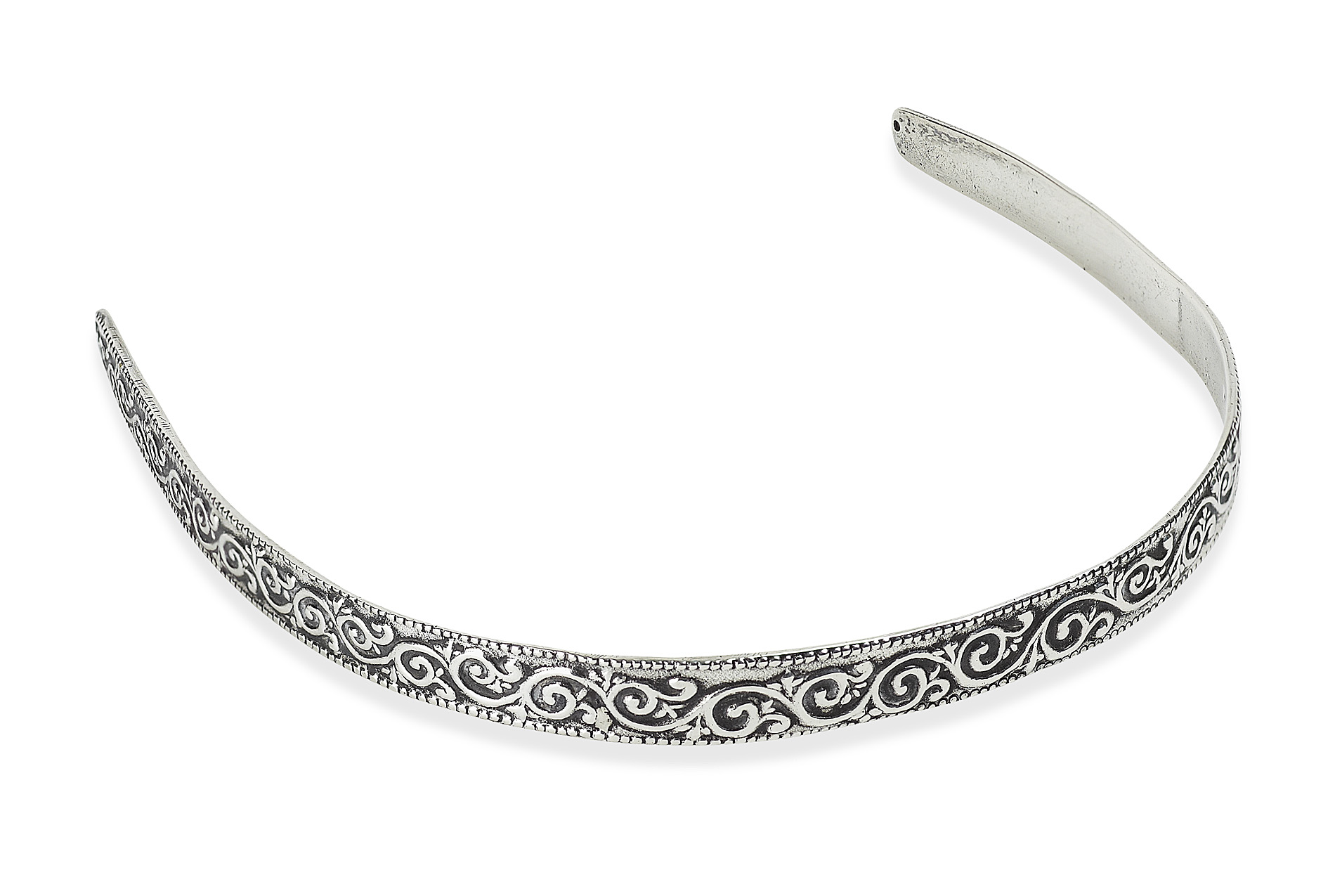
SCARCE SILVER HAIR BAND, 1935
Auction: 16 November 2011 at 11:00 GMT
Description
of tapering form, worked in relief with a meandering foliate design within a beaded border, stamped marks 'A.R./ Iona', stamped maker's mark 'ICA', hallmarked Birmingham 1935
Dimensions
approx 36cm long
Footnote
Literature: MacArthur, E. Mairi 'Iona Celtic Art: The Work of Alexander and Euphemia Ritchie, illus. 24b, page 64.
Curle, Alexander O, 'A Note on Four Silver Spoons and a Fillet of Gold found in The Nunnery at Iona; and on a Finger-ring, part of a Fillet, and a fragment of Wire, all of Gold, found in St Ronnan's Chapel, The Nunnery, Iona', Proceedings of the Society of Antiquaries of Scotland, volume 58, 1923-4, pp. 102-111, illus. p. 109, fig.3
Note: This hair band was made by Ritchie as a replica of a fillet of gold, found as part of a hoard in the grounds of the nunnery Iona in 1922, and now formed as a hair band. The Proceedings of the Society of Antiquities of Scotland for 1923-4 record the find. "In the month of December 1922, while certain necessary measures of preservation were being carried out in the Nunnery at lona by the Ancient Monuments branch of His Majesty's Office of Works, there were discovered underneath a stone at the west corner of the base of the south respond of the chancel arch four silver spoons and a gold
fillet."
"The fillet of gold (fig. 3) which accompanied the spoons is in two pieces, but measured when complete 13 inches in length, £ inch in breadth at the centre, tapering to an obtuse point at either end. Its weight is 129'7 grains. It is formed of a thin plate of beaten gold, and is ornamented in repoussé with a foliaceous design in repeating divergent scrolls, with a border of small pellets around the entire edge. At each extremity there is a small perforation for a thread to draw the ends together when being worn. The ornament is of a character that would be quite consistent with a twelfth- or thirteenth-century date for its employment —in fact, almost the identical pattern may be seen forming one of the inner borders on the plate of Limoges enamel, mentioned above, from the tomb of Geoffrey Plantagenet."