

Lot 377
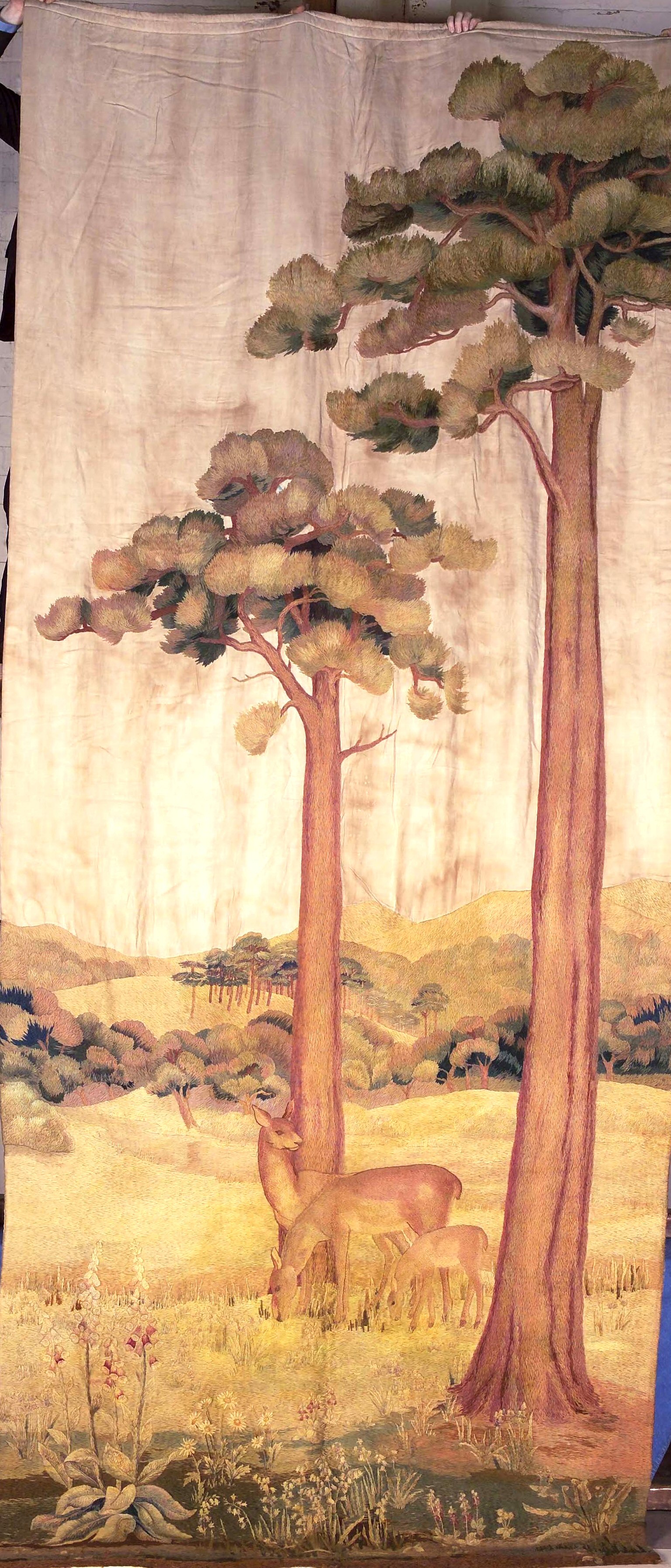
Alexander Fisher (1864-1936) A group of ten tapestry panels, depicting views of the Trossachs, Perthshire, 1907,
Auction: 19 April 2005 at 14:00 BST
Description
executed by The Royal School of Needlework for The Long Gallery, Fanhams Hall, Ware, Hertfordshire; cream silk damask, embroidered silk and crewel wools in short and long stiches, lined with cotton, each depicting a panoramic view of a mountain scene with deer and rabbits grazing and at rest, with flowers and Scots Pines in a landscape, four with embroidered inscription 'Alexander Fisher 1907' and 'Worked by The Royal School of Needlework', one with label verso inscribed 'Royal School of Art Needlework, Exhibition Road, SW', and monogrammed 'RSN', one numbered '1/8' (10)
Dimensions
six tapestries; 410cm x 168cm, four tapestries; 420cm x 215cm (approx.)
Footnote
Literature: Linda Parry, 'Textiles of the Arts and Crafts Movement, pub. London, 1988, p.124
Francesca Galloway, 'Arts and Crafts Textiles in Britain', The Fine Art Society, exhibition catalogue, London 1999, catalogue no. 50
Note;
Alexander Fisher was the leading Arts and Crafts enameller, reviving the ancient art of 'Limoges' enamelling, as well as being an extremely versatile artist and designer, who painted and sculpted. He originally trained as a silversmith and began studying enamelling after attending a series of lectures given by Louis Dalpayrat in Paris. Fisher was a very influential teacher. He taught at the Central School of Arts and Crafts before setting up a school of enamelling at his Kensington studio in 1904. Among his students were Nelson Dawson, who taught his wife Edith Dawson, John Eyre, C. Watts, his daughter Kate Fisher, Lady Carmichael (who taught Phoebe Anna Traquair and the Hon. Mrs. Madeleine Wyndham, to whom Fisher dedicated his book, 'The Art of Enameling upon Metal'), Ernestine Mills (two small pieces by her are in Leighton House) and Henry C. Cunynghame. His work was widely published at the time in publications such as The Studio and The Art Journal and he regularly exhibited at the Arts and Crafts Exhibition Society and the Royal Academy.
Fanhams Hall, partially a Queen Anne house built in 1715 was purchased in 1859 by Henry Page of Ware, who worked in the malting business. His daughter Anne, who later married Richard Benyon Croft, inherited Fanhams Hall and in 1900 enlarged the house in the Jacobean style.
The designs for the house incorporated a Long Gallery where the tapestries offered here were hung. The Trossachs tapestries were commissioned from Alexander Fisher in 1907 and were designed to complement a stained glass window by William Morris and several `Rose Tree' panels, also designed by Fisher, which served as curtains. The Trossachs were originally confined to a small wooded glen bordered by Ben A'an to the north, Loch Achray to the east, Ben Venue to the south and Loch Katrine to the west and now refer to a much wider area bordered by the Crianlarich Hills and Balquhidder in the north and Aberfoyle and the Loch Ard forest in the south. The area includes mountains, hills and glens, lochs, as well as picturesque towns and villages. Since the 19th century the Trossachs have been renowned for their rich variety of wild and beautiful scenery, ranging from high mountain peaks to peaceful wooded slopes, and have inspired many artists and writers like Sir Walter Scott.
The series of ten tapestries remained in the house after it was sold to the National Westminster Bank in 1950, while the other contents, including panels of the `Rose Tree' curtains, were sold.