

Lot 71
SIR EDUARDO PAOLOZZI K.B.E., R.A., H.R.S.A. (SCOTTISH 1924-2005) §
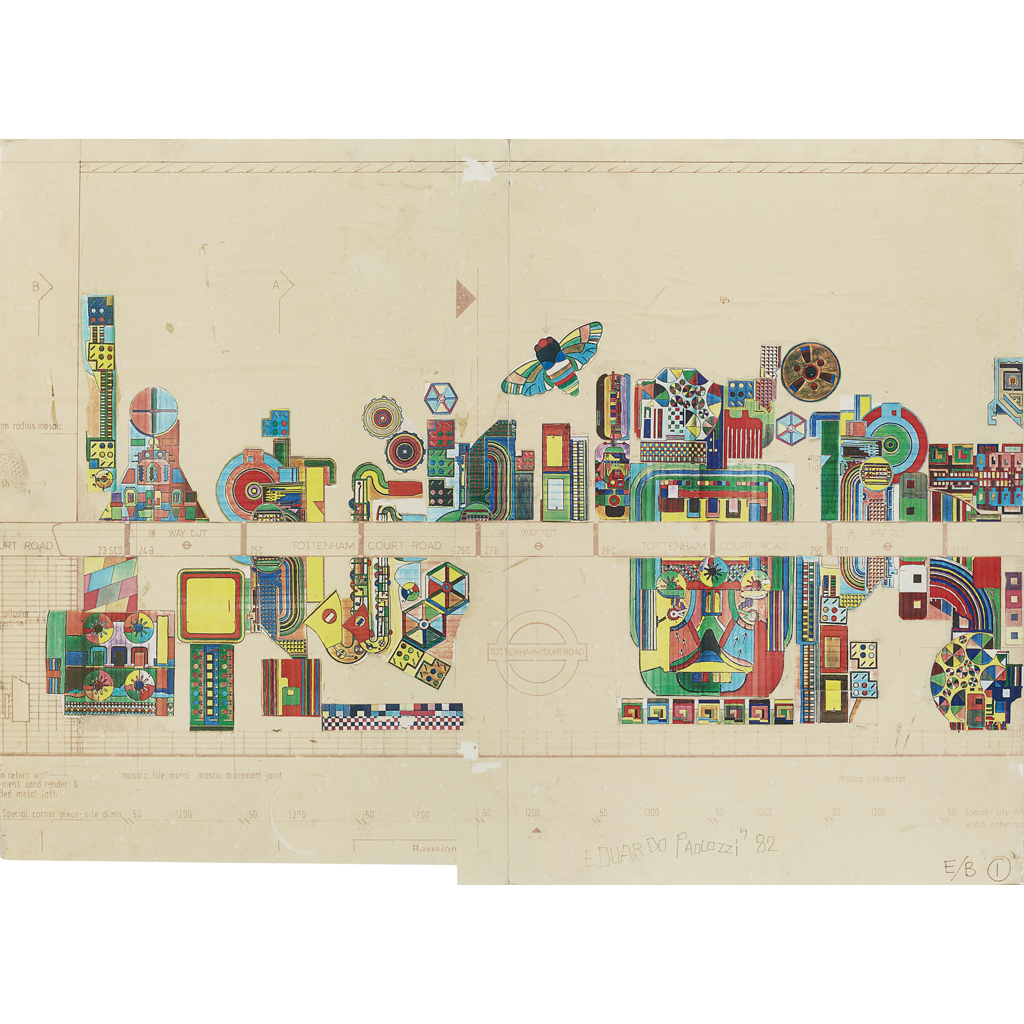
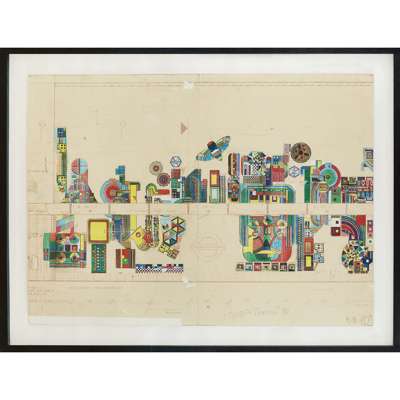
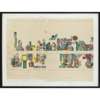
STUDY FOR TOTTENHAM COURT ROAD UNDERGROUND STATION MOSAICS
Auction: 17 August 2017 at 12:00 BST
Description
Signed and dated 1982 in pencil, collage on layout paper mounted on paper board
Dimensions
79cm x 110cm (31in x 43.25in)
Footnote
Exhibited: 'Eduardo Paolozzi', a major retrospective at the Whitechapel Gallery, February-May 2017, London
Note: This works is the definitive flat design for Central Line Platform
Paolozzi enjoyed a long-running association with Germany and in particular with Munich, where he also had a studio, and it was here that he developed the concept of the Tottenham Court Road Station mosaics. The mosaics were commissioned in 1979 by London Transport and are designed to link the interconnecting spaces of the station, featuring strongly on the Northern and Central line platforms. Completed in 1986, the glass mosaics cover some 950 square metres. Having suffered over the years, they were painstakingly restored in 2015 and, while 95% were retained in place, the remainder were removed and given to Edinburgh College of Art where Paolozzi was a visiting professor and where he had himself studied in the 1940s.
In his designs for the mosaics, a key example of which, the definitive flat design for the Central Line platform, is now offered for sale, Paolozzi draws on his knowledge and understanding of popular culture and iconic symbolism. Not least because the concept of their creation united his abiding interest in the culture of mechanisation and his empathy with the station's historic context and its geographical location. Having taught at the nearby Central School of Art in the Fifties, Paolozzi had retained a broad, deep-rooted and not least affectionate understanding of the local area and its diverse communities.
Tottenham Court Road sits at the epicentre of one of the most culturally diverse and historically significant areas of the capital, between Fitzrovia, Bloomsbury and Soho. These streets were the haunt of such writers as Tom Paine, Vanessa Bell, Virginia Wolf, Dylan Thomas, and George Orwell, and artists including Constable, Augustus John, Colquhoun and Macbryde, Francis Bacon (a friend of Paolozzi's), and others too numerous to mention. Here too was the centre of London's jazz community and its buzzing hub of Denmark Street and musicians from Britten and Bechet to Pink Floyd. Thus on the left of this work we find saxophones and musical notes. Cameras and electrical circuits mirror the technical stores of Tottenham Court Road and Fitzrovia, while stylized Egyptian and Assyrian motifs reference the nearby British Museum. A soaring butterfly or moth is an allusion to Paolozzi's recollections of the decoration of a long-vanished Turkish Baths. At the same time, the motifs are constantly self-referential, with powerful and iconic imagery from his past work - tribal masks, spacecraft and robots. Cogs and film reels jostle with what could be pinball machines or jukeboxes in an exuberant evocation of the life of this unique locale.
Using collage in a sense to mimic the painstaking method of the eventual mosaic construction, the artist summons up in a single piece of work the essential meaning of this extraordinary and vitally important commission. It is not perhaps going too far to say that it can be seen as an encapsulation of everything that made Paolozzi one of the greatest British artists of the 20th century.