

Lot 73
India - North-West Frontier Province
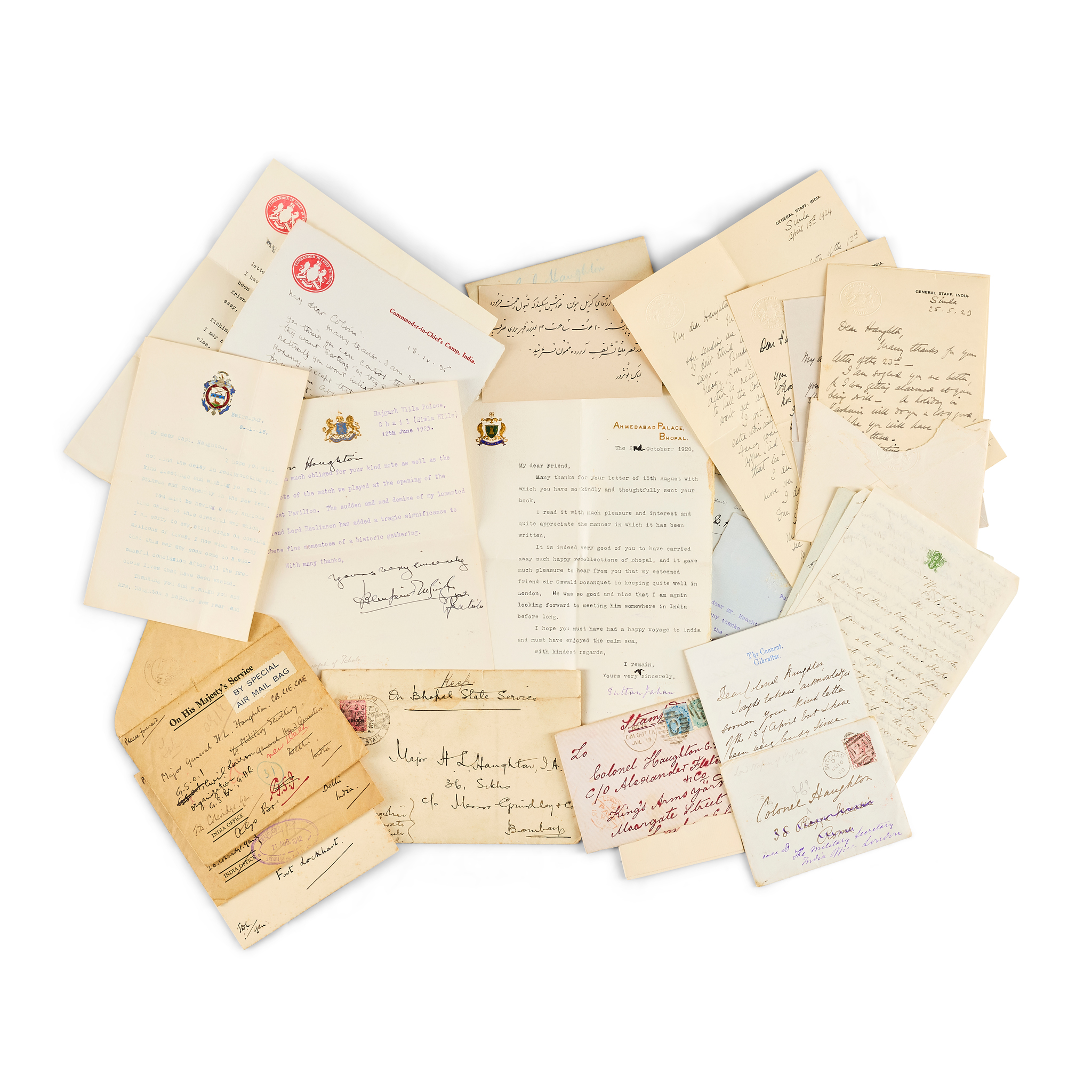
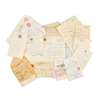
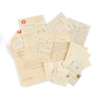
Collection of letters to Major-General H. L. Haughton, 36th Sikhs, Commander of Kohat

Auction: Books & Manuscripts | 01 October 2026 from 10am | Lots 1 to 78
Description
1920s-30s. Approx. 25 letters in total, from native rulers and British Indian Army officers, all autograph letters (unless otherwise stated), all signed, from:
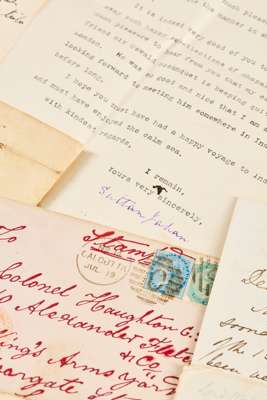
Sultan Jahan, Begum of Bhopal, 1920, typed, 1 p., with embossed gilt crest and Ahmedabad Palace letterhead, on receiving a copy of Haughton's book (q.v.), retaining original envelope addressed to Haughton as an officer in the 36th Sikhs;
Bhupinder Singh, Maharaja of Patiala, 1925, typed, 1 p., with embossed gilt crest to head, ‘I am much obliged for your kind note as well as the snapshots of the match we played at the opening of the cricket pavilion. The sudden and sad demise of my lamented friend Lord Rawlinson has added a tragic significance to these mementoes’, signed ‘Yours very sincerely, Bhupinder Singh, Patiala’ at foot;
Mohammad Hashim Khan, Prime Minister of Afghanistan, 1931, 1 p., the body of the letter apparently in a secretarial hand, the signature in both Latin and Arabic characters presumed to be autograph, together with a manuscript note in Persian, possibly entirely in Khan's hand, conveying New Year's greetings;
General Sir John Duke Coleridge, 1930s-40s, 4 letters, 9 pp. in total, on a possible Sikh homeland ('Pakistan and the Sikhs makes a pretty problem, and this may be solved by the Sikhs being given an enclave within Pakistan, but I don't think Jinnah wants that', ‘possible overrecruiting of the Punjab and N.W.F.', Indian nationalism, Congress, Gandhi ('incomprehensible … beginning to outstay [his] welcome'), policy towards the Shinwari Hassan Khels, the Burma Campaign, and similar;
Field Marshal Sir Claud Jacob (acting commander-in-chief, India, in 1925), 1920s-30s, 5 letters, on mountain warfare, the abdication of Edward VIII ('a sordid business and all due to a woman who has been twice divorced'), social matters including a holiday in Kashmir and a request to collect a tiger skin from the taxidermist;
General Sir Alexander Cobbe VC, 2 letters, one dated 1925, 4 pp., on the proposed creation of an ‘Indian National Army’, the other undated, and a letter to Cobbe from General Sir George Younghusband (author of The Relief of Chitral, 1895) requesting promotion to lieutenant-general on his retirement;
and others (variously typed or autograph) including one letter each from successive commanders-in-chief of India: General Sir Charles Monro, c-in-c 1916-20, General Lord Rawlinson, c-in-c 1920-5 (dated 1924, on Haughton's proposal for a ‘Dominion Army’), General Sir Philip Chetwode, c-in-c, 1930-5 (1935, on his departure from India, with a reminiscence of ‘the delightful fortnight we had fishing together in Kashmir’, together with another letter from Chetwode to a different recipient praising Haughton's fishing skills), and General Sir R. A. Cassells, c-in-c 1935-41 (thanking Haughton for his hospitality at Kohat), and 5 further letters from Lord Montagu of Beaulieu, General Charles Granville Bruce, Henri Verney (director of the Louvre), Basil Blackett (Indian civil servant), and S. G. Burrard of the Survey of India; and 2 letters to a ‘Munn’, from Field Marshal Sir Charles Egerton and General Sir Edmund Barrow, appraising a manuscript treatise by H. L. Haughton on the Indian Army, set forward for publication;
together with a collection of letters evidently to Haughton's grandfather, Lieutenant-General John Colpoys Haughton (1817-1887), defender of Charikar in the First Afghan War (1841), and later the commissioner of Cooch Behar, from:
Field Marshal Robert Napier, Baron Napier of Magdala, 1880, 12 pp., praising Haughton for his conduct at Charikar ('how any one lived through that trial and escaped all the dangers that beset you is one of the miracles of which India can furnish many, but few of them to equal yours');
Lieutenant-General Colin Mackenzie, 1873, 7 pp., on the ‘insolent treatment you have received at the hands of the Bengal and Supreme Government' ('And now they fob you off with the empty compliment of asking your advice about the Staff Corps … Giving good advice to such fellows is simply throwing pearls before swine'), and recalling his (Mackenzie's) contribution to Pollock's march on Kabul in the First Afghan War;
Nriprendra Narayan, Maharaja of Cooch Behar, 1880-4, 2 letters, both 5 pp., the first on urban improvements in Cooch Behar including the rebuilding of his palace, and the implications of his coming of age ('Sir Ashley Eden is of opinion that I ought to take charge of both my state and estate at 21'), the second on local politics, the Bengal Rent Bill ('[which] is bothering us a good deal - our position as jamiadars will be very much lowered'), floods, etc.;
and 2 others (a folder)
Footnote
Major-General Henry Lawrence Haughton CB CIE CBE (1883-1955) joined the Indian Army in 1904 as an officer in the 36th Sikhs, the same regiment as his father, John Haughton (1852-1898), himself the son of another decorated army officer Lieutenant-Colonel John Colpoys Haughton (1817-1887). He was appointed commander of the 10th Battalion, 11th Sikh Regiment, in 1927, of the Abbottabad brigade in 1933, and the Kohat district (North-West Frontier Province) in 1936 with the rank of major-general, before retiring in 1940. He was the author of Sport and Folklore in the Himalayas, published in 1913.