

Lot 223
Williams, John
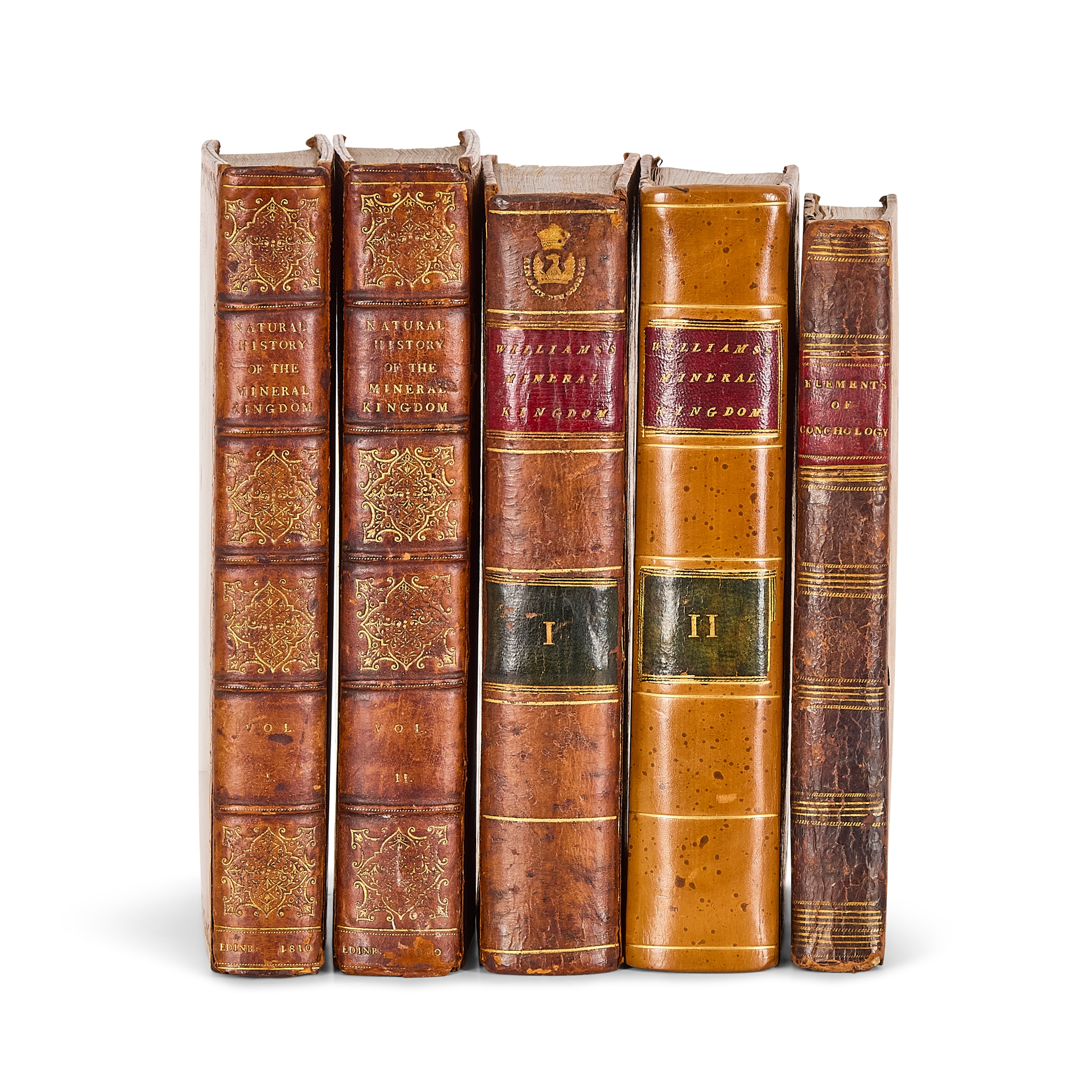
The Natural History of the Mineral Kingdom
Auction: From the Library of Professor Roland Paxton | 01 October 2026 from 10am | Lots 221 to 252
Description
Edinburgh: for the author, by Thomas Ruddiman, 1789. First edition. 2 volumes, 8vo, contemporary streaked calf, volume 1 with gilt crest to head of spine, volume 2 rebacked retaining original labels, errata leaf to volume 1, bound without half-titles (if issued), volume 1 2Z1 with small tear in lower margin, volume 2 D1 with small hole in text and damp-staining to a few quires [Ward & Carozzi, Geology Emerging, 2339];
Ibid. The Natural History of the Mineral Kingdom … The Second Edition. With an Appendix, containing a more extended View of Mineralogy and Geology. Edinburgh; for Bell & Bradfute, 1810. 2 volumes, 8vo, contemporary calf, gilt spines, decorative frames to covers in gilt and blind, engraved frontispiece to each volume, errata leaf to rear volume 2, bookplates of noted female bibliophile Frances Mary Richardson Currer (1785-1861) and one Mathew Wilson, bound without half-titles, volume 1 H3 with small hole in margin, volume 2 front joint cracked and with worm-track to fore margins [Ward & Carozzi, 2340];
and 1 other (5)
Provenance
From the collection of the late Professor Roland Paxton MBE FICE FRSE (1932-2025), 'Britain's foremost historian of civil engineering' (Telegraph, obituary, 12th November 2025); Professor Paxton was also a leading conservationist of Britain's engineering heritage, and led successful campaigns to restore two of the world's most important railway structures, the Laigh Milton Viaduct in Ayrshire, the world's oldest surviving railway bridge, and the Union Chain Bridge, the world's oldest suspension bridge still carrying road traffic.
Footnote
John Williams was a Welsh-born mining engineer who moved to Scotland in the 1740s as a military surveyor. He made important discoveries of mineral deposits in the north of the country, worked for a time at Leadhills in Lanarkshire, and was eventually appointed superintendent of the coalmines at Blackburn near Edinburgh. In 1779 he published his Natural History of the Mineral Kingdom, a major work which ‘filled a vacuum in scientific and technical literature in English [as] its subject matter was not then taught in British universities … For a largely self-educated miner this was a remarkable achievement’ (ODNB).