

Lot 59
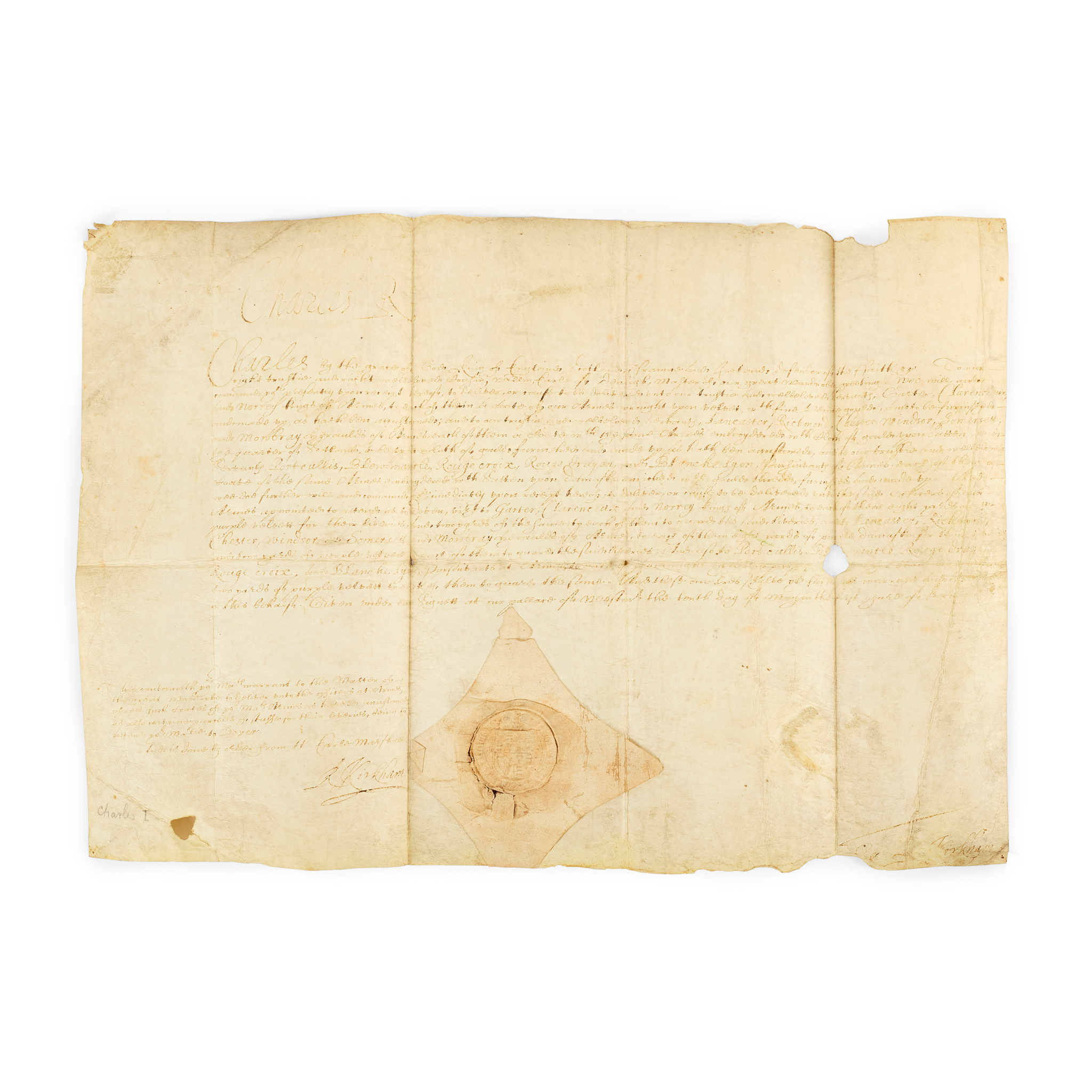
Charles I (1600-1649), King of Scotland, England and Ireland
Signed warrant approving livery for the Officers of Arms to meet the new Queen
Auction: 16 June 2026 from 10:00 BST
Description
Single sheet, parchment (24.3 x 34cm), signed 'Charles R.' in the top left corner, dated 10th May 1625, and countersigned in the lower left by Robert Kirkham as clerk of the signet:
‘Charles by the grace of God …To our right trustie and right noble cousin, William, Earl of Denbigh, Master of our Great Wardrobe, greeting. We will and command … to be delivered unto our trustie and noble servants Garter, Clarenceux and Norrey [Norroy], Kings of Armes, to each of them be coate of our armes wrought upon ... with fine trimmed [?] gould [gold], and to be furnished and made ... and to our trustie … servants, Lancaster, Richmond, Chester, Windsor, Somersett, and Mowbray ... Portcullis, Blew=mantle [Bluemantle], Rouge Croix, Rouge Dragon, and Blanche Lyon Pursuivants of Armes … coats of the same armes embroydered with [satin?] upon damask [enriched?] with gould threads …’.
Verso with ‘warrant for liveries’ and date, original paper seal affixed to the lower half of the document. Old folds, with soiling, creasing, two small holes and fading to signature and right-hand margin of text, but otherwise in good condition
Footnote
A warrant approved by King Charles I shortly after he became king in March 1625, and only nine days after his marriage (by proxy) to Princess Henrietta Maria of France, sister of King Louis XIII. The document relates to the elaborate preparations for the official welcome of Charles's new bride at Dover.
After his failed pursuit of the Spanish infanta Maria as a royal bride, Charles and his chief adviser, the Duke of Buckingham, had switched to the pursuit of the French princess as a means of concluding a military alliance with France against Spain and the Habsburgs. The difficult negotiations for the marriage were only concluded just before the death of King James VI and I, which delayed the planned nuptials. Further delays were caused by an outbreak of plague in London, a Huguenot uprising in France, then unfavourable winds prevented Henrietta Maria sailing to England. To expedite matters, Henrietta was married by proxy on 1st May at Notre Dame Cathedral.
Charles had intended to accompany his Officers of Arms to meet his wife at Dover, she was being escorted by the Duke of Buckingham, but they first met in person on 13th June 1625, in Canterbury, arriving in London on 16th June. Charles's coronation took place on 2nd February 1626 at Westminster Abbey, but without his wife being present. Henrietta Maria had insisted that only a Catholic bishop could crown her, a condition unacceptable to the Anglican establishment, so she had to watch the coronation of her husband from an upstairs window. She would thus never be crowned.