

Lot 49
Lawrence, T. E. (1888-1935), 'Lawrence of Arabia'
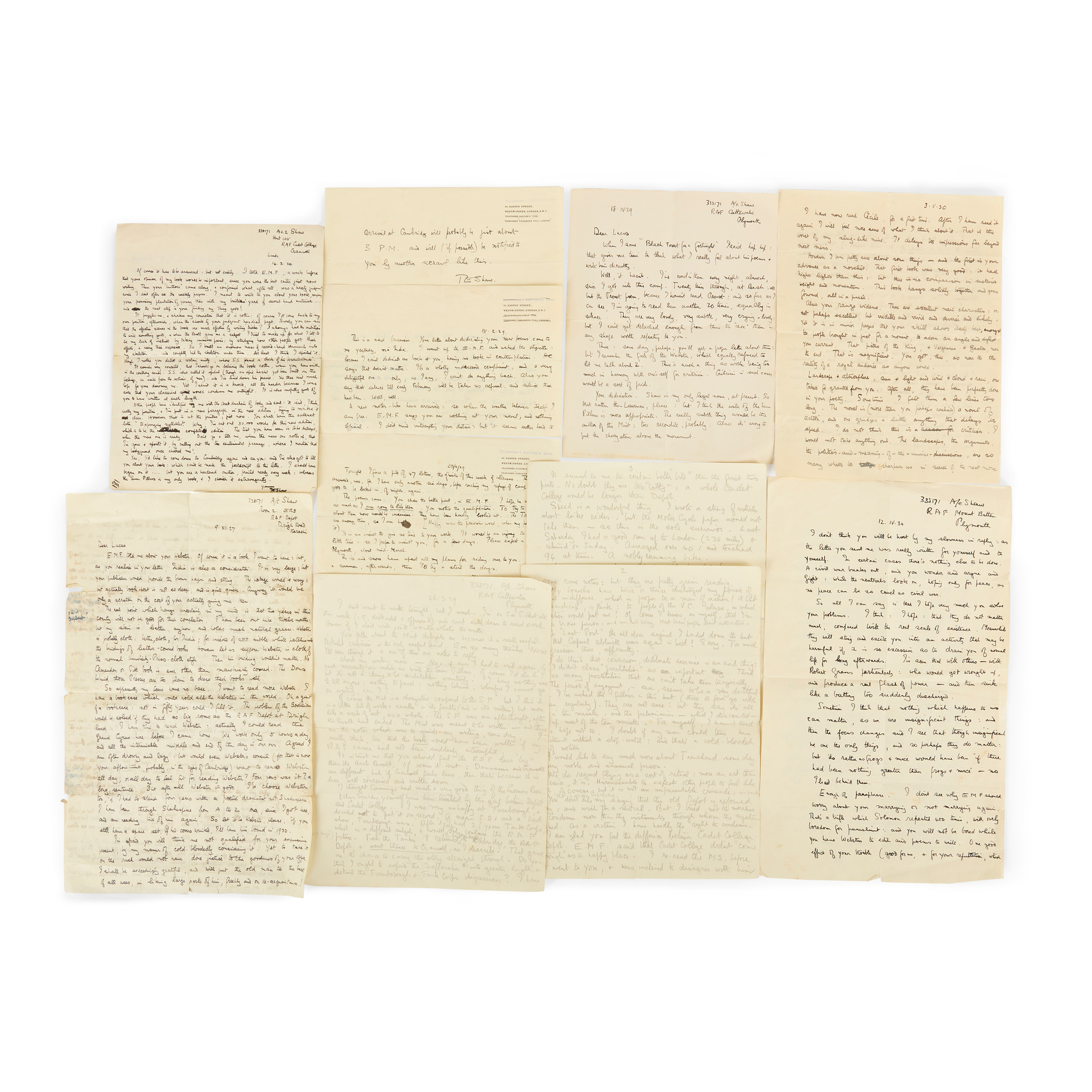
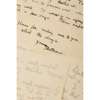
Collection of autograph letters signed to F. L. Lucas
Auction: 16 June 2026 from 10:00 BST
Description
Cranwell, Karachi, London and Plymouth, 1926-30. 8 autograph letters and 1 autograph note, all signed either T. E. Shaw or TES, 18 pages in total (including 2 postscripts), each a single sheet except for item 6, comprising:
1) RAF Cadet College, Cranwell, 14th March 1926, 23 x 18cm, written on both sides (the verso containing a postscript only). ‘I told E. M. F. [E. M. Forster] … that your opinion of my book would be important, since you were the best critic just now writing ... The next step is your finding my thing good! It puzzles me, & shakes my conviction that it is rotten ... I always had the ambition to write something good, and when the Revolt gave me a subject I tried to make up for what I felt to be a lack of instinct by taking immense pains ... I noticed you detect a certain unity, where S. S. [Siegfried Sassoon] found a lack of his ’architectonics' ... Other people have identified me with the Arab dualism of body and soul: it isn't, I think, really my position, & I've just put in a new paragraph in the new edition, trying to make it clear. However that is at the printers just now ... I've cut out 50,000 words for this new edition, which is to be the complete edition. The text you have seen is to be destroyed when the new one is ready. Don't go & tell me, when the new one rolls up, that I've gone & spoilt it ... You are a hardened author, printed nearly every week: whereas the Seven Pillars is my only book, & I cherish it extravagantly';
2) RAF Depot, Drigh Road, Karachi, 9th December 1927, 31 x 21cm, written on both sides, small damp-stains, short splits to head and foot of central fold, short tear to left-hand edge extending into text. On subject's including: Lucas's edition of Webster (1927), Lawrence seeking a copy on the recommendation of E. M. Forster; the letters of Gertrude Bell ('They disappointed me. I used to gaze at her, in life, wondering what there was really true. She was either very secret, or very shallow'); Joseph Conrad ('They show a real agony of effort ... The Mirror of the Sea I feel is unqualified beauty: and I liked the Arrow of Gold and Nostromo The other books wearied me a little'); the Cranwell edition of Seven Pillars of Wisdom ('E. M. F. swears that my unweildy [sic] hulk of a Seven Pillars contains some good stuff ... but I'm hanged if I see any good in 99.5% of it. Did you ever have another bang at it? I gave E. M. F. a copy. I wanted to give you one, and had you on a list: but as my money ran out, pound by pound, so I had to cut out the free copies so that only three writing people (E. M. F., Sassoon and Graves) got them after all. They cost £90 each, and I overestimated my resources, and had great difficulty in packing the whole job into the £19000 which I raised on my old capital and from the prospect of "Revolt in the Desert", to cover it.);
3) 14 Barton Street, London, 15th February 1929, 12.5 x 20.2cm, written on both sides, Barton Street letterhead. 'This is a sad business. Your letter about dedicating your new poems [Time and Memory] came to me yesterday, via India … You say that silence till early February will be taken as refusal: and silence there has been … A new motor-bike has arrived: so when the weather behaves itself I am free. E. M. F. says you are writing your novel … E. M. F. says that an unpublished book [i.e. The Mint] … which I wrote in 1922 is worth your looking at … Shall I try & borrow it from its owner [Edward Garnett], for you?;
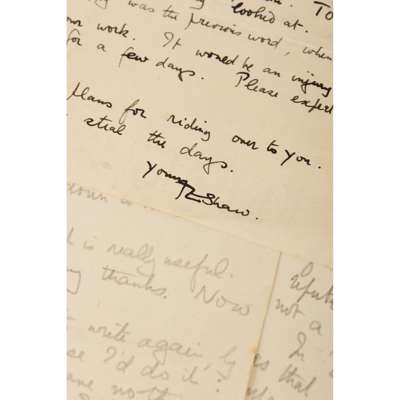
4) 14 Barton Street, London, 28th February 1929, 12.5 x 20.2cm, written on both sides (the verso containing a postscript only), Barton Street letterhead. ‘The poems [Time and Memory] came. You chose the part, in E. M. F. [i.e. as the book’s dedicatee]. I hope he will like them as much as I am going to like them. You notice the qualification. To try to say anything about them now would be insincere. They have hardly been looked at … Oh, I forgot about my measly little "Mint". Its MS is on loan just now. I have asked Edward Garnett, who owns it, to lend it you next';
5) 14 Barton Street, [February 1929], 12.5 x 20.2cm, a note, written on one side only. ‘Arrival at Cambridge will probably be just about 3 P. M. and will (if possible) be notified to you by another scrawl like this. T. E. Shaw’;
6) RAF Cattewater, Plymouth, 26th March 1929, 3 leaves, 26 x 20cm, each written on one side only, in pencil. Containing a substantial discussion of The Mint, RAF life and Seven Pillars, ending with a passage on motorbikes and Lawrence's acceptance of the dedication of Lucas's novel (Cécile): 'About my writing more - No: if ever I had to write again by such necessity as made me write the Seven Pillars, of course I'd do it, but it's not a thing to be undertaken wantonly … Of course the Mint is a cherrystone compared to the S. P. but I think it is a better bit of work: smaller in its fault (and in its virtues) but more like a work of art, as a whole. The S. P. was an afterthought, after the Revolt had ended. The Mint was meant to be written - and these are the notes which were to guide my writing, some day ... It interests me that you should feel the R.A.F. less ‘big’ than the Arab Revolt. Of course it isn't: Damascus and Cranwell are different, but if Cranwell feels less, then that's because it is less well conceived and written down … [A] bad show, Farnborough was. After it I had 2 1/2 years in the Tank Corps. From the Tanks I returned to Uxbridge, the RAF depot, and went thence to Cranwell ... Do you think I ought to expand the "explanation" into greater length, and detail the Farnborough & Tank Corps digressions? … I do think that conscious, deliberate exercises is an evil thing: but I didn't class ‘prostitution’ as important. There are so many prostitutions that one can't take them tragically. The period of enjoyment, in sex, seems to be a very doubtful one. I've asked the fellows in this hut (three or four go with women regularly). They are not sure: but they say it's all over in ten minutes ... For myself, I haven't tried it, and hope not to. I doubt if any man could time his excitement without a stop-watch: and that's a cold-blooded sort of notion … ';
7) RAF Cattewater, Plymouth, 18th April 1929, 23 x 17.6cm, written on both sides. On the arrival of a book of poems ('I've read in them every night … Twenty times through, at least: all put the Proust poem, because I haven't read Proust'), and the wording of Lucas's proposed dedication of Cécile ('Shaw is my only legal name, at present. So that rather than Lawrence, please: but I think the writer of the Seven Pillars is more appropriate. The really subtle thing would be the author of the Mint: too recondite, probably. Also it's wrong to put the cherry stone above the monument');
8) RAF Mount Batten, Plymouth, 12th April 1930, 33 x 20.5cm, written on both sides. Evidently on the end of Lucas's marriage to E. B. C. ‘Topsy’ Jones: ‘All I can say is that I hope very much you solve your problems … Robert Graves particularly … would get wrought up, and produce a real flash of power - and then sink like a battery too suddenly discharged. Sometimes I think that nothing which happens to us can matter, as we are insignificant things: and then the focus changes and I see that though insignificant we are the only things, and so perhaps they do matter ... I don't see why EMF should worry about your marrying or not marrying again. That's a trifle which Solomon repeated 400 times … So write away, and be glad that you can, at 40. Most poets are dead after 30 … My days belong to the R. A. F. and my nights are wasted turning the Odyssey into English prose';
9) [Plymouth], 3rd May 1930, 24.5 x 19cm, written on one side only. Praising and critiquing Lucas's novel Cécile: ' … The dedication makes me feel quite warm all over. It was ever so good of you: for I'm a bit of a renegade in letters. Probably if I went on trying I could achieve more second-rate work: and do not think it worth while. My jobs in the R. A. F. seem more useful …'
Provenance
By direct descent from F. L. Lucas.
Footnote
‘You are a hardened author, printed nearly every week: whereas the Seven Pillars is my only book, & I cherish it extravagantly’
A major collection of T. E. Lawrence’s letters, never previously offered for sale, and constituting the entirety of his known correspondence with the Cambridge literary scholar F. L. Lucas, one of the select few whom Lawrence entrusted with reading the Oxford text of the Seven Pillars of Wisdom. The text of these letters was printed in the Castle Hill Press edition of Lawrence’s correspondence with E. M. Forster and F. L. Lucas in 2010, but from transcripts found in Lawrence’s papers at the Bodleian, with the editors declaring the whereabouts of the originals unknown.
Lawrence first encountered F. L. Lucas’s name in 1924 on seeing his poems in the New Statesman. He wrote to E. M. Forster asking for more information about the young Cambridge don, and the trio met for the first time the next year at King’s College in December 1925. Sufficiently impressed by the meeting, Lawrence then agreed that Lucas could read the Oxford text of Seven Pillars of Wisdom, and subsequently his manuscript of The Mint, his journal of RAF life not published until 1955.
The letters are a microcosm of both Lawrence’s literary style, itself the means by which he strove to establish his reputation for posterity, and his famously singular personality. Filled with portentous abstraction, lyrical flights of fancy, and tactical self-deprecation, interspersed with back-handed pronouncements directed at Lucas and others, they show Lawrence relishing his close contact with an esteemed man of letters, and suggest that it is principally as a man of letters that he himself wished to be understood.
Lawrence was delighted by Lucas’s positive appraisal of the Seven Pillars, professing to take the judgement of ‘the best critic now writing’ as a decisive vindication of a work he would have otherwise believed worthless, and in his response of March 1926 writes inimitably on the motives and genesis of his magnum opus. His next letter of December 1927 shows him entering his literary stride, delivering piquant judgements on Gertrude Bell, his fellow tribune of Arab nationalism, and Joseph Conrad, who ‘tried too hard’, though perhaps overreaching himself in allowing his discussion of Lucas’s edition of Webster, a four-volume monument of scholarship published soon after the Seven Pillars, to assume the aspect of faint praise. He subjects his own work to a similar treatment, decrying ‘my own wreck of a book’ and outlining the disastrous finances of the Cranwell edition, though pre-emptively removes the sting from such remarks by prefacing them with the approval of E. M. Forster.
The relationship established, Lawrence seeks Lucas’s opinion on the manuscript of The Mint. His reply to Lucas’s critique (26th March 1929), in which he compares The Mint to the Seven Pillars, coming out in favour of the former, is a major letter in his canon, revealing as much of the man’s intractably contradictory mind as any letter might, and being replete with Lawrentian motifs of self-aggrandisement alternating with self-deprecation, musings on sex hedged with assertions of personal celibacy, a fascination with motorcycles, and an ostentatious preoccupation with his duties as an RAF ranker.
There are two documented meetings of Lawrence and Lucas, in 1925 and 1929, both in Cambridge. Lawrence visited Cambridge on several further occasions during the 1930s, so further meetings are possible. Lawrence was the dedicatee of Lucas’s second novel, Cécile, which appeared in 1930, with Lawrence named at his request as ‘the author of Seven Pillars of Wisdom’.
Published: T. E. Lawrence, Correspondence with E. M. Forster and F. L. Lucas, edited by Jeremy and Nicole Wilson (Fordingbridge: Castle Hill Press, 2010), pp. 261-287.