

Lot 15
LETTERS FROM A GRAND TOUR
Auction: 8 July 2003 at 12:00 BST
Description
An album of over 90 MS letters mostly with covers from Roger Robertson the Younger of Ladykirk in Berwickshire to his family in Edinburgh from 26 June 1750 to 20 January 1753. Many of the letters contain lengthy separate sections addressed to different members of the family covering different aspects of what the writer encountered. Thus many of those addressed to his mother are in response to her inquiries about famous people whom he might have had the opportunity of encountering, their mode of dress, etc., Paper boards, folio., and other albums of accounts and papers relating to the Robertson family. [9]
Note: A detailed account of the Grand Tour made by a young Scottish gentleman in the middle of the 18th century. The correspondence written mostly in English, but sometimes in French and Italian as the writer's fluency in these languages increases, provides a vivid picture of the 18th century equivallent of the gap year. It is interesting to note the tensions that clearly arise from the writer's being away from home for so long , not least over his continuing expenditure!
The first few letters cover his journey to the South and his crossing to France. In Paris, he recounts the birth of a daughter to the Dauphine and the public celebrations including fireworks representing the sun, the collar of the Order of the St. Esprit, waterfalls, etc. He records a visit to the Scots College in Paris where he was shown the "Mass Book" taken by Mary Queen of Scots to the scaffold, with many of her letters and her testament as well as the letters of James VII, etc. He visits the theatre and Versailles where he sees the Royal family dine and attend Chapel.
After spending some months at Angers studying the language, he starts to write to his father in French. He sends a list of items which he has sent in a trunk from Paris home , including: prints, "3 Musick Books", "A Ladys assortment" containing three pairs of embroidered shoes, a hat with ruffles, handkerchiefs, a "Sac d'Ouvrage of white Silk embroidered with gold", etc to be divided amongst his female relations, and La Fontaine's fables and other books. He journeys next to Lyons by diligence. He describes his journey onwards through Avignon, Nimes, Aix, Toulon, etc. From Toulon he goes to Hyeres ("it being the Orange Garden of France"], thence to Nice where he notes "the French language decayed" and Monaco.
The next letters are from Genoa, Lucca, and Florence where he notes the great number of English present. He reports seeing the Raphael picture of the Holy Family of which his father has an excellent copy. He laments that he has not yet had "the pleasure to hear an Italian Opera this being the dead season of the year". From Florence, he also starts to write home in Italian. He engages a master of architecture to help him appreciate more the wonderful things that he hopes to see in Rome. He visits Siena and Naples where he climbs Vesuvius and descends into the cauldron and where he is surprised to find that brimestone has a most agreeable smell! During his stay at Naples he visits the ruins and excavations and describes how visitors are approached by the publishers of books. He is encouraged to subscribe to Pancrazi's Antichita Siciliana but suggests to Lord Hopetoun that it may be more suitable for his library. He notes Lord Hopetoun's intention to have himself included in the printed list of subscribers. The publisher promises seven volumes, but in fact only two were published.
Finaly he reaches Rome in December 1751. Amongst his first acts are to attend the Pope at his devotions at St Mary Major. He employs a "Ciceroni or Antiquarian" to show him around, explaining the costs to his father as saving precious time. In going through many of the palaces and churches, he spots pictures of which his father has copies. He describes Carracci's fresco of the Triumph of Bacchus and Ariadne as "the most alarming picture composition" he ever beheld, but recalls a copy in the drawing room back home. On Christmas day he attends mass in the Pope's Chapel where amongst the cardinals present, is Cardinal York whose appearance he describes as well advanced in years wondering if this is due to his dress or manner of life.
In a letter of 26 January, 1752, he reports to his father that he has found a very good and well recommended Italian architect to draw up a plan for a house of 70 by 45 feet. He reports that he has begun to purchase prints of the most remarkable statutes, pictures and buildings, taking care not to buy those of which they already have copies at home. Good copies of pictures are deemed to be too expensive and he will "not medle with any thing of that kind, tho' I must own that they are a great temptation and to resist them is a piece of Self denial." He sits for his portrait to "the best Portrait Painter" whose price is "not so dear as Allen Ramsays".
He leaves Rome in early March for Bologna having made all his purchases. He writes "I have ventured to make considerable purchases of Prints, and even a few Pictures for you ." He oversees their packing and heads for Venice by Modena, Parma, Mantua, etc. In Venice he meets a bookseller who wants to set up a connection with Edinburgh and Glasgow publishers such as the Foulis brothers. Next he visits Turin, Milan and then Geneva, Rotterdam, the Hague, and Utrecht. In a letter from the Hague, he notes a consignment sent from Naples, which includes "Green silk umbrello, Three Opera Books" and " A Pomegranate pulled in the Elisian field."
He returns to London in the autumn of 1752. The correspondence closes with a series of letters from London, where the young traveller seems to be delaying his return, somewhat to the displeasure of his parents, and where he also discovers that while he has been away, there was no mention in what was obviously a copious correspondence of his mother being unwell. In January 1753, he finally promises to be back home about the beginning of February.
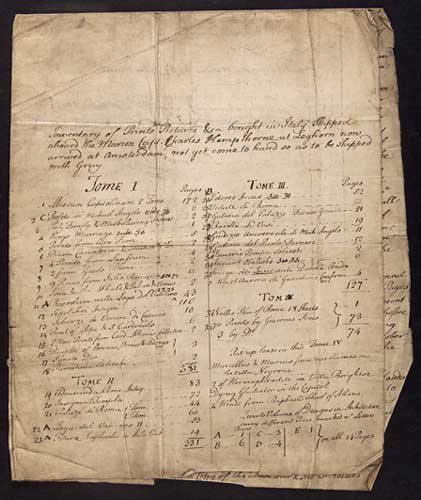
Loosely inserted are two inventories, the one of prints, pictures, etc. bought in Italy and shipped from Leghorn to Amsterdam, and the other of boxes to be sent to Scotland.
Reference: Ingamells A Dictionary of British and Irish Travellers in Italy 1700-1800 p. 815, who makes a brief mention of Robertson undertaking the tour and to the existence of the papers.