

Lot 547
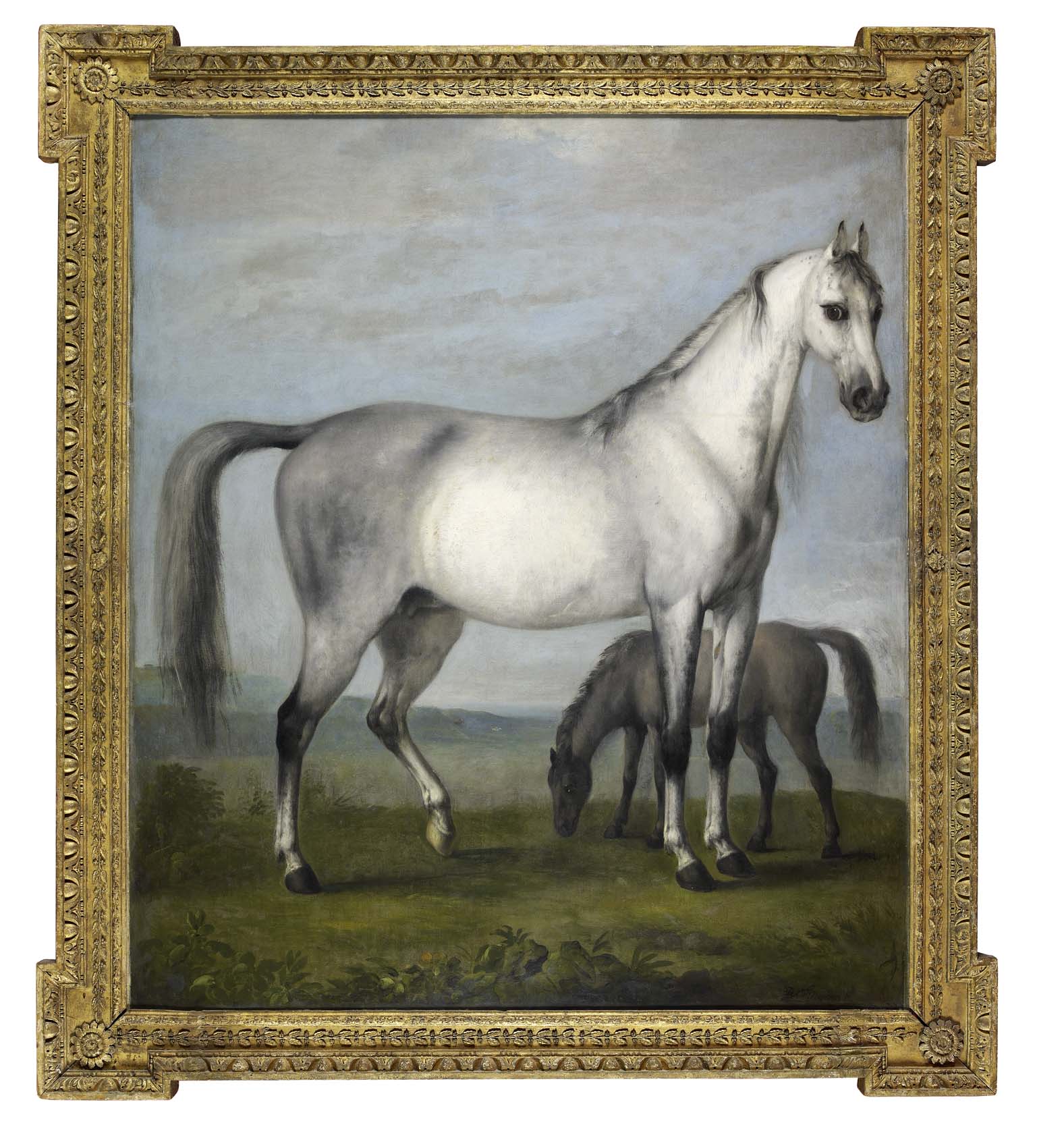
PIETER TILLEMANS (FLEMISH 1684-1734)
A GREY MARE AND A FOAL IN AN EXTENSIVE HILLY LANDSCAPE
Auction: 8 April 2009 at 11:30 BST
Description
Signed, oil on canvas
Dimensions
172.7cm x 151.2cm (68in x 59.5in)
Footnote
Provenance:John Sheppard Esq, Campsey Ash High House
Note: Along with John Wootton and James Seymour, Peter Tillemans is one of the founding artists of the British Equestrian Painting School. Born in Antwerp and the son of a diamond cutter Tillemans studied under various artists but was chiefly influenced by the Flemish school of painting of Brueghel and David Teniers the Younger as opposed to the voluptuous Baroque style of Peter Paul Rubens.
Tillemans moved to England in 1708, quickly becoming a prominent figure in the art and sporting circles. In 1711 he was among the group who met in Great Queen Street, in London, to form the first Academy of Art in the country. He was extensively patronised by the British aristocracy, including the Dukes of Bolton, Devonshire, Rutland and Somerset and the Earls of Derby and Portmore; he also acted as the drawing-master to Lord Byron's family.
As exemplified in the present painting, Tillemans painted a series of very large and impressive horse 'portraits', which proved so popular that a series of engravings and mezzotints were created from them. These were an important step in the development of horse portraiture in England as little work had been done on Equine anatomy until then. Tillemans in particular insisted on depicting the subjects in these series of portraits in 'different actions and postures', as noted on the inscription for the first of these series. He treats his subject with much sensitivity and attention to detail.
As one of England's foremost equine artists Tillemans worked at Newmarket, producing impressive compositions such as his 1722 large panoramic view of 'George I and his court on Newmarket Heath', 'Starting point of the Beacon Course at Newmarket' and 'End of the Beacon Course'. With Wootton and Seymour he led developments in English art which "show the first marriage of the topographical tradition of landscape with a sporting element"(Ellis Waterhouse, Painting in Britain, 1530 to 1790, Baltimore, MD: Penguin, 1953, p. 215.)