

Lot 51
![[PRIVATE COLLECTION, LONDON] CHINESE ARCHAISTIC FLAMBÉ-GLAZED BELL, YONGZHONG](https://media.app.artisio.co/media/104cbde6-0d38-43cb-9e0f-bb721ef57bcf/inventory/7f5167ff-dff5-4f47-83d3-451d5e6a7a7f/fe70dd9e-8b60-45f8-9165-06eb4909dcb3/0001_JwsljS_original.jpeg)
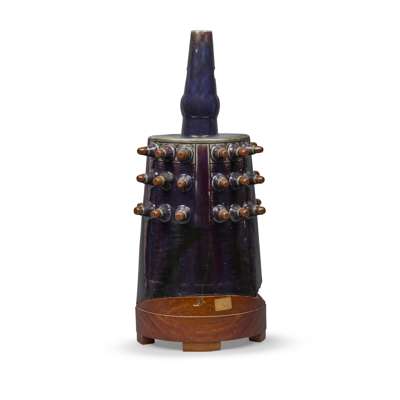
[PRIVATE COLLECTION, LONDON] CHINESE ARCHAISTIC FLAMBÉ-GLAZED BELL, YONGZHONG
QING DYNASTY
Auction: 06 November 2026 from 10:00 GMT
Description
清 仿古窯變釉甬鐘 帶木座
the bell of lenticular section, decorated on each side with a plain panel flanked by three rows of key-fret bands in low relief and alternating with three rows of projecting mei bosses, covered overall in a flambe glazed in purplish hue, with fitted wooden stand
Dimensions
52cm high without stand
Provenance
Private collection, London
倫敦私人收藏
Footnote
During the Western and Eastern Zhou periods, bells were not only used as musical instruments in ancestral temple sacrifices and clan banquets, but could also serve as military instruments, and like ordinary ritual vessels of the container type, inscriptions could be cast on them to record achievements. The earliest known yongzhong was unearthed from Tomb No. 7 at Zhuyuangou in Baoji, a tomb dating to the late early Western Zhou period. It first appeared in the Western Zhou and flourished from the Spring and Autumn and Warring States periods through the Qin and Han dynasties. The vessel form changed little, with only the decorative patterns changing over time.
During the Qing dynasty, the fashion for antiquarianism prevailed, and there was no lack of works imitating antiquity in porcelain, jade, gold, and bronze. This piece, however, is not only an imitation of antiquity, but also a work using porcelain to imitate bronze, highlighting the ingenuity of its manufacture. As is well known, the Qianlong Emperor had a strong interest in epigraphy. The Qinding Xiqing Gujian, compiled by his order, is evidence of this; in volume thirty-six alone, forty-three Zhou and Han yong bells and loop bells are included. This piece may have been modelled and adapted from a yongzhong among them, making it especially rare.
A closely comparable flambe glaze bell of similar size and form, dated to the Qing dynasty, Qianlong period, was sold at China Guardian Beijing, 17 November 2019, lot 3150.
西周與東周時期,鐘不僅用於宗廟祭祀及氏族宴饗之樂器,亦可作為軍樂器,且如一般容器類禮器,可鑄銘文以記功績。已知最早之甬鐘出土於寶雞竹園溝七號墓,該墓定年為西周早期晚段。甬鐘首見於西周,至春秋戰國及秦漢時期而盛。器形變化不大,僅裝飾紋樣隨時代而變。
清代慕古之風盛行,瓷器、玉器、金器、銅器中皆不乏仿古之作。此件不僅為仿古,更是以瓷仿銅之作,凸顯其製作之巧思。眾所周知,乾隆皇帝對金石學興趣濃厚,其命編纂之《欽定西清古鑑》即為明證;僅第三十六卷即收錄周漢甬鐘及鐶鐘四十三件。此件或即依其中某件甬鐘為範本模製改編而成,尤為罕見。
一件可資比較之窯變釉鐘,尺寸及形制相近,定年為清乾隆時期,2019年11月17日在北京中國嘉德拍賣,拍品3150。