

Lot 38
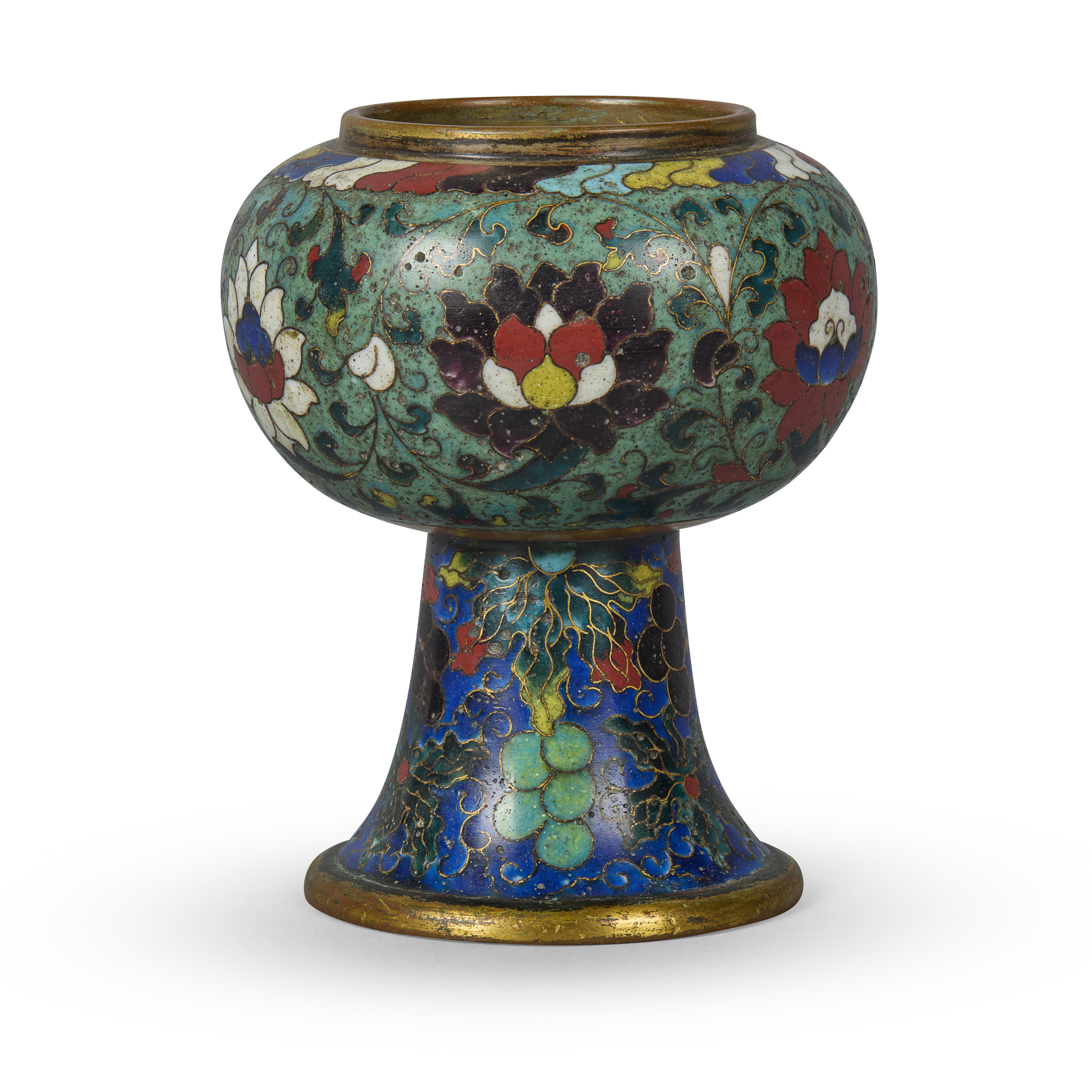
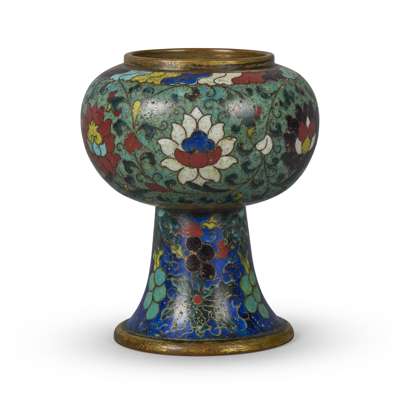
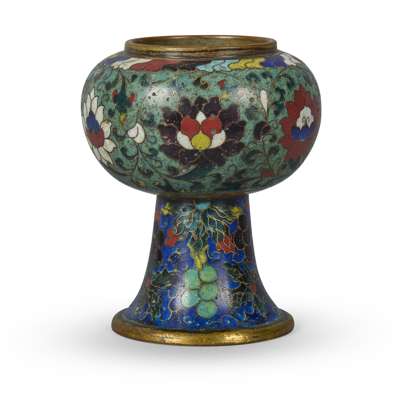
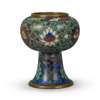
CHINESE CLOISONNÉ ENAMEL STEM BOWL, DOU
MING-QING DYNASTY
Auction: 06 November 2026 from 10:00 GMT
Description
明至清 銅胎掐絲琺瑯纏枝花卉紋豆
with a slightly compressed globular body sitting on a tall flaring foot, decorated overall on the exterior with lotus flowers borne on foliate scrolls
Dimensions
10cm high; 326.6g
Provenance
Formerly in a French private collection
前法國私人收藏
Footnote
Stem bowl of this globular form derives from an ancient Chinese bronze vessel used to contain food, named dou. While there may be a predecessor among Neolithic (c. 5000–2000 bc) pottery forms, the bronze dou was popular principally during the middle and, especially, late Zhou dynasty (c. 900–256/255 bc). During the Ming dynasty, Yongle and Xuande porcelain wares also drew inspiration from Middle Eastern metalwork to form this stem cup-form vessel. See a fine and rare blue and white ‘floral’ stem cup, dou, mark and period of Xuande, at Sotheby’s Hong Kong, 30 October 2026, lot 6009.
A closely comparable dou vessel with cover, also of cloisonné enamel, dated to the mid-Qing dynasty, formerly in the Qing Court Collection, now in the Palace Museum, Beijing, museum no. Gu 故00119120. Also see a coppe Dou food container with cloisonné enamel decoration of Indian lotus, Qing dynasty, in a slightly different form, in the National Palace Museum, Taipei, accession no. Zhong Fa 中琺001058N. Further compare to two related cloisonné enamel stem bowls and covers, Qing dynasty, sold at Christie’s New York, 29 Mar 2017, lot 81.
此類球形器身的高足碗,其造形源自古代青銅食器「豆」。新石器時代(約公元前5000至前2000年)的陶器中或已有其前身,而青銅豆則主要盛行於周代中期,尤以晚期最為流行(約公元前900至前256/255年)。至明永樂、宣德年間,瓷器亦受到中東金屬器的啟發,發展出此類高足杯式器形。可參一明宣德款及年代,青花纏枝花卉紋豆,香港蘇富比,2026年10月30日,拍品6009。
另可比較一件器形及裝飾相近的掐絲琺瑯纏枝蓮紋豆式盒帶蓋,清代中期,清宮舊藏,現藏於北京故宮博物院,館藏號「故00119120」。另見臺北國立故宮博物院藏一件清代掐絲琺瑯番蓮紋豆,其器形略有不同,館藏號「中琺001058N」。此外,亦可參考紐約佳士得於2017年3月29日售出的兩件清代掐絲琺瑯高足碗及蓋,拍品81。