

Lot 89
![[PRIVATE ENGLISH COLLECTION] YANG JIKUI (1938-)](https://media.app.artisio.co/media/104cbde6-0d38-43cb-9e0f-bb721ef57bcf/inventory/5e540072-16ab-4f75-8d32-da4c5d43d710/ce3aa849-9157-46b2-8112-8e24000650b3/0001_EzyOkt_original.jpeg)
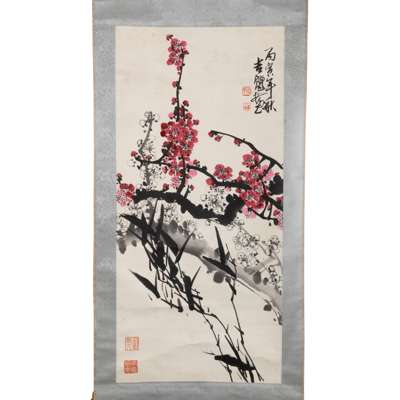
[PRIVATE ENGLISH COLLECTION] YANG JIKUI (1938-)
CHINESE INK PAINTING OF CHERRY BLOSSOMS, DATED 1986
Auction: 15 May 2026 from 10:00 BST
Description
楊吉魁 梅竹圖 水墨設色紙本 立軸
款識:丙寅年秋畫,吉魁
鈐印:吉魁、虎肖形印、水墨醉人、美意延年
ink and colour on paper, with inscriptions, dated to the autumn of Bin Yin year, corresponding to 1986, signed and with four seals of the artist, hanging scroll
Dimensions
78cm x 37cm
Provenance
Private English collection, formerly in the personal collection of Tien Shu Hsiu (1921-1998), collected primarily in the first half of the 20th Century, through original inheritance and personal purchase, thence by direct descent based in England.
Tien Shu Hsiu was the mother-in-law of Ho Kwok Keung 何國強 (1948 - 2014). She was born into a high-ranking military family in 1921. Her father Tien Do Jun, himself born during the reign of the Dowager Empress Cixi, after succeeding in Imperial examination, rose through army ranks to prestigious office in the reign of the last Emperor Puyi. The Tien estate was located north of Beijing, and was famed for supplying white peaches to the Imperial court, which were carried by sedan procession to prevent the fruit from bruising. A progressive man, Tien founded a small private school to educate his eldest daughter and her friends, after being informed by officials that she should not be taught scientific subjects due to being female, and despite having a male heir, arranged for Shu Hsiu to inherit his estate under primogeniture. After the loss of her beloved father in a hunting accident, Shu Hsiu, then a very young woman, found herself in full charge of a large estate. During WWII, Shu Hsiu was forced to flee from her estate across China with two small children in tow and only the possessions she could hurriedly pack, after receiving information that her compound was imminently being occupied by invading forces. In later years, she was to sign over the estate to her previous tenant farmer families. An early career at Fudan University, at a time when women in teaching positions were few and far between, was followed by a post at Hong Kong University, teaching Mandarin to British Foreign Office officials in the early 1950s. It was there that Shu Hsiu met her future husband, Capt. James Macdonald, eventually leading via translation for Cambridge University, to her becoming a founding lecturer of the Centre for Chinese Studies at the University of Leeds, where she happily remained until retirement in the late 1980s. Shu Hsiu retained close contact with China through numerous visits and her academic friends.
英國私人收藏,原為田淑秀(1921–1998)個人收藏,主要蒐集於二十世紀上半葉,通過繼承及個人購買得之,後由位於英國的直系後裔傳承。
田淑秀為何國強的岳母, 1921年出生於一個高階軍官家庭。其父田多俊 (音譯) 生於慈禧太后垂簾聽政時期,在科舉中取得成功後,於末代皇帝溥儀在位期間由軍界晉升至顯要官職。田家府邸位於北京以北,以向皇宮進貢白桃而聞名——這些桃子需以轎子抬送,以防果實碰傷。田父思想開明,當官員告知他不應讓女兒學習科學科目(因其女性身份)後,他創辦了一所小型私塾,親自教育長女及其友人;儘管已有男性繼承人,他仍安排淑秀以長子繼承權繼承其莊園。在摯愛的父親因打獵意外去世後,當時尚年輕的淑秀便獨自掌管偌大的田產。二戰期間,淑秀在獲知日軍即將佔領其宅院的消息後,被迫帶著兩個年幼的孩子,僅能匆匆收拾隨身物品,穿越中國逃難。晚年,她將莊園產權簽署轉讓給昔日的佃農家庭。她早年任教於復旦大學——當時女性擔任教職極為罕見——隨後於1950年代初在香港大學任職,教授英國外交部官員普通話。正是在港大,她結識了未來的丈夫詹姆斯·麥克唐納船長。其後,經由為劍橋大學從事翻譯工作,她最終成為利茲大學中國研究學院的創院講師之一,並在那裡愉快地任教直至1980年代末退休。淑秀通過多次返回中國的訪問以及與學術界友人的聯繫,始終與中國保持著緊密的關係。