

Lot 132
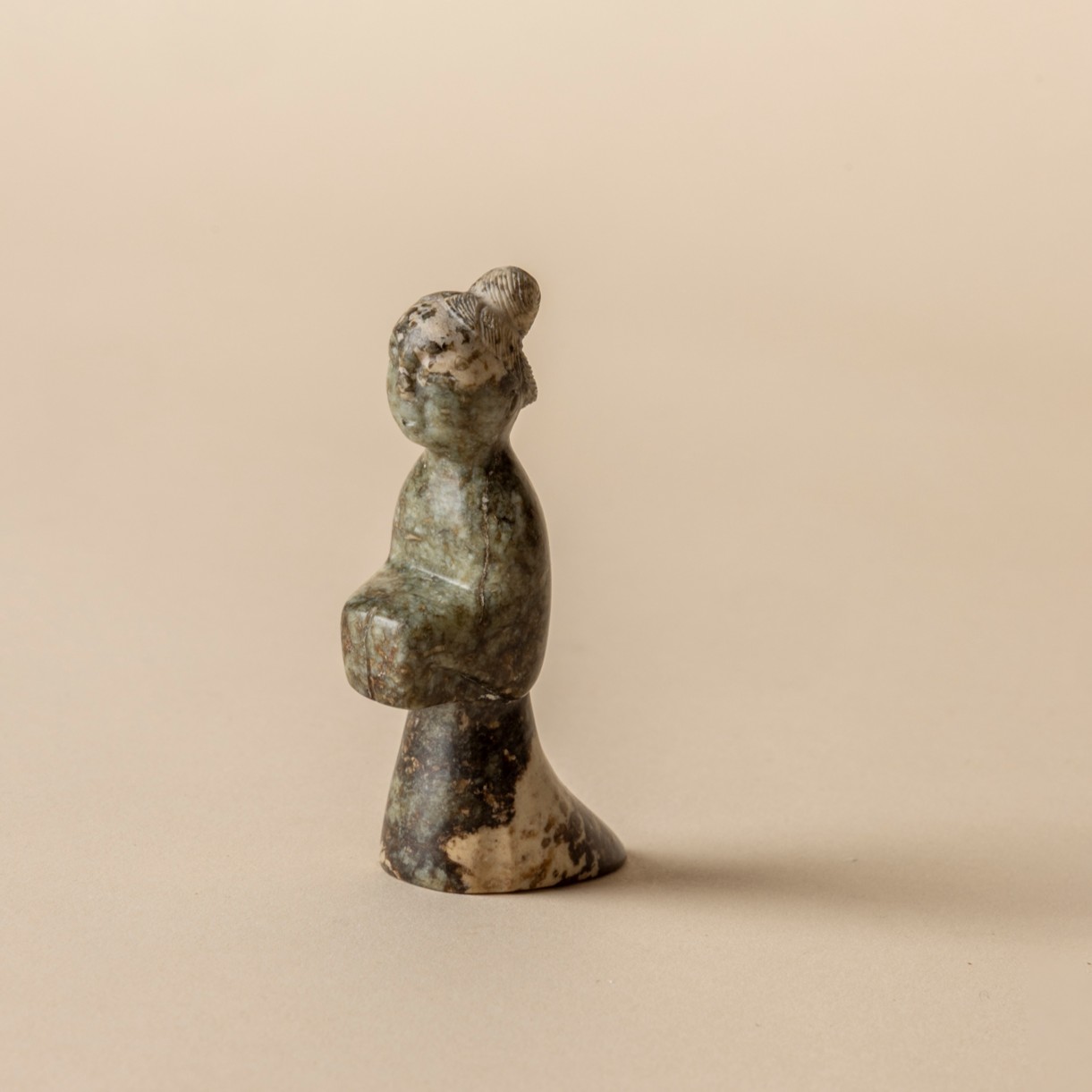
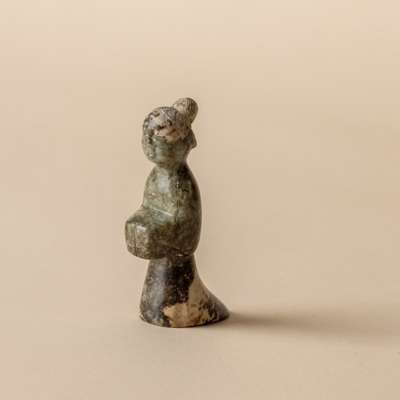
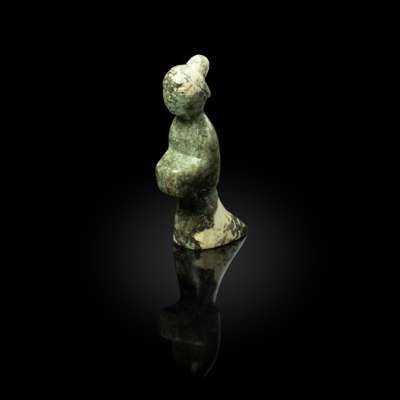
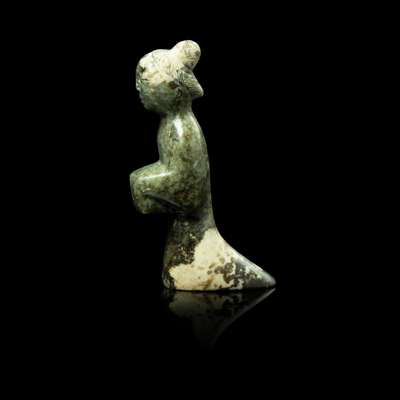
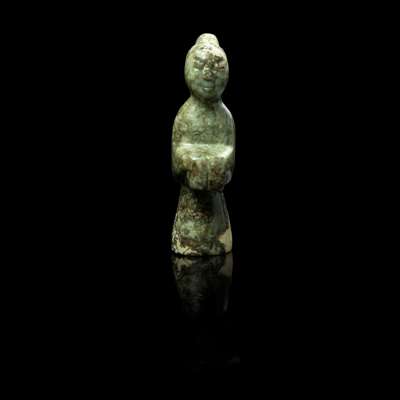
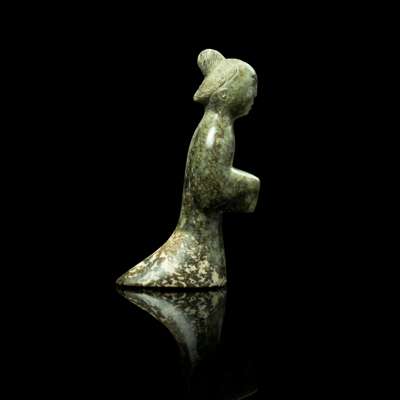
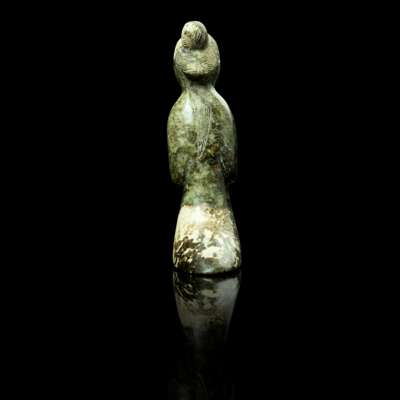
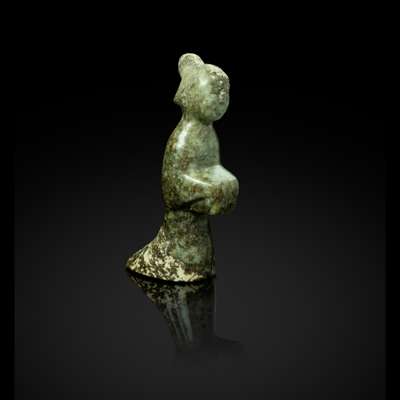
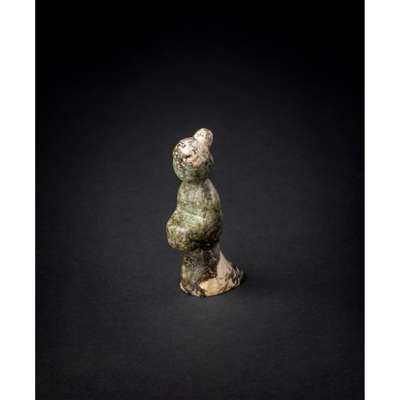
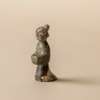
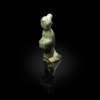
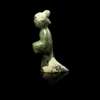
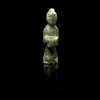
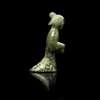
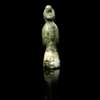
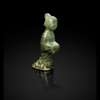
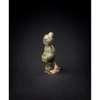
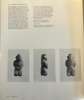
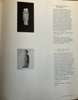
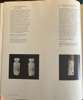
RARE CHINESE CALCIFIED CELADON JADE FIGURE OF A STANDING ROBED LADY ‡
EASTERN HAN DYNASTY
Auction: 15 May 2026 from 10:00 BST
Description
東漢 青玉帶沁雕仕女
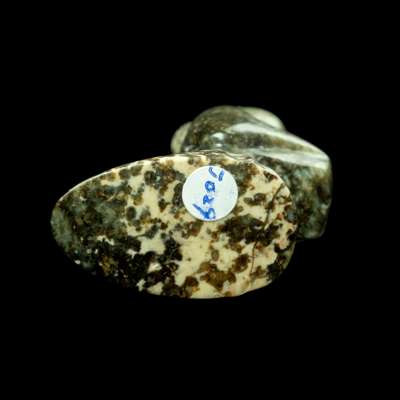
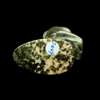
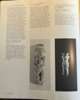
the standing figure slightly leaning forward, wears an all-over enveloping robe of quiet elegance, with her hands held together and extended in front of her with the long sleeves folded over, her hair pulled up at the centre into a coiled bun, the stone in fractured grey-green colour with black flecking patches and calcified white tone
Dimensions
7.6cm high
Provenance
Private collection; acquired from Sotheby's Hong Kong, 27 November 2020, lot 547 (part lot);
Formerly in the Peony Collection
私人收藏;購自香港蘇富比,2020年11月27日,拍品547(其一);
前牡丹堂收藏
Publication:
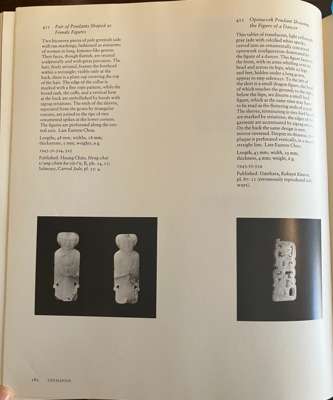
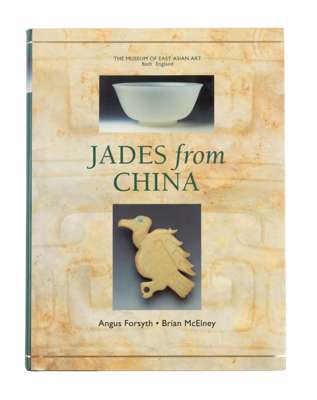
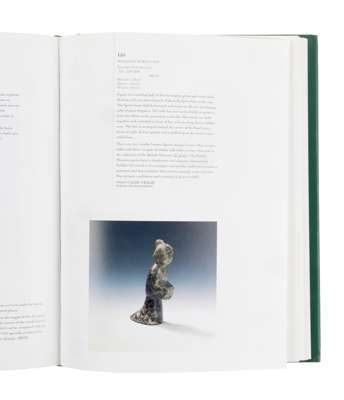
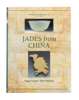
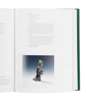
Angus Forsyth and Brian McElney, Jades from China, The Museum of East Asian Art, Bath, 1994, cat. no. 155
出版:
Angus Forsyth 及 Brian McElney,《Jades from China》,東亞藝術博物館,巴斯,1994年,圖版155
Footnote
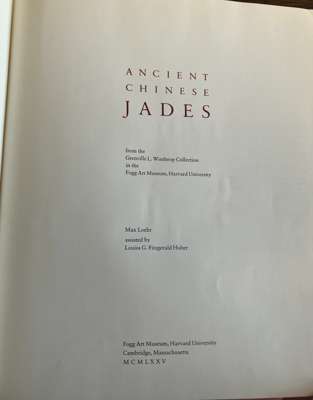
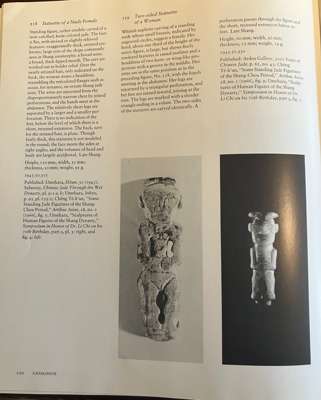
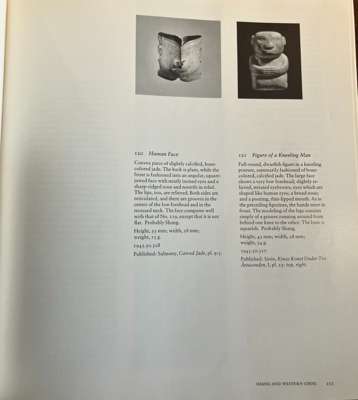
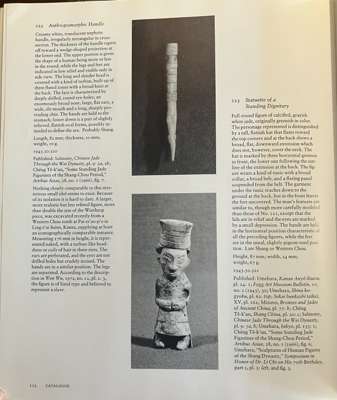
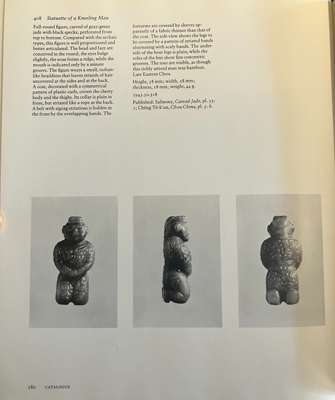
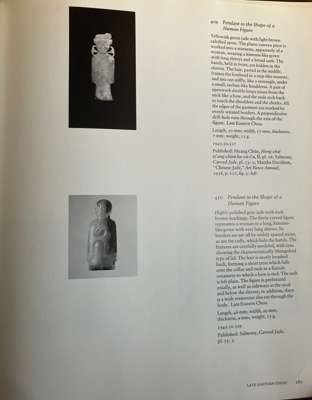
Exceptionally rare as jade figural carving is, it does have precedents. The early jade-carving traditions of the Shang (c. 16th–11th century BCE) and Zhou (c. 1046–771 BCE) dynasties—whose works were usually modelled after bronze or ceramic prototypes—each yielded rare examples of three-dimensional figural pieces. Compare a Shang dynasty kneeling figure in the Harvard Art Museums, Cambridge, USA, accession no. 1943.50.317, also published in Max Loehr and Louisa G. Fitzgerald Huber, Ancient Chinese Jades from the Grenville L. Winthrop Collection in the Fogg Art Museum, Harvard University, Cambridge, 1975, cat. no. 121. A famous Eastern Zhou figure of a jade kneeling man adorned with a patterned coat, also from the Winthrop Collection, ibid., cat. no. 408.
Han Dynasty jade figure carving, however, developed fully three-dimensional and lifelike sculpture in the round, just like the present piece. Compare with a jade dancer excavated from the tomb of the King of Nanyue (175–124 BCE), now in the Museum of the Western Han Mausoleum of King of Nanyue, Guangzhou. It was exhibited at The Fitzwilliam Museum, University of Cambridge, UK, from 5 May to 11 November 2012, and published in James C. S. Lin, The Search for Immortality: Tomb Treasures of Han China, Yale University Press, New Haven, 2012, catalogue no. 149, pp. 271-2.
Also see a jade kneeling figure excavated from the Mancheng tomb site, Hebei, published in Wu Hung, “The Prince of Jade Revisited: The Material Symbolism of Jade as Observed in Mancheng Tombs,” in Colloquies on Art & Archaeology in Asia: Chinese Jades, no. 18, Percival David Foundation of Chinese Art, London, 1997, pl. 17, p. 165.[1] Mancheng tombs were built in the late second century BC for Prince Liu Sheng of the Zhongshang principality (d. 113 BC). Carved jades were placed in the space between the two innermost coffins of Liu Sheng, including a large bi with two dragons and a jade figure. The jade figure, representing a gentleman seated in a formal posture, with arms resting on a low stand, with an inscription on the bottom, identifies the figure as an immortal, called ‘gu yu ren’ or ‘Jade gentleman of antiquity’. According to Wu Hung, “The placement of this figure resembles that of the Mawangdui portrait. But instead of portraying Liu Sheng’s physical and hence temporary appearance, this jade figure reconfirms his newly gained eternity”.
For further related examples, see a small Western Han kneeling figure on a podium, in the Harvard Art Museums, Cambridge, USA, accession no. 1943.50.331. For a closely related example from private hands, see a jade figure of a male dancer, Eastern Han dynasty, formerly in the Sze Yuan Tang Collection, sold at Bonhams Hong Kong, 5 April 2016, lot 35.
玉雕人物雖極為罕見,卻並非沒有先例。商(約公元前16至11世紀)與周(約公元前1046至771年)兩朝早期的玉雕傳統——其作品通常模仿青銅或陶器原型——各自產生了少數立體人物玉雕的珍稀實例。比較美國劍橋哈佛藝術博物館藏一件商代玉跪人, 藏品編號:1943.50.317,亦出版於羅樾與 Louisa G. Fitzgerald Huber,《Ancient Chinese Jades from the Grenville L. Winthrop Collection in the Fogg Art Museum, Harvard University》,劍橋,1975年,圖版121。一件著名的東周玉跪人,身著紋飾外衣,亦出自同錄 Winthrop收藏,同上著錄,圖版408。
漢代的人形玉雕工藝,卻發展出完全立體且逼真的圓雕,正如本件作品。比較南越王墓出土圓雕玉舞人,現藏於廣州南越王博物院,曾於2012年5月5日至11月11日在英國劍橋大學菲茨威廉博物館展出,並收錄於James C. S. Lin所著
《The Search for Immortality: Tomb Treasures of Han China》,耶魯大學出版社,New Haven,2012,圖錄149,頁271–272。
另可參考河北滿城墓葬遺址出土的一件玉跪人,刊載於巫鴻,〈The Prince of Jade Revisited: The Material Symbolism of Jade as Observed in Mancheng Tombs〉,著錄於《Colloquies on Art & Archaeology in Asia:Chinese Jades》,編號18,大維德中國藝術基金會,倫敦,1997,圖版17,頁165。[2] 滿城漢墓建於公元前二世紀末,為中山靖王劉勝(卒於公元前113年)之陵墓。在劉勝最內兩層棺槨之間的空間中,放置了數件玉雕,包括一件飾有雙龍的大型玉璧,以及一件玉跪人。該玉人表現一位端坐的君子,雙臂置於低矮几案上,姿態莊重;其底部刻有銘文,指明此像為一位仙人,稱為「古玉人」。根據巫鴻的觀點,「此玉人的擺放位置與馬王堆的帛畫肖像相似,但這件玉人並非描繪劉勝那短暫而物質性的容貌,而是重新確認了他新獲得的永恆。」
參其他漢代人形玉雕,繁簡各異,如美國劍橋哈佛藝術博物館藏一西漢玉跪人例,立於方基上,藏品編號:1943.50.331。私人收藏中,另可參考一件極為重要的東漢玉雕說唱舞人,為思源堂舊藏,香港邦瀚斯2016年4月5日售出,拍品35 。
[1] The paper can be downloaded via Aacademia.edu
[2] 文章可於此網站下載Aacademia.edu
This lot has been imported from outside of the UK and placed under Temporary Admission. An amount in lieu of Import VAT will be charged at 5% on the hammer price.
此拍品是從英國以外地區進口,憑藉暫准進口許可證(暫准進口)在拍賣會上出售,該許可證允許這些物品暫時全部或部分免征關稅(增值稅和關稅),代替進口增值稅的金額將按落槌價的5%收取,請参閱業務規定之增值稅符號和說明部分以獲取更多資訊。