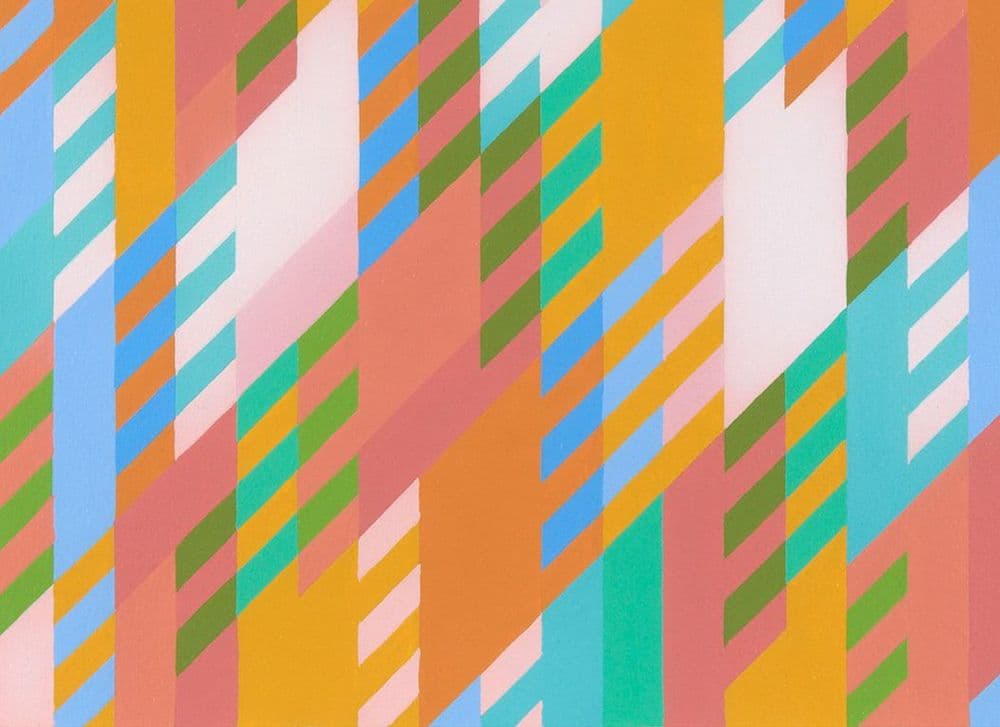
British artist Bridget Louise Riley is known as one of the foremost exponents of Op Art and a significant figure in Modern British Art. Her work combines lines, colour arrangements and geometric precision to create engaging visual effects.
Bridget Riley’s extraordinary career continues unabated, despite the fact that the grand dame of Op Art is now in her 80s. Riley has achieved that elusive artistic ideal: creating a body of work as pioneering as it is ubiquitous. Her graphic style came to epitomise the ‘Swinging Sixties’ but her continued exploration of Op Art’s possibilities has proved it to be fertile ground. Despite focusing her work in a narrow field, she has managed to side-step the pitfalls of cliché.
Whilst the results of her painstaking technique and careful colour-play display a technical understanding firmly rooted in the scientific, Riley asserts that her approach has always been intuitive. Beyond the initial optical illusion, her art sets out to provoke an emotional response from the viewer.
She enjoyed a period of experimentation in the 1990s and early millennium. By this stage Riley had long abandoned the more rigid monochromatic structures associated with her 1960s output, discovering that the ‘lozenge’ forms endowed her juxtapositions of form and colour with more movement and depth than anything she had previously achieved. The nature of Riley’s work is to place demands on the viewer’s gaze but in these later works the calmer palette and the playful arabesque forms result in a series of works which are unequivocally fun and light-hearted to read.
Rhythm, Repetition and Print
Bridget Riley has also played a significant role in the development of contemporary printmaking, using the medium to extend her rigorous exploration of perception, rhythm and optical effect. Working primarily in screenprint, Riley has produced prints which expand on the precision of her painted works, presenting her carefully constructed optical patterns in multiple formats and variations.
From the 1960s onwards, Riley’s engagement with printmaking developed alongside her painting practice. Works such as her Fragments series, and later stripe-based compositions demonstrate the adaptability of her visual language across media. Her prints are characterised by precise geometry, controlled colour relationships and subtle shifts in form that generate dynamic visual effects. Printmaking has allowed Riley to systematically explore repetition and variation, central concerns in her work, while maintaining a high level of technical refinement. Her editions remain highly regarded for their visual appeal and optical intensity and are widely collected as key examples of Op Art within the printed medium.
Her works are currently held in the collections of MoMA in New York, the National Gallery of Art in Washington, D.C., the Tate in London, and the Peggy Guggenheim Collection in Venice.